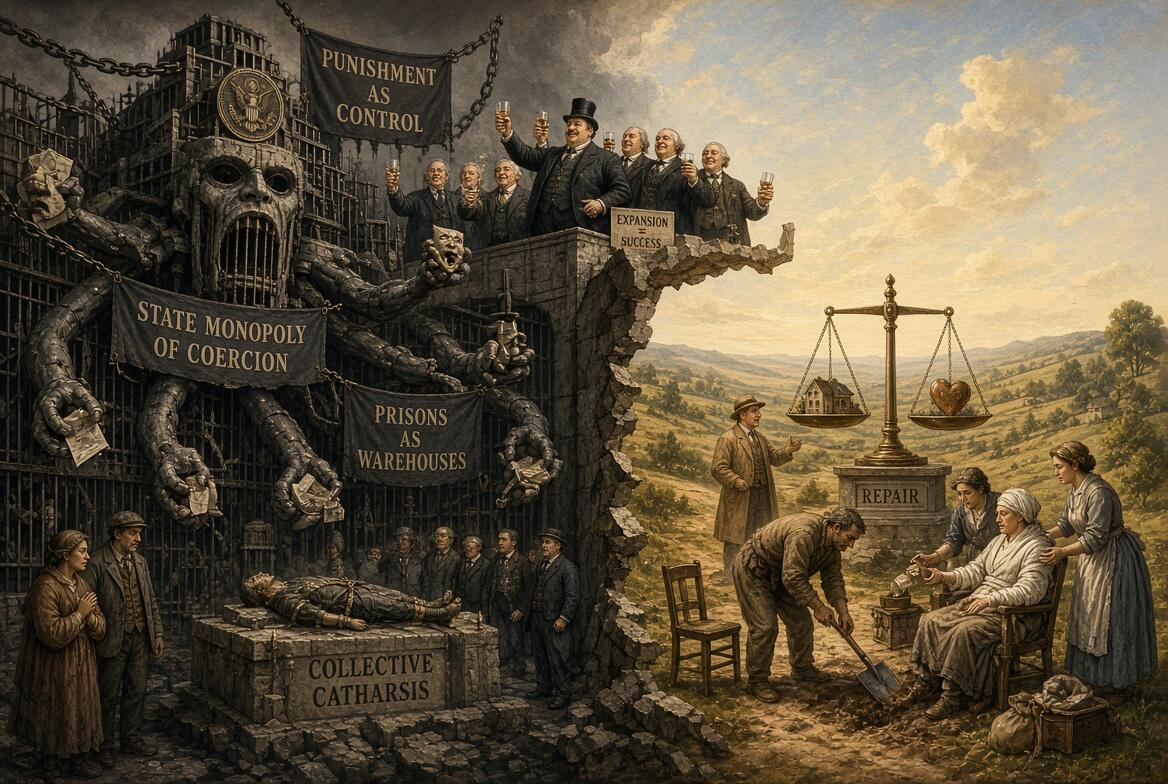
The Penal Leviathan: What Wacquant And Rothbard Reveal About Modern Punishment
The short version
- Wacquant, in Punishing the Poor (2009), analyzes how modern states manage marginalized populations through policing and incarceration.
- Rothbard, in The Ethics of Liberty (1982), argues that the state is a monopoly of coercion and that real justice means restitution to victims rather than punishment imposed by the…
- At first glance, they seem to have nothing in common.
- Wacquant argues that modern punishment targets not crime itself but people with low incomes.
- In Punishing the Poor , he writes that "it is not so much crime that is being fought, but the poor themselves." He attributes this dynamic to welfare retrenchment and what he…
The story
Authored by Luc Lelièvre via Mises Institute,
Loïc Wacquant and Murray Rothbard come from completely different worlds. Wacquant, in Punishing the Poor (2009), analyzes how modern states manage marginalized populations through policing and incarceration. Rothbard, in The Ethics of Liberty (1982), argues that the state is a monopoly of coercion and that real justice means restitution to victims rather than punishment imposed by the government. At first glance, they seem to have nothing in common. Yet, when you look closely at what each says about crime and punishment, they describe remarkably similar institutional dynamics: a penal system that does not exist to deliver justice but to maintain political power, control vulnerable communities, and satisfy the public's desire for punishment.
Wacquant argues that modern punishment targets not crime itself but people with low incomes. In Punishing the Poor, he writes that "it is not so much crime that is being fought, but the poor themselves." He attributes this dynamic to welfare retrenchment and what he interprets as neoliberal restructuring. This is Wacquant's interpretation. My purpose here is not to defend or refute it, but to summarize his institutional analysis and compare it with Rothbard's critique of state power. Wacquant's central point is that the penal system expands as social protections shrink, turning prisons into warehouses for people pushed out of the labor market. He portrays the United States as an expansive apparatus of social control in which punishment falls primarily on street crime while much white-collar wrongdoing is managed through administrative and legal processes.
Rothbard approaches the issue from a different angle. For him, crime is fundamentally an aggression against a person or their property. Justice should repair the victim. That means restitution - returning what was taken, plus a penalty for the harm done. In Rothbard's view, prison is a double injustice. It fails to compensate the victim and forces taxpayers to pay for the criminal's room and board. As one Mises Institute essay summarizes, "the victim receives nothing and is then 'robbed' once more through taxes to feed and house the criminal." Rothbard sees the prison system as wasteful, immoral, and fundamentally misaligned with justice. His alternative is clear: restitution, even if it must be paid through supervised work when the offender has no money.
Rothbard's critique is not only moral but also economic. In his landmark article "Crime and Punishment: An Economic Approach" (1968), Gary Becker reached a similar conclusion from a different perspective. Every sanction carries costs as well as benefits, and incarceration is among the most expensive. If restitution, fines, or compensated labor can deter crime while restoring victims, prison becomes difficult to justify except for dangerous offenders. Becker's analysis complements Rothbard's argument by showing that restitution is not merely ethically preferable - it is also economically superior.
Wacquant and Rothbard share an understanding of the state's role. Wacquant views the penal state as a bureaucratic arm of what he calls neoliberal governance, used to control marginalized populations. Rothbard views the penal state as a predatory institution that thrives on coercion. Both agree that the penal system tends to neglect victims, expand state power, and generate political legitimacy rather than genuine justice.
Their agreement becomes even more striking when viewed through the lens of institutional incentives. A penal bureaucracy does not merely administer justice; it sustains a network of police agencies, prosecutors, correctional officers, prison contractors, and public budgets, all of whose continued existence depends on the expansion of penal institutions. Restitution threatens this logic by shifting attention from the state to the victim. A system centered on repairing private harm requires fewer bureaucracies and leaves less room for political theater. From this perspective, incarceration persists not merely because citizens demand punishment, but because governments have institutional incentives to provide it.
René Girard, in Violence and the Sacred (1972), helps explain how punishment operates. Girard argues that societies have always used scapegoats to relieve social tension. In modern times, the criminal becomes that scapegoat, and the prison becomes the altar. As one Mises Institute essay notes, "the real product of the penal system is collective catharsis." Punishment is not a rational policy, it is a ritual. This is why voters demand harsher penalties even when prisons fail. This is why mass incarceration persists despite its cost and lack of results. Punishment satisfies a symbolic need, not a practical one.
Girard also helps explain why governments find this ritual politically useful. If societies repeatedly seek symbolic victims to restore social cohesion, the state becomes the institution that organizes and legitimizes those sacrifices. Public fear creates demand for punishment; political institutions supply it. Rothbard exposes the institutional side of this relationship, while Girard reveals its anthropological foundation. Together, they show how emotional expectations and bureaucratic incentives reinforce each other, enabling the penal system to expand even when it fails to reduce crime or compensate victims.
This is where Rothbard offers something Wacquant does not: a way out. Restitution replaces the sacrificial logic of punishment with a logic of repair. It shifts the focus from the offender to the victim, closes the moral account rather than leaving it open, and satisfies the need for justice without feeding the bureaucratic machine. In To Serve and Protect (1990), Bruce Benson shows that pre-state legal systems, such as Anglo-Saxon weregild, relied on restitution to prevent feuds and maintain peace. These systems worked because they focused on compensation rather than punishment.
Wacquant advocates "radical penal minimalism," a model that narrows the scope of punishment while preserving its democratic legitimacy. Rothbard calls for a justice system based on restitution rather than incarceration. Girard calls for an end to sacrificial violence. Benson shows how restitution can be implemented. Becker argues that incarceration is often less economically efficient than restitution, fines, and other alternative sanctions.
Despite their profound philosophical disagreements, all five raise serious doubts about the effectiveness and legitimacy of a prison-centered model of justice. Becker questions its efficiency. Benson presents historical alternatives. Girard exposes its sacrificial logic. Wacquant reveals its bureaucratic expansion. Rothbard offers restitution as a principled alternative.
The penal Leviathan will not disappear through abolitionist slogans or bureaucratic reforms. It will disappear only when justice ceases to be a ritual of punishment and becomes a process of repair. That requires reexamining the assumption that crime should be understood primarily as an offense against the state rather than as an injury to identifiable victims. Once the victim again becomes the central figure in justice, restitution naturally replaces punishment as the primary objective.
As long as governments monopolize punishment, they retain incentives to expand the penal apparatus, regardless of its effectiveness. Restitution reverses that logic. It limits bureaucratic power, restores the victim to the center of justice, and transforms punishment from a political ritual into a genuine process of moral and legal repair. Whether approached through sociology, economics, anthropology, or libertarian political philosophy, the victim - not the state - emerges as the indispensable starting point for any coherent theory of justice.
Related Markets
All MarketsMarket data may be delayed. Not financial advice.
Powered by Gab AI
The Story At A Glance
Reading this article now — analysis appears below
💡 AI analysis provides alternative perspectives on current events