Why Socialism Fails
.jpg?itok=6KINwaqx)
The short version
- Custom image by FEE Ludwig von Mises, in his work “ Human Action ,” explains that individuals act to replace a less satisfactory state of affairs with a more satisfactory one.
- This process is inherently subjective and teleological, meaning that the values guiding economic activity are rooted in individual choices, and not in physical objects themselves.
- Economic calculation serves as the bridge between the subjectivity of human desires and the objective reality of scarce resources.
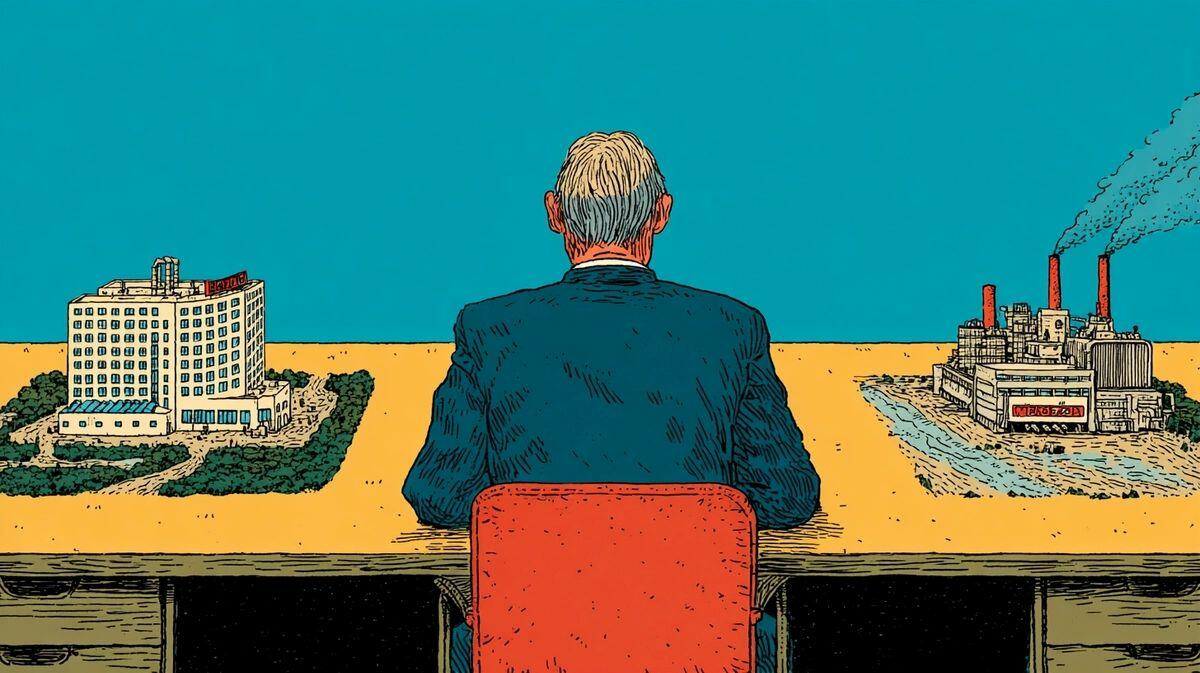
- Consider a quantity of steel that could be used to build either a hospital or a factory.
- Without a system of prices reflecting society’s preferences and the relative scarcity of resources, there would be no way to determine which of these projects creates greater…
The story
Authored by Deborah Palma via The Epoch Times (emphasis ours),
Economics is not a zero-sum game in which one person’s gain comes at another’s expense; nor is it just about numbers or purposeless statistical aggregates, but conscious human action.
Ludwig von Mises, in his work “Human Action,” explains that individuals act to replace a less satisfactory state of affairs with a more satisfactory one. This process is inherently subjective and teleological, meaning that the values guiding economic activity are rooted in individual choices, and not in physical objects themselves.
Economic calculation serves as the bridge between the subjectivity of human desires and the objective reality of scarce resources. Consider a quantity of steel that could be used to build either a hospital or a factory. Without a system of prices reflecting society’s preferences and the relative scarcity of resources, there would be no way to determine which of these projects creates greater value. Economic calculation, expressed through prices, allows for the comparison of alternatives, whilst directing resources toward their most-valued uses.
Similarly, consider an entrepreneur evaluating whether they should open a bakery. They must decide how much to invest in equipment, rent, labor, and so on. By comparing the costs of these factors with the expected revenue from sales, our entrepreneur can estimate whether the business will create value. If revenues are expected to exceed total costs and taxes, there will be profit.
Profit, therefore, is not merely a financial gain, but evidence that scarce resources have been allocated in ways that better satisfy societal needs, because society has, in an undirected way, decided its needs are satisfied this way. Conversely, losses would indicate that those resources should have been allocated to more valuable uses. Without prices, profits, and losses, the entrepreneur would have no way of knowing whether resources are being used efficiently.
In a complex economy with an advanced division of labor, individuals cannot rely solely on their own direct knowledge to decide how to allocate resources among many possible combinations. They require a common denominator that allows for the comparison of costs and benefits. This denominator is the price, which emerges from voluntary exchanges in the market.
Prices are not arbitrary numbers; they are determined by exchange values arising from the competitive interaction between consumers and producers. Price reflects the relative scarcity of a good in relation to all other possible uses of the same factors of production.
When an entrepreneur invests in new technology or capital infrastructure, they rely on monetary calculation to assess whether the value of the final product will exceed the total value of the inputs consumed. This “surplus” is profit, an unmistakable signal that value has been created by, and for, society. The opposite—loss—signals the waste of scarce resources.
The importance of prices becomes even more evident when we examine historical attempts to artificially control them. Throughout history, governments have sought to replace the market price system with centrally-directed mechanisms, and the results have been consistently disastrous.
One of the earliest examples dates back to the reign of Diocletian in the Roman Empire. In 301 AD, the emperor issued the Edict on Maximum Prices, imposing price ceilings on thousands of goods and services, including basic items such as wheat, meat, and clothing, as well as wages for various professions such as farmers, bakers, craftsmen, and teachers. By fixing prices below their market-clearing levels, the policy reduced the incentive for producers to supply these goods, since many could no longer cover their costs or earn a profit. At the same time, artificially low prices increased consumer demand. This imbalance between reduced supply and increased demand led to widespread shortages. As a result, many goods disappeared from official markets and were instead traded illegally at higher prices, contributing to the expansion of black markets and the disruption of normal productive activity. The policy ultimately proved unsustainable and was abandoned due to its failure.
More recently, similar policies were implemented in Brazil under the government of José Sarney, particularly during the Cruzado Plan of 1986. The freezing of prices, initially celebrated as a solution to inflation, quickly resulted in widespread shortages, empty shelves, and the emergence of parallel markets. Unable to adjust prices, producers reduced supply, exposing the inability of such measures to coordinate a complex economy.
More recent cases reinforce this pattern. In Venezuela, strict price controls implemented over the past decades have contributed to chronic shortages, the collapse of domestic production, and increasing dependence on imports. Basic goods disappeared from store shelves, while informal markets became central to the population’s survival.
These episodes produce the same outcome: scarcity. Prices emerge from decentralized interactions between individuals, reflecting their preferences and the relative scarcity of goods. Once formed, however, they also serve to coordinate economic activity by conveying information that guides producers and consumers in their decisions. When prices cease to reflect the relationship between supply and demand, they lose this informational and coordinating function. Instead of promoting order, price controls generate disorganization, shortages, and waste.
Mises’s thesis was challenged by economists such as Oskar Lange, who proposed a form of “market socialism.” Lange argued that a planning board could simulate the market through a process of trial and error, adjusting prices as surpluses or shortages emerged. However, Mises and his student Friedrich Hayek refuted this view, emphasizing that the problem is not merely one of data processing. The crucial point is that the data required for economic calculation, such as subjective preferences and local knowledge, only come into existence through real market exchanges.
Attempts to treat the economy as a system of simultaneous equations, in which equilibrium can be mathematically determined, ignore the dynamic nature of reality. The market is a continuous process of discovery, not a static state of rest. The economy cannot be managed like a problem of engineering or mechanical physics, because it involves constant change, subjective expectations, and genuine uncertainty, elements that no fixed equation can fully capture.
Under socialism, the abolition of private property in the means of production destroys the very concept of capital as a calculable value. When the state owns all higher-order goods (machines, land, and raw materials), there are no exchanges between private owners for these items. Consequently, there are no market prices for capital goods. Without these prices, the central planner, no matter how well-intentioned, lacks the necessary information to determine whether they are creating wealth or merely consuming the nation’s capital.
From the Foundation for Economic Education (FEE)
How other outlets covered this
Compare allAlto found this story at 2 outlets. Same event, different framing — compare the headlines.
How this story developed
Full timelineAlto has tracked this across 5 days of coverage from 2 outlets.
Powered by Gab AI
The Story At A Glance
Reading this article now — analysis appears below
💡 AI analysis provides alternative perspectives on current events