Aramco CEO Says Energy Market May Not Normalize Until 2027 Amid Billion-Barrel Supply Shock

The short version
- There was good news over the weekend, as a Qatari LNG tanker transited the Hormuz chokepoint.
- However, a second tanker from the energy-rich Gulf country abruptly made a U-turn in the Strait early Monday, dashing hopes for any near-term normalization…
- The countdown to global energy chaos is increasingly viewed in weeks , not months.
- Amin Nasser warned that the market could lose around 100 million barrels of oil each week if Hormuz remains closed.
- Nasser told investors on an earnings call earlier today that if the Hormuz chokepoint is disrupted for another couple of weeks…
The story
From the Trump administration's recent Project Freedom push to mounting warnings from Wall Street analysts, security experts, energy strategists, and major oil company executives, there is a growing sense that the global energy market is quickly approaching a breaking point due to the heavily disrupted Strait of Hormuz.
There was good news over the weekend, as a Qatari LNG tanker transited the Hormuz chokepoint. However, a second tanker from the energy-rich Gulf country abruptly made a U-turn in the Strait early Monday, dashing hopes for any near-term normalization, especially since the U.S. and Iran have yet to reach a peace deal.
The countdown to global energy chaos is increasingly viewed in weeks, not months. If the maritime chokepoint remains impaired for the next several weeks, according to Frederic Lasserre, head of research at Gunvor, one of the world's largest oil traders, then the "tipping point to something has to give is June."
Warnings of incoming energy market turmoil continued on Monday, with the CEO of Aramco, formerly known as the Saudi Arabian Oil Company. Amin Nasser warned that the market could lose around 100 million barrels of oil each week if Hormuz remains closed.
Nasser told investors on an earnings call earlier today that if the Hormuz chokepoint is disrupted for another couple of weeks, then it would take the global energy market until 2027 to normalize.
Here are the most important comments from Nasser's call with the analyst:
-
Energy Supply Shock Is Largest Ever Experienced
-
It'll Take Months for Oil Market to Rebalance Even If Hormuz Reopens Today
-
Market to Normalize in 2027 if Hormuz Opening Is Delayed by Few More Weeks
-
Market Has Seen Supply Loss of About 1 Billion Barrel of Oil
-
Alternative Flows Bypassing Hormuz, Strategic Reserve Releases Partially offset that
-
Market Could Lose Around 100 Mln Barrels of Oil For Every Week
-
Demand Rationing to Continue As Long As Supply Remains Disrupted
-
Return to Demand Growth Expected to Be Robust If Trade Resumes
-
Demand Growth to Be Driven by Urgency to Ensure Security of Supply
-
Supply Chains Will Need Several Months to Return to Normal
Building on the countdown-to-energy-chaos theme, Morgan Stanley analyst Martijn Rats warned clients that the oil market is in a "race against time" as the maritime chokepoint remains heavily disrupted. He noted that global supply buffers, which have kept crude prices contained during the ten-week Iran war, are starting to come under pressure.
Rats said that nearly 1 billion barrels have already been lost, yet Brent crude futures have not exceeded 2022 levels because the market entered the crisis with spare supply buffers and because traders kept assuming Hormuz would reopen.
"The ability of the US to continue this elevated level of exports is hard to gauge but appears under more pressure," the analyst noted, adding, "The United States' 3.8m b/d increase in exports and China's 5.5m b/d cut in imports have shielded the rest of the world from 9.3m b/d of tightness."
Rats warned, "Even if the Strait reopened tomorrow, the time required to restart fields, repair refineries, and reposition tanker tonnage means the market is on track to lose another billion barrels over the balance of 2026."
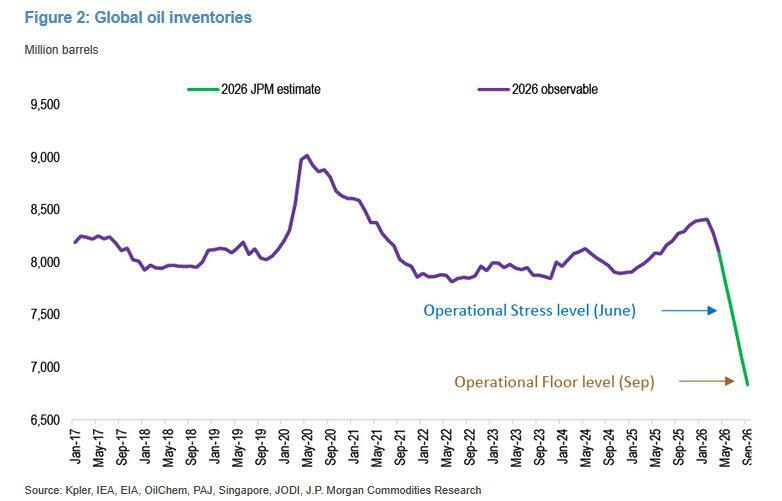
In a separate note, JPMorgan's resident commodity expert, Natasha Kaneva, explained where the next phase of the global energy shock could unfold.
Kaneva's chart on global oil inventories is truly shocking.
Overall, the warnings are piling up. If the maritime chokepoint remains shuttered through this month, real panic may begin then.
Related Markets
All MarketsMarket data may be delayed. Not financial advice.
Powered by Gab AI
The Story At A Glance
Reading this article now — analysis appears below
💡 AI analysis provides alternative perspectives on current events