Remember: In A Crisis, Everyone Will Consider Themselves 'The Good Guys'
.jpg?itok=7zKmprhY)
The short version
- We’re entering an era in which push comes to shove will lead to immovable objects encountering irresistible forces .
- All sorts of verities and vanities will be bulldozed as kicking the can down the road descends into desperation to stave off collapse…
- The only responses at this late stage are even more desperate, so desperation is self-reinforcing.
- The previous eras of institutional-state desperation were 1) The 1930s Great Depression, 2) the 1973-74 Gas Crisis and 3) the inflationary recession of 1980-82.
- The strong-arm policies of the 1970s and 1980s worked, and were relatively brief.
The story
Authored by Charles Hugh Smith via substack,
The state has two monopolies it must protect whatever the cost: the monopoly on decreeing what is legal tender and on force.
We’re entering an era in which push comes to shove will lead to immovable objects encountering irresistible forces. All sorts of verities and vanities will be bulldozed as kicking the can down the road descends into desperation to stave off collapse, a desperation that unleashes second order effects the desperate did not anticipate. The only responses at this late stage are even more desperate, so desperation is self-reinforcing.
The previous eras of institutional-state desperation were 1) The 1930s Great Depression, 2) the 1973-74 Gas Crisis and 3) the inflationary recession of 1980-82. The desperation in the 1930s was truly serious: banning private ownership of gold other than coin-collecting, attempting to remake the Supreme Court, one new federal program after another, slashing the wages of municipal / city employees to keep as many people employed as the shrinking revenues could allow, and so on.
The desperation of the 1970s and 80s were relatively narrow in scope, but felt serious at the time: gas rationing and wage/price controls in the 1970s, and then rocketing bond yields / interest rates in the early 1980s that triggered millions of layoffs in interest-sensitive sectors such as autos and housing.
The strong-arm policies of the 1970s and 1980s worked, and were relatively brief. The crises lasted around two years, and then things normalized.
The strong-arm policies of the 1930s didn’t work, and desperation slid into despair. The official happy-talk continued, but it rang increasingly hollow as the decade ground on.
Given the present-day confluence of disintegrative forces, a.k.a. mutually reinforcing polycrisis, hopes for a brief recession and a quick return to “growth” may be misplaced. If inflation and scarcities intensify, the usual bag of tricks--dropping interest rates to zero, flooding the financial sector with credit / liquidity, increasing federal pork spending, etc.--will not just fail, they will be counter-productive, fueling inflationary forces not in assets that enrich but in real-world goods and services that impoverish.
The footprint of the Central State--and state/county/local government--was relatively modest in the 1930s compared to the footprint of the state now: 36% of GDP in the US (23% federal, 13% state/local) and much higher in many developed nations.
Note that in a recession, GDP drops and state spending tends to rise to compensate for the contraction of private sector spending. so this ratio can climb very quickly.
To a degree few question, the state is the nation. The nation is defined by the state’s legal structure and its ability to enforce that structure. If the state collapses, the nation is in dire straits.
Should the state’s finances enter a self-reinforcing death-spiral, the desperation will quickly reach a level in which nothing is off the table--no extreme is too extreme. The typical self-reinforcing death-spiral is a currency crisis in which the currency loses value so rapidly that everyone holding it wants to convert it into some other form of value. That selling is self-reinforcing.
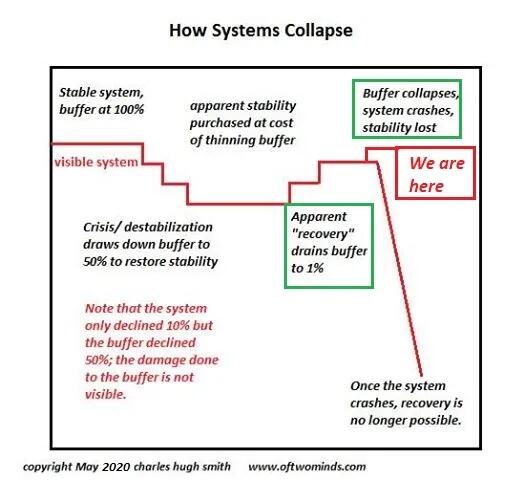
But that doesn’t exhaust the possibilities of the state’s finances becoming unsustainable, either financially and/or politically. A slow-moving crisis can phase shift into a fast-moving crisis like an avalanche no one is prepared for.
States face an insoluble dilemma: the powerful interests that dominate state decisions find higher taxes on corporations, trusts, foundations and the wealthy unacceptable, while the public living off the state’s largesse finds cuts deep enough to matter unacceptable.
Recency bias kicks in hard: after decades of “growth” and expanding state spending, anything that smacks of discipline or sacrifice is rejected out of hand as needless: why can’t we just go on as we have for the past 17 years, where assets soar in value, and the state spends more every year?
This leads to the illusory “solution” of kicking the can down the road: monetary policy tricks, fiscal sleight of hand, fake policy-tweak fixes presented as “solutions,” and so on. This magic can prop up the illusion of sustainability for years, but since every trick eventually makes the problems worse, this illusory “solution” actually hastens the push comes to shove moment where everyone is seated at the banquet of consequences.
Those tasked with saving the state’s finances from collapsing will view themselves as absolutely The Good Guys, working to saving the nation from greedy leeches on the state, speculators, financiers and those hoarding wealth acquired back when the state could afford to be generous. Now that things are at risk of unraveling, the fun and games are over and we need to do whatever it takes to save the nation--i.e. the state.
The wealthy trying to evade the new taxes will consider themselves The Good Guys: we worked hard for our wealth, created jobs and innovations that benefited the nation. Why should we give our hard-earned wealth to a corrupt, spendthrift state?
In the lower reaches of the economy, those evading taxes will also see themselves as The Good Guys: I’m just trying to support my family, and it’s the rich who should make the sacrifices as they have more than enough.
Those enforcing the expropriations / taxes will develop a unit-cohesion us-vs-them esprit de corps--the ultimate Good Guys who have to put up with both sets of greedy weasels: the weasels sucking off the state and the weasels trying to evade their civic duty to pay what they owe. Their tolerance for the self-serving claims of being “the good guys” by those protesting massive cuts in state spending and massive increases in taxes will be low to start and drop from there.
The state has two monopolies it must protect whatever the cost: the monopoly on decreeing what is legal tender and on force. So when the NSA is tasked with ferreting out miscreants cheating the state, tax-evading millionaires and other federal agencies are tasked with renditioning those who reckon they evaded their responsibilities by fleeing overseas, these are the tip-of-the-spear Good Guys who are trying to save the nation from the terminal rot of a citizenry that has long since lost any sense of civic duty that demands sacrifice and frugality.
Should push come to shove, nothing will be off the table. It will be too late to whine that we’re one of the Good Guys; the money from the state will stop flowing, and the safety deposit boxes and overseas accounts will be opened by force. As the cries of anguish increase, the demands to close down the tax havens of the super-wealthy will reach fever pitch, and whomever is tasked with saving the nation will have an agenda that reverses the order and the priority of wealth and power.
The super-wealthy are safe until they’re understood as the key impediment to saving the state. Right now, nobody thinks push could come to shove to the point that nothing will be off the table in terms of force. States that wait too long to act find their ability to apply force is insufficient to save the state, and this will weigh ever heavier on those tasked with protecting the state from financial collapse.
The irony here is the forces protecting their self-interests by kicking the can down the road are hurrying the collision of immovable objects and irresistible forces. Those who reckon they’ll do fine if the state collapses will find themselves nostalgic for the days when they could whine about a tax on second homes worth in excess of $5 million.
Chaos Unleashed: When “Irrational” Makes Perfect Sense.
I’m not saying I “like” this or that it’s inevitable; I’m saying the longer illusory “solutions” of kicking the can down the road are substituted for real solutions, the more likely a crisis of the state’s financial coherence becomes. Betting on which one wins--immovable objects or irresistible forces--might be a lose-lose proposition.
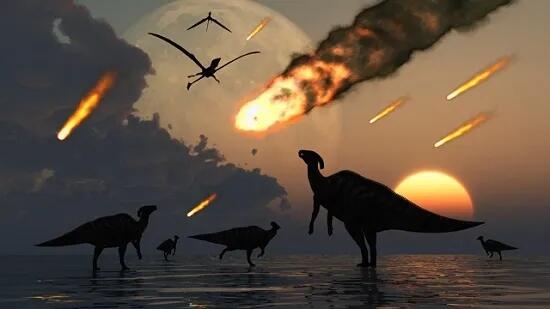
The only dinosaurs that survived the meteor strike were small birds that didn’t need much to get by, were mobile and were adapted to tough conditions. The descendants of those birds are the ones we see today.
How birds survived the dinosaurs’ doomsday (Scientific American)
Related Markets
All MarketsMarket data may be delayed. Not financial advice.
How other outlets covered this
Compare allAlto found this story at 2 outlets. Same event, different framing — compare the headlines.
How this story developed
Full timelineAlto has tracked this across 19 days of coverage from 2 outlets.
Powered by Gab AI
The Story At A Glance
Reading this article now — analysis appears below
💡 AI analysis provides alternative perspectives on current events