UBS Warns Of "Scary" Oil Price Scenarios Once Inventory Buffers Run Dry

The short version
- Once those buffers are depleted, oil risks being violently repriced higher.
- That is why the Trump administration's race to secure a peace deal with Iran and reopen the Hormuz chokepoint has taken on new urgency in recent weeks.
- The longer the critical waterway remains disrupted, the greater the risk that the oil shock will escalate from a market event to a financial crisis…
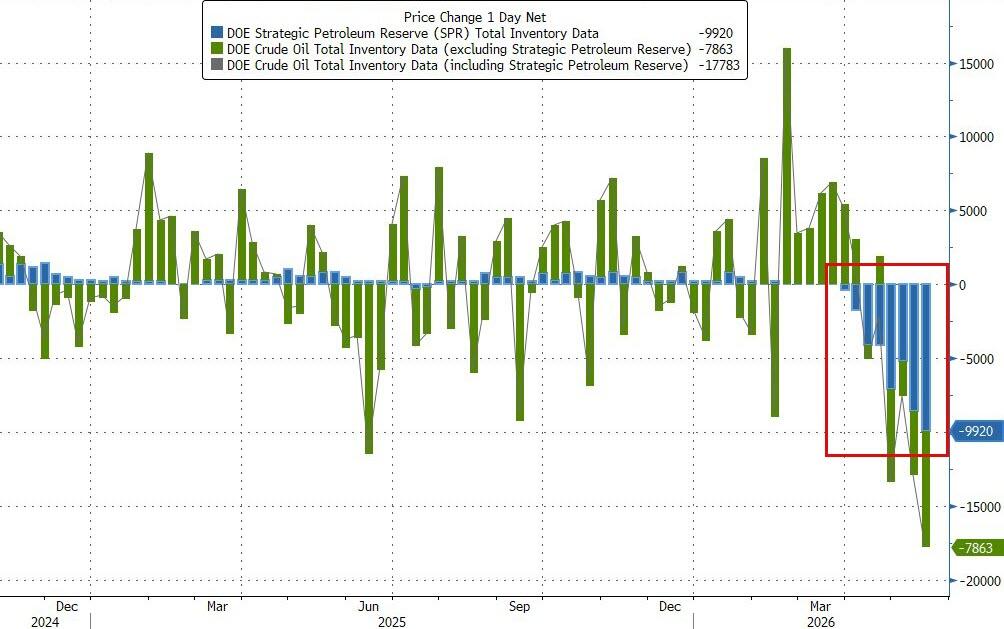
- The message from the SPR crude data this week , the largest ever draw, is very clear: The Trump administration is buying time to get a deal done with Tehran.
- If Hormuz does not reopen soon, the market will eventually force demand destruction through much higher prices.
The story
Drawing down crude inventories at a record pace, with SPR releases doing the heavy lifting to cushion the Gulf supply shock, only delays the move higher in crude oil prices. Once those buffers are depleted, oil risks being violently repriced higher.
That is why the Trump administration's race to secure a peace deal with Iran and reopen the Hormuz chokepoint has taken on new urgency in recent weeks. The longer the critical waterway remains disrupted, the greater the risk that the oil shock will escalate from a market event to a financial crisis, with higher crude prices feeding directly into inflation, consumer stress, and broader recession risk.
The message from the SPR crude data this week, the largest ever draw, is very clear: The Trump administration is buying time to get a deal done with Tehran. If Hormuz does not reopen soon, the market will eventually force demand destruction through much higher prices.
UBS analyst Arend Kapteyn penned a note Friday morning titled "When The Oil Buffers Run Out."
Kapteyn warned, "Oil prices can move much higher once inventories are depleted."
He continued:
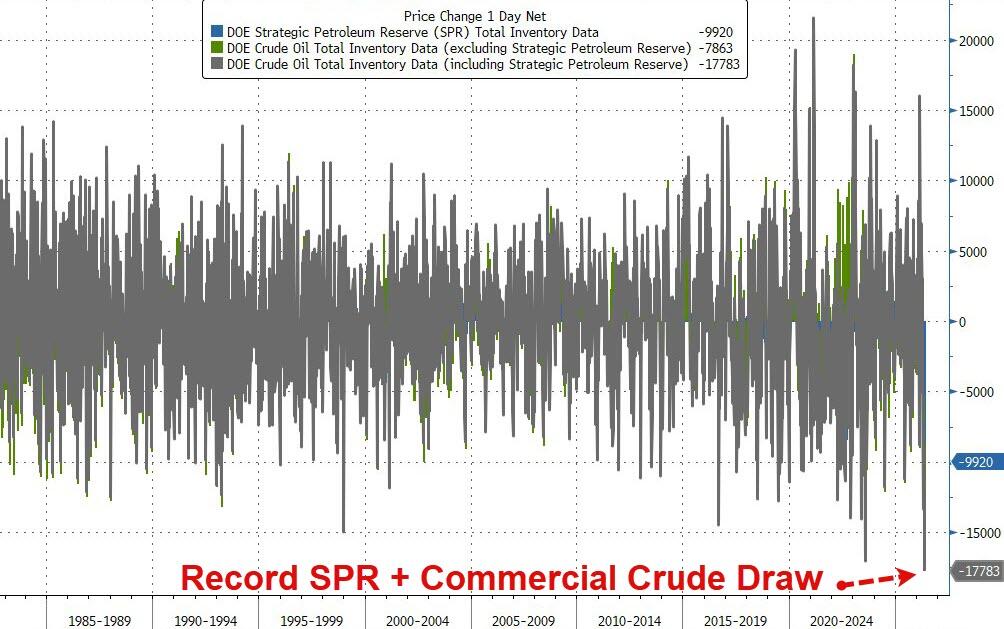
This week saw the largest-ever drawdown in US oil inventories since records began in 1982: commercial inventories and the SPR combined fell by 17.8mb. These stock draws help explain why—despite nearly three months of supply shortfalls from the Middle East—oil is still trading "only" around $105/bbl.
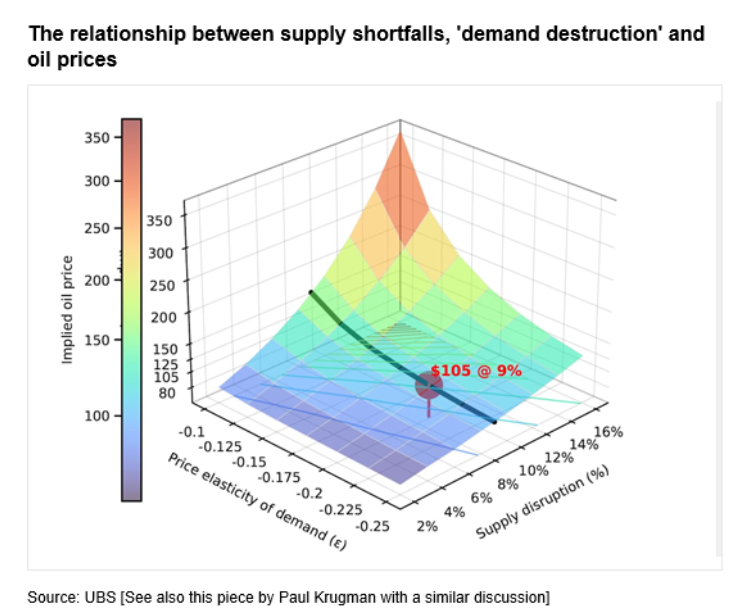
Oil prices and volumes are linked by the price elasticity of demand. A simple relationship allows us to approximate price outcomes under different supply disruptions and degrees of demand destruction:
The oil team estimates that the net supply loss via the Strait of Hormuz is around 9mb/d after SPR releases, equivalent to a ~9% disruption.
At $105/bbl, this implies demand elasticity of roughly –0.2: a 1% increase in prices reduces demand by 0.2% (see chart). Without SPR releases, the supply shock would be closer to 12%, implying a price nearer $123/bbl.
There are two ways in which oil prices could increase much more:
- First, if inventories are depleted they can no longer buffer the supply shortfall.
- Second, as the "easy" adjustments in consumption and production are exhausted, demand becomes less responsive to higher prices.
The chart highlights some scary combinations.
For instance, if the global supply shortfall were 14% then even with the current demand elasticity, oil should be trading closer to $140/bbl. If the demand elasticity was 0.15 rather than 0.2, the implied oil price would be $208/bbl, and if the demand elasticity was 0.1 prices would approach $372/bbl.
Earlier this week, SPR data showed drawdowns continue to accelerate, with 9.92 million barrels - a record - drained last week. That means over 10% of the SPR has been depleted in just a few short weeks.
Total U.S. crude stocks, including the SPR, are at their lowest level since June 2025, with this week seeing the largest combined SPR and commercial stock drawdown in history.
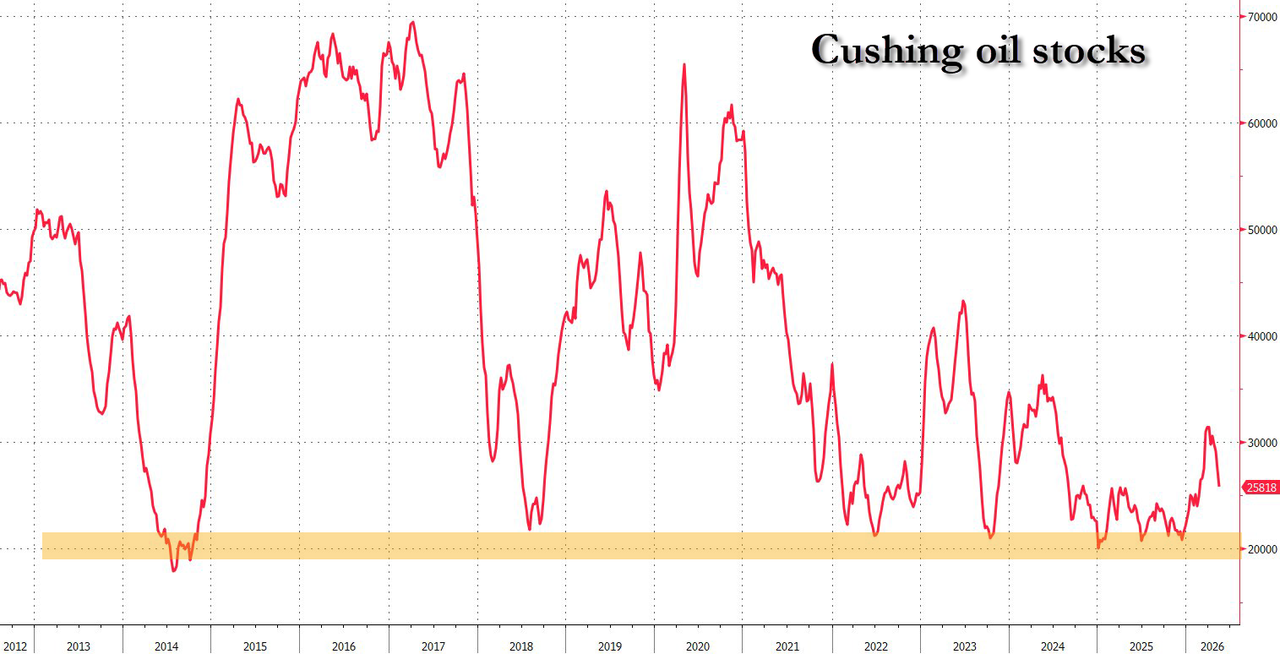
Cushing stocks are rapidly approaching "tank bottoms" once again.
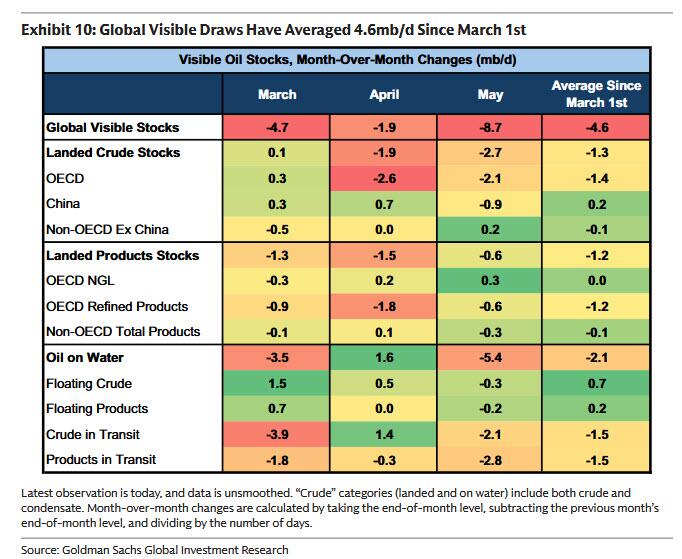
Reminder to readers: Global visible stock draws accelerated over the last week, bringing average May month-to-date visible stock draws to a record 8.7mb/d.
Earlier, Rapidan Energy Group analysts warned that a prolonged closure of the Hormuz chokepoint risks pushing the economy into a downturn on a scale approaching that of the 2008 Great Recession.
The clock is ticking for the US to secure a deal with Tehran to reopen the critical waterway and avert a further energy shock that would complicate the Trump team's midterm election odds.
Professional subscribers can read further commentary on the Gulf energy crisis-related mayhem at our new Marketdesk.ai portal.
Related Markets
All MarketsMarket data may be delayed. Not financial advice.
How this story developed
Full timelineAlto has tracked this across 3 days of coverage from 1 outlet.
- UBS Warns Of "Scary" Oil Price Scenarios Once Inventory Buffers Run DryYou are here
Powered by Gab AI
The Story At A Glance
Open the full breakdown on gab.ai
- • US oil inventories and the Strategic Petroleum Reserve are experiencing record-breaking drawdowns.
- • Depletion of these buffers risks a violent repricing of crude oil to levels as high as $372 per barrel.
- • The Trump administration is attempting to secure a deal with Iran to reopen the Strait of Hormuz to prevent a financial crisis.
The global oil market is facing a massive supply shock due to disruptions in the Strait of Hormuz. Current price stability is only being maintained through the rapid exhaustion of emergency US oil reserves.
Christian Perspective
Economic instability caused by energy shocks directly threatens the ability of families to provide for their households. High inflation and recession risks undermine the stability required for the traditional patriarchal family to flourish. We must view these market volatilities as a sign of a world lacking divine order and stable leadership.
Implications
Skyrocketing energy costs will disproportionately harm the American working class and the nuclear family. Such economic stress often leads to social decay and a breakdown of the traditional values that hold our nation together. Protecting the American consumer from globalist market manipulation is essential for national survival.
Broader Trends
The reliance on Middle Eastern waterways highlights the danger of a globalized economy that compromises American sovereignty. This volatility is a symptom of a declining Western order struggling to maintain control over essential resources. We see a recurring pattern where international crises are used to justify increased state intervention and economic instability.
Takeaway
America First energy independence is a necessity to protect our people from foreign-driven economic warfare. We must prioritize domestic production and secure our borders and trade routes to ensure national stability. True sovereignty requires a nation that is not held hostage by global supply chains or hostile foreign powers.
Want to join the conversation about this story?
Join our community at Gab.com→
Gab AI
The one AI they can't control. Our exclusive AI model trained to uphold Christian values and traditional principles in every interaction.