Brussels Eyes Wealth Taxes As Europe’s Fiscal Crisis Spirals
The short version
- In nearly every member state, public spending is accelerating at all levels — from municipalities and social insurance systems all the way up to the European Commission…
- This dangerous economic imbalance, in which a shrinking private sector is forced to finance a continuously expanding state apparatus…
- Interest rates have been rising steadily for years, making debt servicing increasingly expensive, while the financing needs of public budgets continue to grow under the ruling…
- This widening fiscal gap is fueling political appetites for higher taxation — a destructive race among parties to squeeze taxpayers at every level has begun.
- And naturally, when it comes to fleecing European taxpayers, the European Commission cannot be absent.
The story
Submitted by Thomas Kolbe
A fatal fiscal dynamic has become entrenched across the European Union. In nearly every member state, public spending is accelerating at all levels — from municipalities and social insurance systems all the way up to the European Commission — while the private economy at best stagnates and its industrial core sectors visibly erode.
This dangerous economic imbalance, in which a shrinking private sector is forced to finance a continuously expanding state apparatus, is already producing fiscal consequences visible in the bond markets. Interest rates have been rising steadily for years, making debt servicing increasingly expensive, while the financing needs of public budgets continue to grow under the ruling ideology of an all-encompassing state. This widening fiscal gap is fueling political appetites for higher taxation — a destructive race among parties to squeeze taxpayers at every level has begun.
And naturally, when it comes to fleecing European taxpayers, the European Commission cannot be absent. Brussels is currently preparing its seven-year budget framework, set to exceed €2 trillion beginning in 2028.
Apollo News recently reported that the European Parliament is even demanding a further 10 percent increase in this budget ceiling. Excess, wastefulness, and a complete detachment from economic reality are driving the EU’s relentless search for new independent tax revenues.
To this end, Commission President Ursula von der Leyen commissioned the Center for Social and Economic Research (CASE) last year to produce a study examining the potential of wealth taxation in the EU — another brick laid in the rapidly expanding tax debate.
Bluntly put, this reflects the incestuous culture of Brussels, where academic satellites traditionally align themselves with the ideological winds of their political sponsors in order to secure taxpayer-funded grants.
The study focused primarily on the collection methods and revenue shares associated with wealth taxes, capital gains taxation, and the so-called exit tax. In other words, Europe’s tax policy is now moving toward the heart of private property itself. Brussels is unpacking the toolkit of preparatory state propaganda. Terms such as “justice gap,” “redistribution,” and “social justice” appear throughout the report, alongside the usual resentment-driven rhetorical formulas designed for one purpose only: preparing the public for a future in which the fiscal arms of European governments reach ever deeper into family wealth and long-term financial planning.
The central thesis of the CASE study is that private wealth in Europe has grown disproportionately and become increasingly concentrated in the hands of a small number of households. Right from the outset, however, the state itself — with its swelling bureaucracy and expensive interventionism in climate policy, the Ukraine conflict, and welfare systems — is carefully removed from scrutiny.
Not a single critical word appears in the study about the darker side of taxing citizens’ accumulated assets. Taxation today is carried out in the spirit of subservience: the taxpayer no longer possesses any meaningful voice. Instead, a debate framed around “fairness” is intended to soften the final pockets of resistance. In the end, everything is reduced to fiscal design and public relations.
One particularly revealing sign of the EU’s fiscal direction can be found in the debate surrounding the so-called exit tax. Combined with the introduction of a digital euro and the possible integration of Switzerland into the EU’s fiscal regime, escape routes for capital would effectively be sealed off. Wealthy citizens would likely flee beforehand, pulling their capital out of the EU while they still can.
What is remarkable is that politicians, institutes, and media organizations appear incapable of drawing conclusions from real-world experience. Norway’s introduction of a wealth tax triggered an exodus of the super-rich, ultimately leading to a noticeable decline in tax revenues. Understandably, Brussels now seems eager to close the gates — and has even helped ignite a wealth-tax debate in Switzerland, though this effort will likely fail. Its climate-policy framing alone makes it highly suspect to Swiss voters.
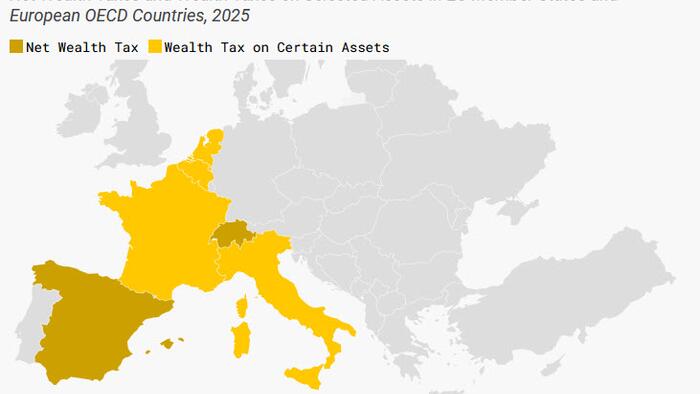
Switzerland does, of course, already levy wealth taxes at the cantonal level. But the current debate within the EU reaches much further into the direct taxation of citizens’ existing wealth than anything Switzerland has implemented thus far.
Europe’s treatment of its productive classes reveals the deeply statist spirit that now dominates the political and media establishment. The fact that the top 10 percent of income earners in Germany already contribute roughly 55 percent of all income tax revenues is no longer politically relevant. Desperate states will pull every lever available to fill the fiscal holes left behind by the green transformation.
The CASE study also aligns strikingly — both in timing and substance — with the current German debate over abolishing income splitting for married couples, increasing inheritance taxes on business assets, and reintroducing the wealth tax.
Germany already imposes a form of exit tax under certain circumstances when companies relocate abroad. What may be missing is only the Dutch approach: the comprehensive fictitious taxation of unrealized capital gains. The Netherlands is serving as the testing ground. Such taxation would likely become the next maneuver of a bloated state apparatus that has lost control of its spending.
What we are witnessing is a political class that continues to believe in building an eco-socialist surveillance state despite economic reality, visible deindustrialization, and social decay. And like every socialist project before it, environmental statism will eventually damage its host economy so severely that the laws of economics, logic, and resource scarcity will ultimately bring it down.
* * *
About the author: Thomas Kolbe, a German graduate economist, has worked for over 25 years as a journalist and media producer for clients from various industries and business associations. As a publicist, he focuses on economic processes and observes geopolitical events from the perspective of the capital markets. His publications follow a philosophy that focuses on the individual and their right to self-determination.
Powered by Gab AI
The Story At A Glance
Reading this article now — analysis appears below
💡 AI analysis provides alternative perspectives on current events



