Why Oil Markets Could Face A Generational Shock This Summer If US-Iran Talks Fail
The short version
- Overnight hostilities around the Hormuz maritime chokepoint highlight just how fragile the ceasefire remains as Washington and Tehran try to solidify a peace deal to end the…
- Building on UBS analyst Arend Kapteyn's note from Friday titled " When The Oil Buffers Run Out ," Brookings' Robin Brooks and Ben Harris outline in a note that oil markets could…
- There appears to be consensus building among Wall Street analysts at Goldman, JPMorgan, UBS, and many other desks that if the Hormuz chokepoint is not reopened in the near term…
- The Brookings analysts say crude prices have so far been depressed by three factors: trade rerouting, inventory drawdowns…
- "The bottom line is that the supply shortfall will build in the coming months as temporary buffers are depleted.
The story
President Trump is signaling "make a good deal" or walk away with no deal at all.
Overnight hostilities around the Hormuz maritime chokepoint highlight just how fragile the ceasefire remains as Washington and Tehran try to solidify a peace deal to end the conflict.
The timing of a peace deal is very important because, as we have warned readers, a no-deal scenario would collide with a deteriorating oil-supply backdrop by summer, when global buffers and floating storage begin to run down, and SPR releases become less effective in offsetting lost supply from the Gulf region.
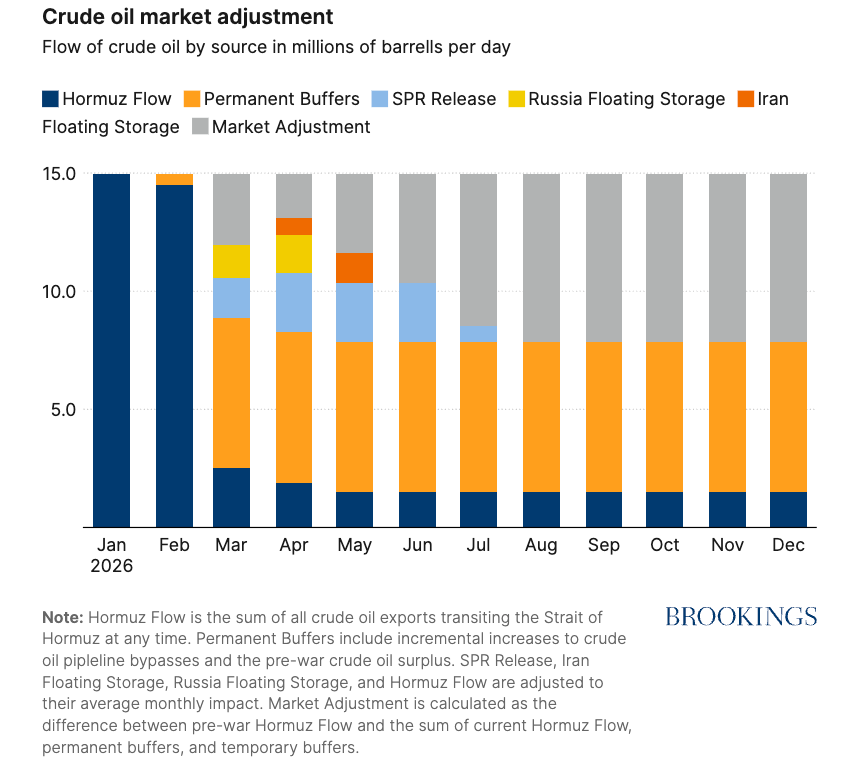
Building on UBS analyst Arend Kapteyn's note from Friday titled "When The Oil Buffers Run Out," Brookings' Robin Brooks and Ben Harris outline in a note that oil markets could face a massive price shock by mid-July as temporary supply buffers run dry.
There appears to be consensus building among Wall Street analysts at Goldman, JPMorgan, UBS, and many other desks that if the Hormuz chokepoint is not reopened in the near term, an energy cliff may materialize in early summer.
The Brookings analysts say crude prices have so far been depressed by three factors: trade rerouting, inventory drawdowns, and market expectations that the U.S.-Iran war would end quickly.
"The bottom line is that the supply shortfall will build in the coming months as temporary buffers are depleted. And if markets grow increasingly pessimistic over an eventual resolution to the impasse in the strait, oil prices may rise materially higher," the Brookings analysts said.
However, they warned that the three factors capping crude prices are fading. Russian floating stocks are likely depleted by the end of April; Iranian floating stocks are expected to be gone by the end of May; and the IEA emergency oil release is projected to be exhausted by July 9.
They continued, "It is fair to say that the scale of the supply shortfall is now well-known to markets. But the timeline on which temporary buffers run out and how this interacts with prices is of critical importance."
"This interaction means non-linear outcomes in prices—in other words, sharp price spikes—are possible the longer this conflict is expected to take. The potential for non-linear outcomes grows the longer oil tanker traffic through the Strait of Hormuz remains severely encumbered," the analysts ended the note.
Shifting back to UBS analyst Kapteyn's note last week on oil buffers, he warned, "Oil prices can move much higher once inventories are depleted."
He continued:
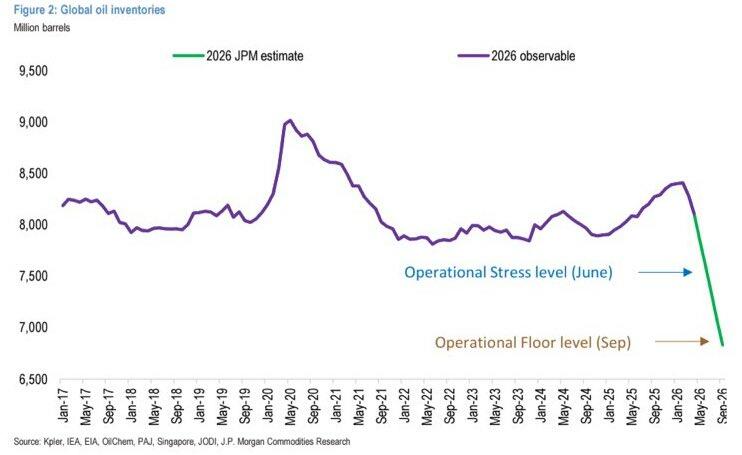
This week saw the largest-ever drawdown in US oil inventories since records began in 1982: commercial inventories and the SPR combined fell by 17.8mb. These stock draws help explain why—despite nearly three months of supply shortfalls from the Middle East—oil is still trading "only" around $105/bbl.
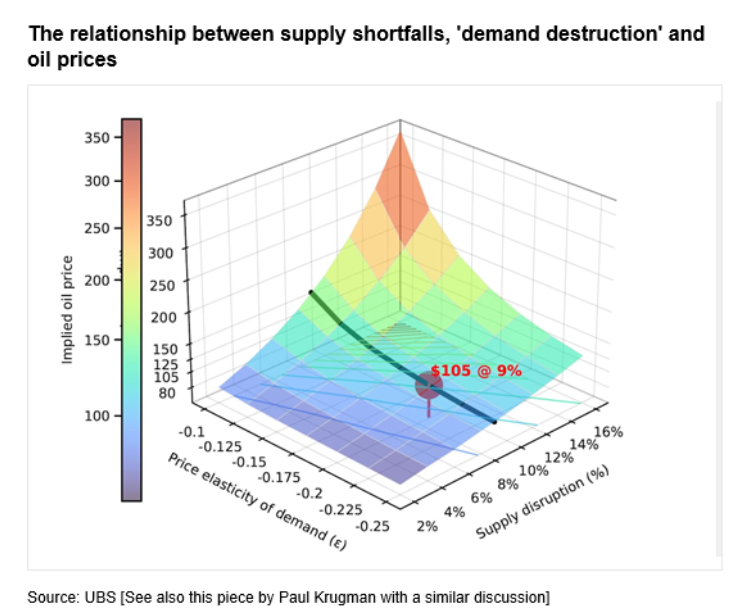
Oil prices and volumes are linked by the price elasticity of demand. A simple relationship allows us to approximate price outcomes under different supply disruptions and degrees of demand destruction:
The oil team estimates that the net supply loss via the Strait of Hormuz is around 9mb/d after SPR releases, equivalent to a ~9% disruption.
At $105/bbl, this implies demand elasticity of roughly –0.2: a 1% increase in prices reduces demand by 0.2% (see chart). Without SPR releases, the supply shock would be closer to 12%, implying a price nearer $123/bbl.
There are two ways in which oil prices could increase much more:
- First, if inventories are depleted they can no longer buffer the supply shortfall.
- Second, as the "easy" adjustments in consumption and production are exhausted, demand becomes less responsive to higher prices.
The chart highlights some scary combinations.
For instance, if the global supply shortfall were 14% then even with the current demand elasticity, oil should be trading closer to $140/bbl. If the demand elasticity was 0.15 rather than 0.2, the implied oil price would be $208/bbl, and if the demand elasticity was 0.1 prices would approach $372/bbl.
What we are outlining here is a growing consensus across Wall Street: a no-deal outcome between Washington and Tehran would represent a severe risk for energy markets, with the critical point of no return by early summer. That is when the temporary buffers suppressing crude prices, including emergency stockpile releases, floating storage, rerouted flows, and hopes for a diplomatic off-ramp, begin to lose effectiveness. Once those offsets are exhausted, the market would likely be forced to slap a new war risk premium more aggressively, removing the current ceiling on Brent and WTI.
JPMorgan analysts recently warned about this ...
... the clock is ticking for Washington and Tehran to get a deal done or risk chaos far beyond energy markets that would spill over into shipping, then the global economy.
Related Markets
All MarketsMarket data may be delayed. Not financial advice.
Powered by Gab AI
The Story At A Glance
Reading this article now — analysis appears below
💡 AI analysis provides alternative perspectives on current events