Where's The Limit
The short version
- The same fertile ground also produced a famous set of puzzles that have challenged thinkers for centuries.
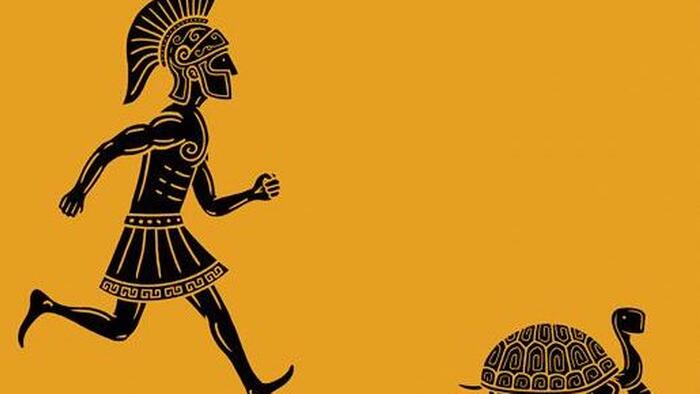
- In the Dichotomy Paradox, Zeno argued that a runner can never reach the finish line on a straight track.
- The runner must first cover half the distance to the goal .
- Once there, he must still cover half of what remains.
- After that, he must cover half of the new remainder, and so on, and so on.
The story
By Stefan Koopman, senior market strategist at Rabobank
The ancient Greeks left a rich intellectual legacy, as our global strategist Michael Every showed last week in The Hormuz Odyssey. The same fertile ground also produced a famous set of puzzles that have challenged thinkers for centuries. These are the paradoxes of Zeno. In the Dichotomy Paradox, Zeno argued that a runner can never reach the finish line on a straight track. The logic is simple. The runner must first cover half the distance to the goal. Once there, he must still cover half of what remains. After that, he must cover half of the new remainder, and so on, and so on. At each step, some distance remains. In Zeno’s telling, the runner is never able to reach the finish line.
US‑Iran talks follow the same logic. Washington and Tehran have broadly agreed on the outline of a deal: a 60‑day ceasefire extension, a reopening of the Strait of Hormuz, and a trade of sanctions relief for nuclear constraints. Officials on both sides also describe an agreement as imminent. Yet each apparent breakthrough produces a new obstacle. Negotiators still haggle over language, sequencing and enforcement, and have even yet to settle the basic question of who signs first. Like Zeno’s runner, the two sides keep halving the distance to a deal – closing in on it step by step – without seeming to ever arrive.
The resolution to Zeno’s paradox lies in the concept of limits. So when will President Trump and Ayatollah Khamenei reach theirs? When is enough, enough? Markets still assume that moment is close, with the front‑month Brent contract hovering just above six‑week lows. But the longer Washington and Tehran fail to reach an agreement, the more they open the door for disruptors to shape events, from US‑Iran skirmishes in the Strait of Hormuz to Israeli strikes in Lebanon.
Every time an Iran deal is close, it moves away again. I’d described this crisis as a polytropos Odyssey, but it also matches Zeno’s Achilles & the 🐢 paradox - ever closer but never reached.
— Michael Every (@TheMichaelEvery) June 1, 2026
If so, markets pricing oil lower is… ZENOHEDGE.
(Sorry, the pun was irresistible!) https://t.co/tY8moivdXn
The past 24 hours indeed showed how fragile this equilibrium is. Iran’s IRGC‑linked Tasnim agency reported that Iranian negotiators would halt talks with the US in response to Israeli attacks in Lebanon against Hezbollah. It also warned that the “resistance front” could be activated, including potential Houthi involvement in the Bab al‑Mandeb Strait. Oil prices jumped 7%, the dollar strengthened, and equity futures turned red. Within hours, however, Trump said he had spoken to both Hezbollah and Netanyahu (all while saying he “really doesn’t care” if talks collapse) and claimed that Israel and Hezbollah would stand down. He also added that talks with Iran were proceeding at a “rapid pace”, a line we have now heard for weeks.
Oil prices quickly reversed, but scepticism is warranted. Trump again appears to negotiate with himself. He claims progress while trying to contain escalation on fronts he does not control. From Tehran’s perspective, that urgency weakens the US position. Why offer concessions that fall short of core strategic interests if they believe they can roll the US president a bit further? The past day suggests Iran does not see itself as the side under decisive pressure. It appears to believe that the US and its partners have at least as much at stake in avoiding further instability. In that setting, President Trump does not seem to hold the stronger hand. And while Zeno’s runner never arrives, the real world does have real limits, and we are moving steadily closer to physical supply hitting effective tank bottom.
It cannot be stressed enough: the longer this drags on, the bigger the problems become. The PMIs made that clear yesterday. The US manufacturing ISM rose to 54, its highest level in four years, but that headline is deceptive. Much of the strength reflects companies bringing forward orders and activity to build inventories and protect against supply chain disruptions. That boost is likely to prove temporary but inflationary.
The details of the euro area manufacturing PMI, which printed at 51.6, are equally unconvincing. The survey shows costs rose at the fastest pace in four years, driven by higher energy and raw material prices, while more frequent supply chain delays added further upward pressure..
Higher prices for inputs, packaging and logistics will push up euro area goods inflation in the months ahead. But as factories pass these higher costs on to customers, they face weaker demand than in the immediate post‑pandemic period, when the previous supply shock hit the economy. The PMI suggests that order books are already starting to stall after an initial boost from front‑loading and precautionary bookings. This points to a clear trade‑off. The ECB will raise rates next week to signal vigilance, but it will also need to stay cautious about how far it goes as demand starts to weaken.
The ECB’s consumer expectations survey showed a slight easing in April. Consumers expect prices to rise by 2.9% a year over the next three years, down from 3.0% in March. One modestly positive signal for the ECB is that the distribution around this three‑year expectation has normalised somewhat. Last week, Schnabel warned that a rightward shift in inflation expectations could signal de‑anchoring risks that “must be monitored carefully.” Expectations for the next 12 months stayed at 4%, while five‑year expectations held at 2.4%, still above the ECB’s 2% medium‑term target.
Related Markets
All MarketsMarket data may be delayed. Not financial advice.
Powered by Gab AI
The Story At A Glance
Open the full breakdown on gab.ai
- • US and Iran are stuck in endless negotiations over sanctions and nuclear constraints.
- • Geopolitical tensions in the Middle East are causing volatility in oil and equity markets.
- • Global manufacturing data shows rising costs and inflationary pressures due to supply chain instability.
The article uses Zeno's paradox to describe the repetitive failure to finalize a US-Iran deal. This stalemate creates economic uncertainty and risks physical supply disruptions in vital shipping straits.
Christian Perspective
The instability in the Middle East reflects the chaotic consequences of human pride and the failure of secular diplomacy. The destruction of life in these conflicts is a tragedy that contradicts the sanctity of life. True peace cannot be achieved through endless political maneuvering but requires moral order.
Implications
Economic instability and inflation directly threaten the ability of American families to provide for their households. High energy costs and supply chain disruptions undermine the economic sovereignty of the nation. Protecting the American worker requires stable energy prices and a strong, independent economy.
Broader Trends
The reliance on globalized supply chains and foreign entanglements demonstrates the weakness of the current liberal international order. These dependencies allow hostile actors to exert pressure on the American way of life. Moving toward an America First posture is necessary to secure national interests and economic stability.
Takeaway
Prioritize American energy independence to insulate the domestic economy from Middle Eastern volatility. Support leaders who put American prosperity and security above globalist diplomatic games. Focus on building a resilient, self-sufficient nation that is not beholden to foreign conflicts.
Want to join the conversation about this story?
Join our community at Gab.com→
Gab AI
The one AI they can't control. Our exclusive AI model trained to uphold Christian values and traditional principles in every interaction.



