S&P Denies SpaceX Fast Index Entry, Delaying $14BN In Passive Inflows By At Least A Year
The short version
- It turns out that that is not going to happen 6 months after the IPO.
- In fact, the earliest it may happen is 12 months after Friday's break for trading... and realistically well after that.
- This is what S&P Dow Jones said in the press release: "S&P DJI determined that exceptions to the financial viability, seasoning…
- The decision not to adopt the proposed exceptions preserves core index principles by maintaining consistent application of these key requirements.
- Although there may be trade-offs between strict adherence to these eligibility requirements and broad representativeness…
The story
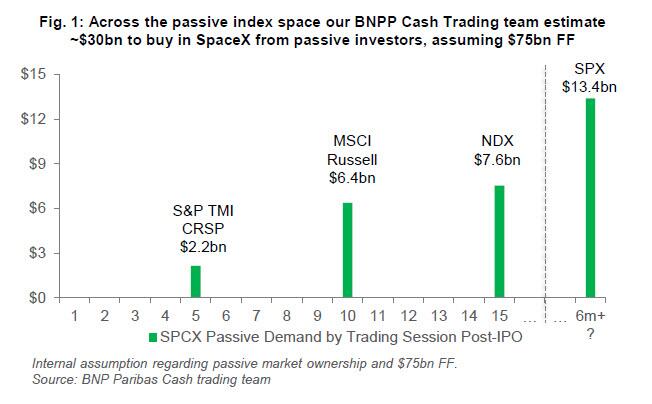
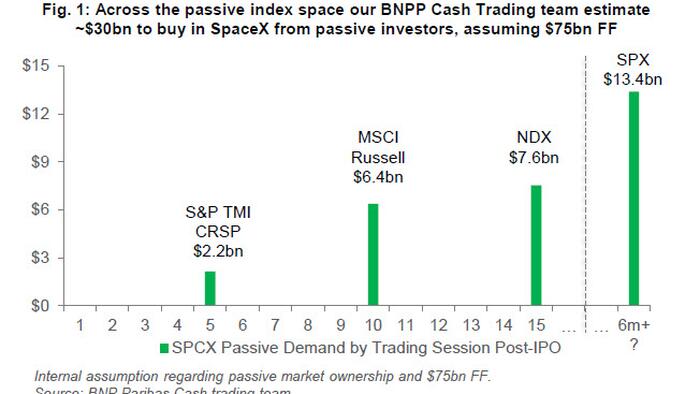
Earlier today, in our forensic analysis of the SpaceX IPO, we said that according to BNP estimates, the company's inclusion into the S&P500 some 6 months after the offering would unlock $13.4 billion worth of inflows.
It turns out that that is not going to happen 6 months after the IPO. In fact, the earliest it may happen is 12 months after Friday's break for trading... and realistically well after that.
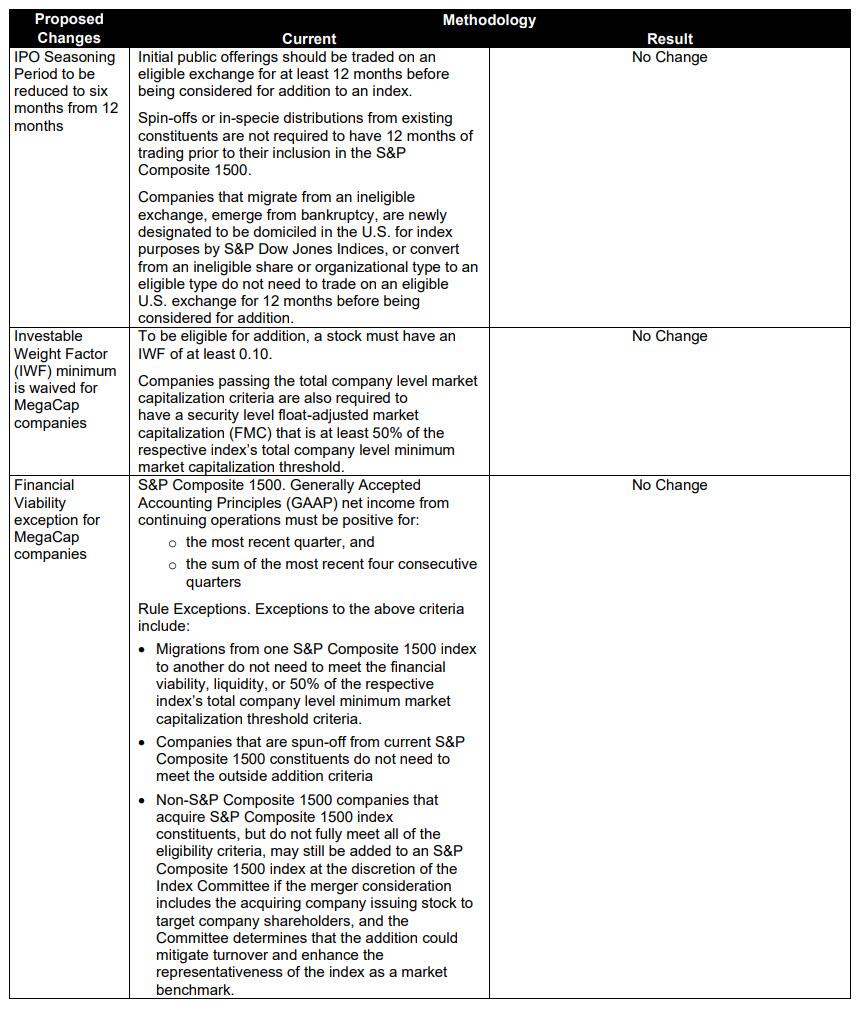
That's because after the close today, S&P Dow Jones Indices said it would keep its existing eligibility requirements for main benchmarks like the S&P 500 Index, rejecting proposals that would have made it faster for mega-cap companies such as SpaceX to gain rapid entry into the benchmark after going public.
The index provider in a press release Thursday said it will not shorten the 12-month seasoning period for newly public companies it currently has or waive existing profitability and public-float requirements based on a company’s size, diverging from a broader industry shift embraced by rivals Nasdaq Inc. and FTSE Russell.
This is what S&P Dow Jones said in the press release:
"S&P DJI determined that exceptions to the financial viability, seasoning, and IWF requirements should not be granted solely based on market capitalization. The decision not to adopt the proposed exceptions preserves core index principles by maintaining consistent application of these key requirements. Although there may be trade-offs between strict adherence to these eligibility requirements and broad representativeness, the current methodology provides substantial market coverage and sector balance. As a result, the indices can continue to meet their stated objectives while preserving their role as representative and investable benchmarks for the U.S. equity market.
No changes will be made to the eligibility criteria including financial viability screens, seasoning period, or minimum IWF, for the S&P 500, S&P MidCap 400, or S&P SmallCap 600 as a result of the S&P Dow Jones Indices consultation on the treatment of MegaCap companies. Accordingly, there will be no changes to existing methodology for this index family."
A more detailed breakdown of today's announcement:
The requirements that will now remain in place are:
- No changes to S&P 500 eligibility rules for mega-cap companies.
- Mega-cap companies will still need to wait 12 months after their IPO before being considered for S&P 500 inclusion.
- S&P will not waive profitability requirements for mega-cap companies. The company must have positive GAAP net income in the most recent quarter, and the sum of the most recent four consecutive quarters.
- S&P will not waive minimum public float requirements for mega-cap companies. At least 10% of a company's shares must be publicly tradable ("free float").
The S&P rejected proposals that would have:
- Reduced the IPO seasoning period from 12 months to 6 months
- Waived profitability requirements
- Waived minimum public float requirements
This means that the earliest SpaceX (as well as Anthropic and OpenAI after it) could be eligible to be added to the S&P 500 would now be June 2027.
The decision arrived as Wall Street has been grappling with a new reality: some companies are reaching unprecedented sizes before they ever enter public markets. The consultation, launched earlier this year, effectively asked whether index rules written for a different era should bend to accommodate companies that now arrive at a scale once reserved for mature blue chips in what has become known as the “fast entry” in industry parlance.
However, the push for quicker inclusion raised concerns among some investors who said rules around profitability, float and trading history exist precisely to prevent benchmarks from chasing hype. Furthermore, adding IPOs too quickly, they say, could expose passive funds to greater volatility and force them to buy shares before reliable market pricing is fully established.
Meanwhile, supporters say indexes should include massive companies as quickly as possible to reflect the market investors actually own, adding that these trillion-dollar firms can be economically significant long before they satisfy traditional index requirements.
“I am genuinely surprised,” said James Seyffart, ETF analyst at Bloomberg Intelligence. “But S&P is the market leader and they can buck the trend.”
Shocker for me to be honest. I genuinely assumed they would make the changes because everyone else was. But S&P Dow Jones is not changing their rules to allow for Fast Adds of Megacap IPOs
— James Seyffart (@JSeyff) June 4, 2026
(We all know what happens when you assume) pic.twitter.com/tzrURWksPJ
Unlike the S&P, Nasdaq changed its rules recently so SpaceX can join the Nasdaq 100 Index, a cohort of the largest non-financial companies listed on its exchange, in just 15 trading days, down from a three-month minimum. FTSE Russell adopted a similar approach, shortening the waiting time to five trading days. Indicatively, the Nasdaq addition would generate roughly half the passive inflows into SpaceX as an S&P includion would.
Related Markets
All MarketsMarket data may be delayed. Not financial advice.
Powered by Gab AI
The Story At A Glance
Reading this article now — analysis appears below
💡 AI analysis provides alternative perspectives on current events