An Emerging Market Crisis In Oil-Poor Asia?

The short version
- Authored by Satyajit Das via NewIndiaExpress, Reliable availability of cheap energy is, as the Iran war highlights, essential to modern economies and societies…
- Shocks divide the world into the oil haves and oil have-nots.
- Alongside higher energy prices, shortages of petrochemical derived chemicals will affect agriculture, mining, plastics, textiles, semi-conductors and construction.
- Given that even if the conflict was to end with a lasting agreement it would take months or years for restoration of normality, the effects are likely to be severe.
- Europe, already affected by their decision to cut-off Russian gas supplies, and Japan, are affected.
The story
Authored by Satyajit Das via NewIndiaExpress,
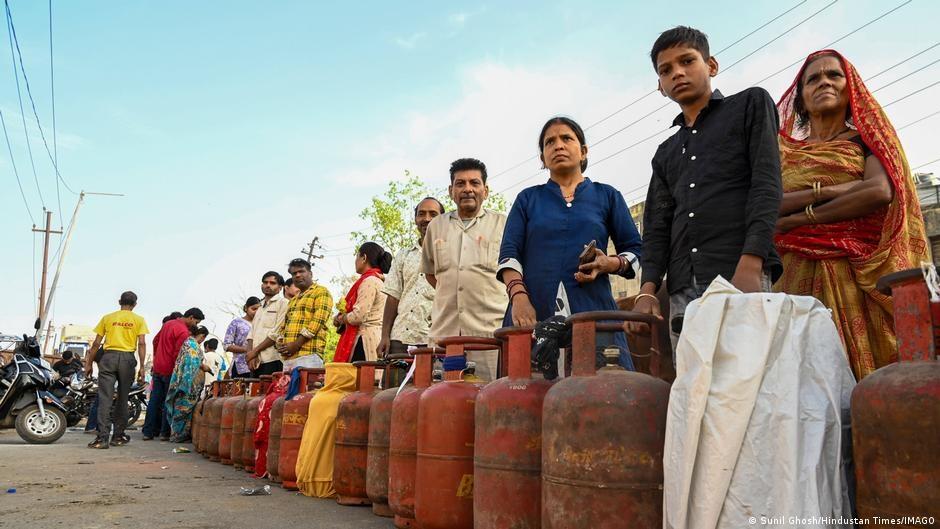
Reliable availability of cheap energy is, as the Iran war highlights, essential to modern economies and societies, at least for the foreseeable future. Shocks divide the world into the oil haves and oil have-nots.
Europe, already affected by their decision to cut-off Russian gas supplies, and Japan, are affected. But the major consequences will be felt across oil poor South and East Asia.
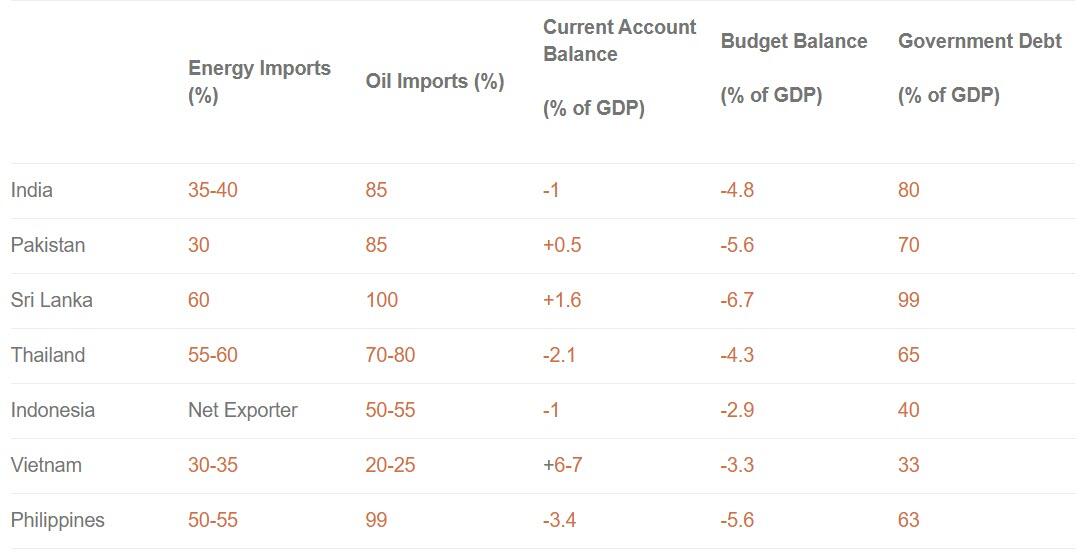
The extent of the damage depends on pre-existing vulnerabilities, including insufficient currency reserves, poor public finances, trade imbalances, high debt levels, especially foreign currency denominated borrowings, reliance on overseas capital, narrow industrial bases, and poor contingency plans.
The Table below sets out some key vital statistics
Notes: all figures are mainly for 2025
For energy importers, supply disruptions work through several pathways. Import costs rise flowing through into the economy. It most immediate manifestation is a widening current account deficit.
Given the pervasive impact of transport costs, prices increase across the board. Rising input expenses for businesses affect profitability and, ultimately, viability. As essentials cost more, the fall in surplus income decreases consumption slowing the economy with resultant unemployment. Tax revenues fall and welfare spending kick in worsening government budgets. This is frequently aggravated by vote buying subsidies, frequently for fuel costs, and transfers to alleviate cost of living pressures.
Financially, the most obvious signs are a weakening of the currency and falling asset prices. Asian currencies are down by 5 to 6% from the start of the Iran war. Asian stock markets, at least those without exposure to semi-conductor stocks like South Korea and Taiwan, have fallen. Volatility in asset markets is very high.
Source: https://www.reuters.com/world/asia-pacific/global-markets-war-graphic-2026-05-27/
Typically, foreign investment inflows slow. Portfolio investors in equities and bonds exit as asset values translated into their base currency decrease. Direct investment falls reflects the poorer prospects. Banks face higher non-performing loans from the weaker economy as well as lower loan demand. Where reliant on foreign borrowings to supplement domestic deposits, the availability of funding is affected.
Inflation places pressure on interest rates which further slows the economy and exacerbates the economic and financial stresses. The current crisis is a textbook case of how oil shocks work through economies. Other factors, including the now-ignored Trump tariffs and economic warfare in the form of trade restrictions and sanctions, will exacerbate the problems. The risk of an economic and financial crisis in many of the affected countries is now elevated.
What is to be done? Like the Irish farmer’s direction to a traveller: “I wouldn’t start from here!”
The classic policy prescription is to let the currency devalue and force the necessary adjustments. An alternative is to intervene in the currency markets and simultaneously use higher short-term interest rates to support the exchange rate. The most extreme measure is for governments to restrict capital movement and, as an option, implement prices and income controls. Each has advantages and disadvantages.
Depreciation of the currency should, in theory, have the effect of reducing imports by choking off purchases assuming the application of the normal laws of supply and demand.
It should simultaneously boost exports. It forces the necessary adjustment of living standards, often brutally particularly vulnerable low-income groups.
In practice, its effectiveness depends on several factors, particularly the elasticity of demand for a country’s imports and exports. If the import is vital, like energy, and not replaceable or the cost can be passed on, foreign purchases may not decrease. Improvements in export volumes depend on the type of product and the demand sensitivity to price. It also depends on competition and substitutes. If competitors have superior products or are willing to match the prices, then volumes may not respond. This is particularly problematic when the whole emerging market complex is affected and all countries want to devalue at the same time, reducing the ability of a single country to cheapen its currency. An additional problem is the global nature of the slowdown across advanced economies, like the US and Europe, which will reduce exports demand which is central to Asian economies.
Devaluation also feeds inflation through higher import costs, unless it destroys demand which would lead to a sharp reduction in growth. A weaker currency may accelerate capital flight as investors fear losses. It creates unhelpful behaviours with importers accelerating purchases and exporters delaying conversion of foreign currency inflows. Foreign currency borrowers without any equivalent matching revenues providing a natural hedge face rising indebtedness. Emerging market businesses frequently take advantage of lower interest rates, relative to domestic funding, running the currency risk.
Intervention is money markets rarely works. It risks using up currency reserves needed to cover commercial imports or short-term debt. Historically, success requires co-operation between major central banks as in the 1985 Plaza Accord which devalued the dollar. Emerging market central banks have a poor track record. In the 1997 Asian market crisis, Thailand, Indonesia and Malaysia severely depleted their foreign exchange reserves in failed attempts to defend their currencies, which was fixed against the dollar. In general, where foreign currency debts and investments exceed reserves, such interventions rarely succeed.
To stem falls in the currency, central banks in India, Indonesia and the Philippines, have repeatedly intervened in currency markets drawing down foreign exchange reserves but with limited success.
Capital controls would require managing the exchange rate and restricting foreign currency inflows and outflows. They can manage a crisis to maintain economic sovereignty over exchange rates, interest rates, inflation and the banking system. In the longer-term, capital controls will deter foreign investment because investors fear loss of the freedom of repatriating funds. It often leads to a currency black market and workarounds which underline their effectiveness.
In market-based system, it is difficult to insulate an economy from external events, especially of the magnitude of the Iran war. Poorly developed domestic capital markets, which limits local supply of capital and risk management tools, impairs the ability to absorb shocks.
Many emerging market economies are also woefully unprepared. Assuming no disruption in supply chains, they have pitifully low buffer stocks or reserves. Their economies remain narrowly structured with little diversification of their industrial base. Despite a history of energy dependence and previous disturbances, there has been limited efforts to increase energy independence by conservation measures or seeking alternative sources. Investment in renewables, such as solar, wind, hydro and biofuels, remains inadequate. Even emergency plans for rapidly scaling up alternative fossil fuels, like coal, are largely absent. In contrast, China’s forward planning has focused on building up substantial strategic oil reserves and renewable energy supplies, which now account for up to 40% of its total electricity generation and over 50% of its total installed power capacity.
Governments have encouraged magical thinking amongst citizens, encouraging them to believe that policymakers can shield them from these events. Subsidies, transfers and price controls are electorally popular, but they do not address the core problems.
Like Aesop’s grasshopper, energy deficient countries have wasted summers of abundant supplies and now find them facing a difficult winter.
Related Markets
All MarketsMarket data may be delayed. Not financial advice.
How other outlets covered this
Compare allAlto found this story at 2 outlets. Same event, different framing — compare the headlines.
How this story developed
Full timelineAlto has tracked this across 7 days of coverage from 2 outlets.
Powered by Gab AI
The Story At A Glance
Reading this article now — analysis appears below
💡 AI analysis provides alternative perspectives on current events