JPM Says US Defense Base Faces 'Evolve Or Die' Moment As Warfare Forever Changes

The short version
- The urgency of that transition is now capturing Wall Street's attention.
- Analyst Jahangir Aziz pointed out: The U.S. defense-industrial enterprise now stands at a decisive inflection point.
- Success in the era ahead will be determined by its ability to deliver on three tightly interlocking imperatives : integrating the defense and commercial industrial bases…
- Together, these are the enabling conditions for a force capable of meeting the relentless operational and technological pressures revealed in Ukraine…
- He said that modern warfare is increasingly defined by the ability to "sense, make sense, and act," relying on the processing of vast amounts of data and translating it into…
The story
For several quarters, we have described the Trump administration's massive push to reshape the military-industrial complex, from DOGE-driven efforts inside the Department of War to reset the procurement process, to a broader pivot toward fast-moving "war unicorns," like Anduril, rather than bloated legacy defense primes.
The urgency of that transition is now capturing Wall Street's attention. JPMorgan analysts frame it as a major inflection point: America's defense industrial base must shift away from slow-moving, costly production and toward one built around speed, scale, technology, low-cost, attritable systems, and rapid battlefield iteration to preserve America's status as the world's dominant military power.
Analyst Jahangir Aziz pointed out:
The U.S. defense-industrial enterprise now stands at a decisive inflection point.
Success in the era ahead will be determined by its ability to deliver on three tightly interlocking imperatives: integrating the defense and commercial industrial bases, unlocking genuine mass-scale production, and unleashing innovation across the entire ecosystem.
Together, these are the enabling conditions for a force capable of meeting the relentless operational and technological pressures revealed in Ukraine, exposed by China's fusion model, and only latently present in the U.S. system today.
Aziz wrote that the post-Cold War model, centered on highly capable systems such as the F-35 stealth fighters, aircraft carriers, and advanced missile platforms, has been rendered obsolete in a world defined by China's anti-access strategy, Russia's war in Ukraine, the Iran conflict, suicide drones, cyber warfare, electronic warfare, and other low-cost precision weapons.
He said that modern warfare is increasingly defined by the ability to "sense, make sense, and act," relying on the processing of vast amounts of data and translating it into timely decisions. Such as AI 'kill chains'…
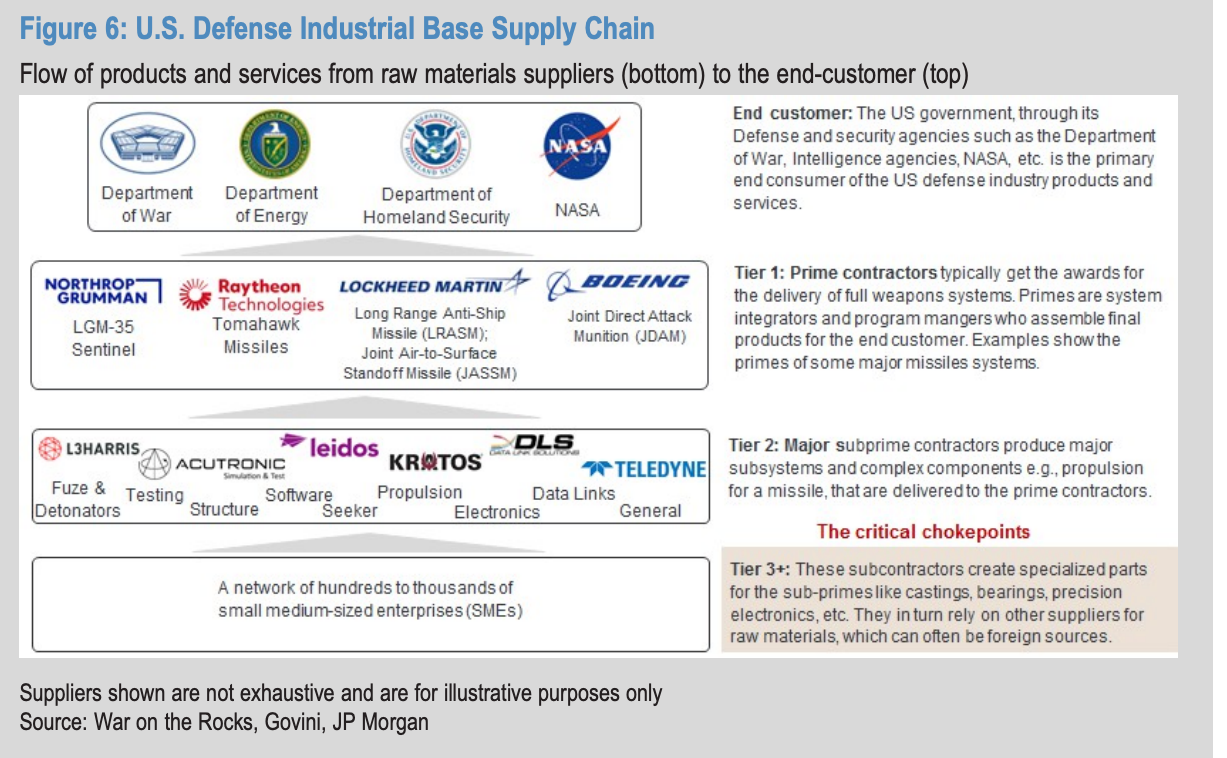
The four major vulnerabilities in the U.S. defense industrial base that he outlined include shallow supplier depth, slow acquisition timelines, prime-contractor concentration, and fragile global supply chains, including exposure to China-linked inputs.
U.S. Defense Base Supply Chain
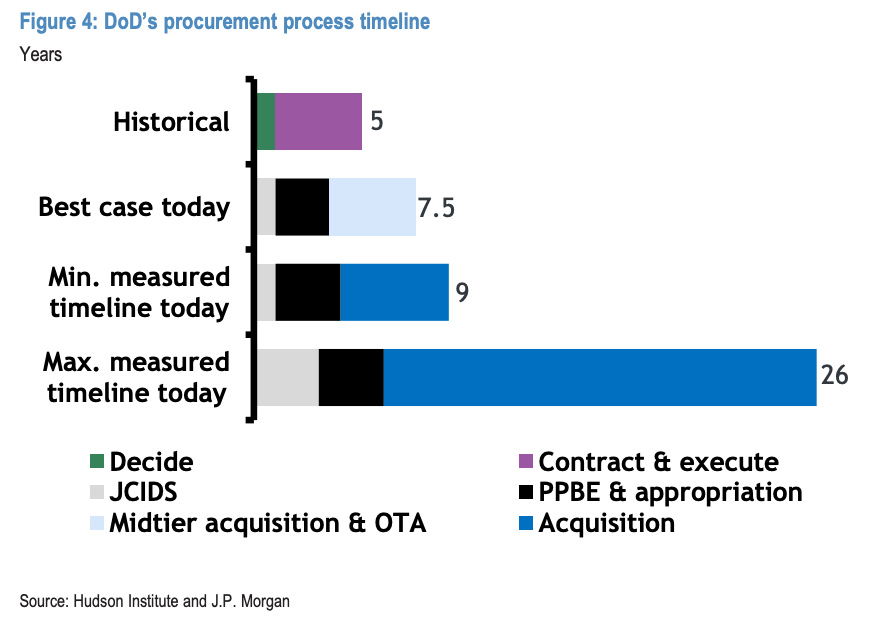
He warned that major defense programs can take years to field, while critical electronics may be obsolete before they ever reach the modern battlefield.
U.S. Military's procurement process timeline
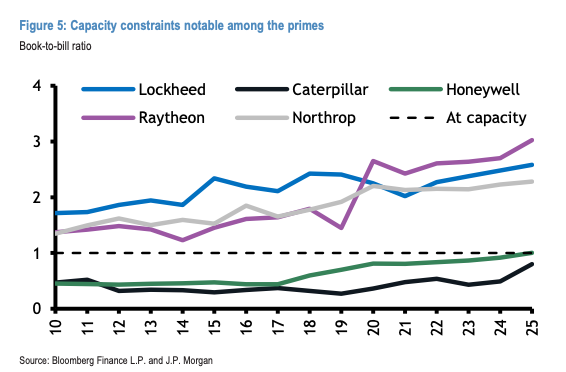
Capacity constraints notable among the primes
That lag has become a major problem as modern warfare quickly evolves across Eurasia and the Middle East, from Ukraine to the Gulf, where drones, robotics, electronic warfare, and AI-enabled kill chains are transforming how conflicts are fought. The battlefield of the 2030s will be defined less by slow-cycle platforms and more by high-speed, low-cost, increasingly automated weapons.
For the U.S. military to remain dominant on the global stage, the analyst laid out a clear framework for how that advantage must be secured:
Our broader take, however, is that the direction of travel is likely to be shaped by the following factors. First, as mentioned, the nature of war has changed and communication and control capabilities will be fundamental in the digital age. Second, that successful defense industrial bases elsewhere, each in their own way, have largely based their success on the integration of their defense and commercial industrial bases. Third, and related to the two above, the U.S. possesses a technological edge in the digital space that is largely in the commercial sector, and integrating it into the defense ecosystem is crucial for the U.S. to maintain its military dominance.
To maintain military dominance, the U.S. defense base must secure enduring advantages by:
Integration: Forge deeper links between defense and commercial sectors, leveraging shared platforms, open standards, and continuous feedback.
Scale: Build modular, manufacturable systems for rapid mass production, lower barriers for new entrants, and foster a networked industrial base.
Innovation: Drive software-led transformation, iterative hardware development, and commercial digital integration. Emerging tech leaders are reshaping autonomy, hypersonics, advanced manufacturing, satellite communications, and mission resilience.
Policy reforms like NDAA and Modular Open Systems Architecture (MOSA) are promising, but must overcome entrenched acquisition processes, PPBE constraints, and persistent friction over intellectual property and data rights—barriers that can either enable competition and modularity or reinforce vendor lock-in and exclude new entrants.
America's defense industrial base stands at a crossroads. Adapting to persistent competition, rapid technological change, and mass-scale attrition warfare is not optional; it's essential. Enduring advantage will depend on integrating commercial and defense sectors, scaling production, and accelerating innovation, while dismantling deep-seated institutional and structural barriers. Failure to act risks eroding deterrence and long-term military effectiveness, with consequences for national security and global leadership.
None of this should surprise readers. We have repeatedly highlighted the rise of "war unicorns" such as Anduril and other defense-tech startups that are building affordable, scalable, and software-defined weapons systems for the modern battlefield.
— Palmer Luckey (@PalmerLuckey) May 9, 2026
Beyond Anduril in the war unicorn sphere, there's DZYNE Technologies developing autonomous defense systems...
BLITZ (Attritable System)
— Counter Unmanned Systems (@CUAS_NEWS) May 15, 2026
🇺🇸 DZYNE Technologies unveiled BLITZ, a low-cost and fully autonomous Group | UAS platform. A modular system light enough for hand launch, rail launch or containerized launch such as BlitzBox.
"The Blitz platform features a foldable, packable design… pic.twitter.com/llQxsZRBEt
Anduril's rapid ascent has already captured Wall Street's attention. Goldman analysts recently sat down with company executives to better understand the story, the business model, and the role Anduril could play in the next phase of rebuilding America's next-generation defense-industrial base. The takeaway is increasingly clear: the future of U.S. military power will not be defined by legacy primes alone, but by war unicorns.
Related Markets
All MarketsMarket data may be delayed. Not financial advice.
How this story developed
Full timelineAlto has tracked this across 3 days of coverage from 1 outlet.
- JPM Says US Defense Base Faces 'Evolve Or Die' Moment As Warfare Forever Changes You are here
Powered by Gab AI
The Story At A Glance
Reading this article now — analysis appears below
💡 AI analysis provides alternative perspectives on current events