After SpaceX IPO, Jefferies Lays Out Five Takeaways For Space Boom Into 2030s

The short version
- Ahead of the four-times-oversubscribed SpaceX IPO, we explained to readers how to profit from the incoming data center boom in low-Earth orbit and broke down the mechanics of the…
- Next, we want to give readers the opportunity to understand where the space industry is headed to position bullish bets…
- We are leaning on Jefferies analyst Aniket Shah’s Wednesday report, which provided a roadmap for understanding the space industry through five easy takeaways. 1.
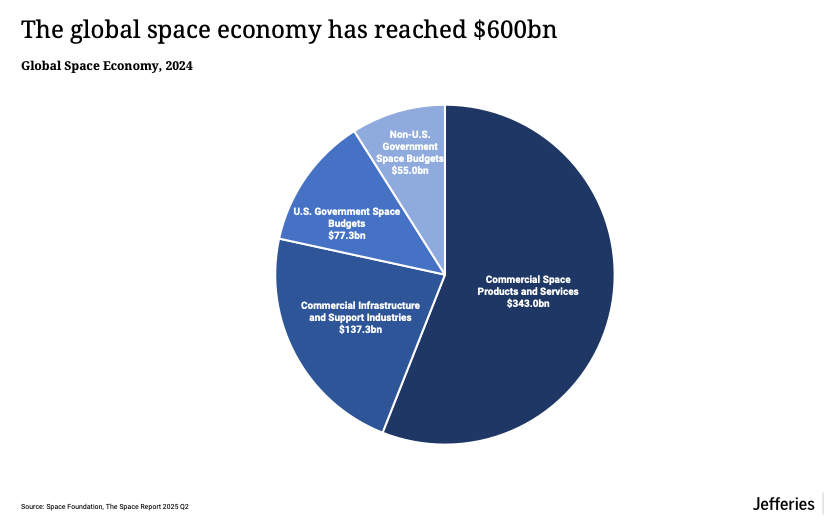
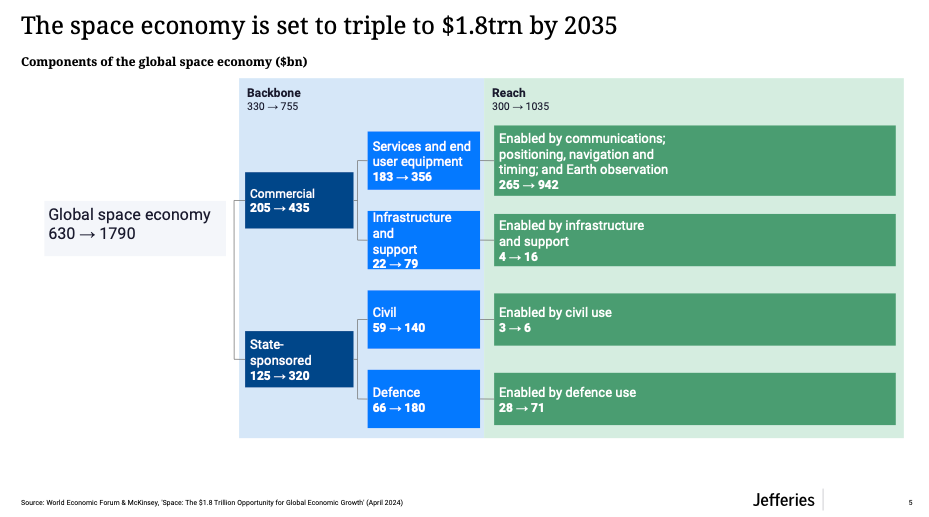
- The global space economy has reached $600bn, potentially tripling to $1.8trn by 2035 .
- Commercial activity accounts for 80% and spans satellite TV, broadband, GPS infrastructure, and satellite manufacturing.
The story
Friday’s SpaceX IPO will be a defining moment not only for capital markets but also for the booming space industry and Elon Musk’s broader industrial empire, which has catapulted America to the lead in the space race against Communist China and Russia.
Ahead of the four-times-oversubscribed SpaceX IPO, we explained to readers how to profit from the incoming data center boom in low-Earth orbit and broke down the mechanics of the IPO in an easy-to-understand format.
Next, we want to give readers the opportunity to understand where the space industry is headed to position bullish bets, as this industry will likely have tailwinds for years to come. It's all about following the money.
We are leaning on Jefferies analyst Aniket Shah’s Wednesday report, which provided a roadmap for understanding the space industry through five easy takeaways.
1. The global space economy has reached $600bn, potentially tripling to $1.8trn by 2035. Commercial activity accounts for 80% and spans satellite TV, broadband, GPS infrastructure, and satellite manufacturing. The remaining 20% is government spending. Within the investable "backbone" of physical infrastructure, state-sponsored spending is projected to grow faster than commercial, rising from $125bn to $320bn (+256%) vs $205bn to $435bn (+212%) for commercial over the next decade. Defense is the fastest-growing category within the space economy.
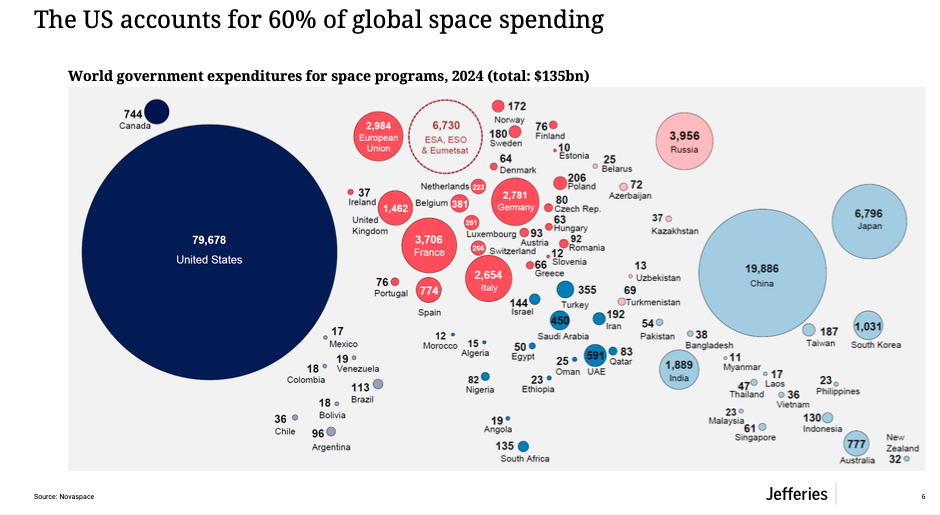
2. The US accounts for 60% of global government spending on space; China ranks second. US government space spending is ~$80bn, more than the rest of the world combined. China spends ~ $20bn, but this figure is not PPP-adjusted, meaning its effective spending power is materially closer to the US than the nominal gap implies. Japan is a notable third player, having designated space as one of Prime Minister Takeshi's 17 strategic sectors (see here & here). China has similarly identified space as a strategic area in its 15th Five-Year Plan (see here & here).
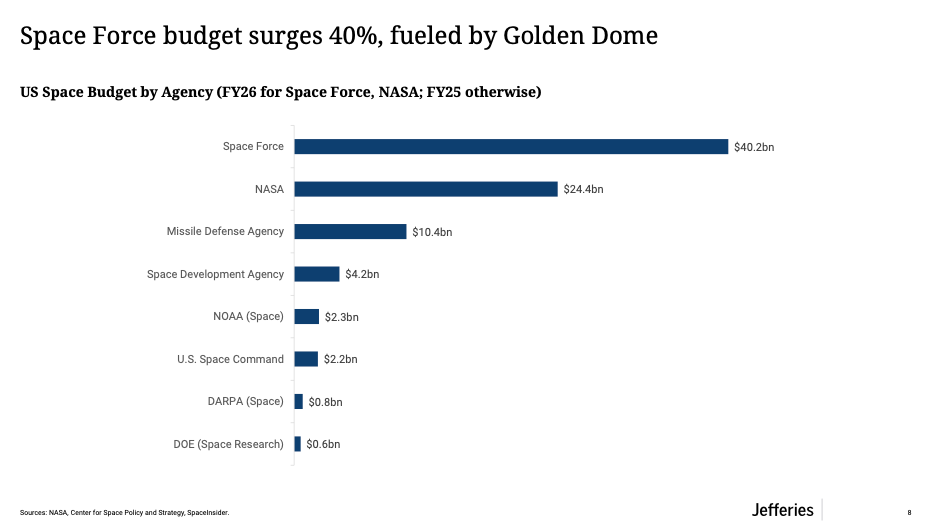
3. Space Force budget surged 40% in one year, fueled by the Golden Dome program. Golden Dome is a top strategic priority driving the budget surge. Golden Dome is a multi-layered missile defense initiative that integrates space-based sensors, interceptors, and AI-enabled command and control to address ballistic, hypersonic, and cruise missile threats. Space Force now commands ~$40bn and the Missile Defense Agency ~$10bn, totaling ~$50bn, far exceeding NASA's budget ($24.4bn).
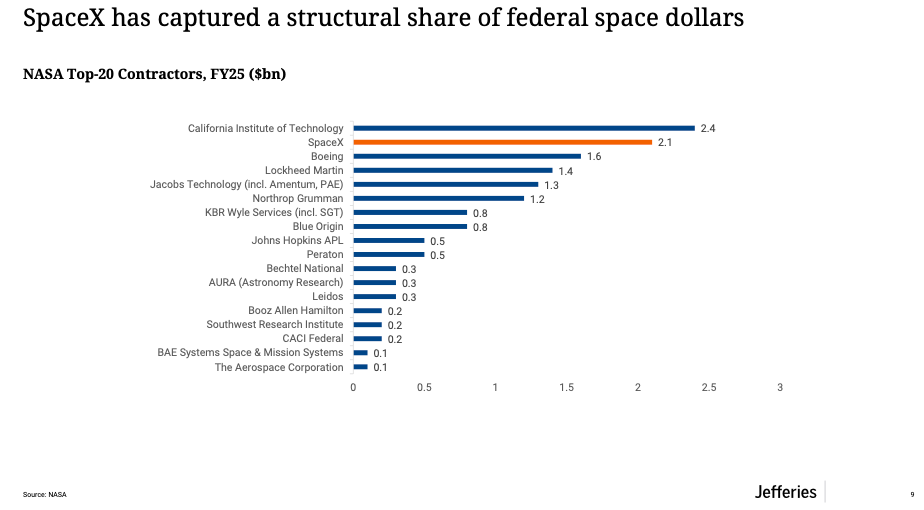
4. SpaceX has captured a structural share of federal space dollars. It is NASA's largest commercial contractor and plays a critical role across launch services, communications, IT, and the broader data layer of the space architecture. The US government has effectively outsourced significant space activity to SpaceX, creating an inextricable linkage between federal spending priorities and the company's business.
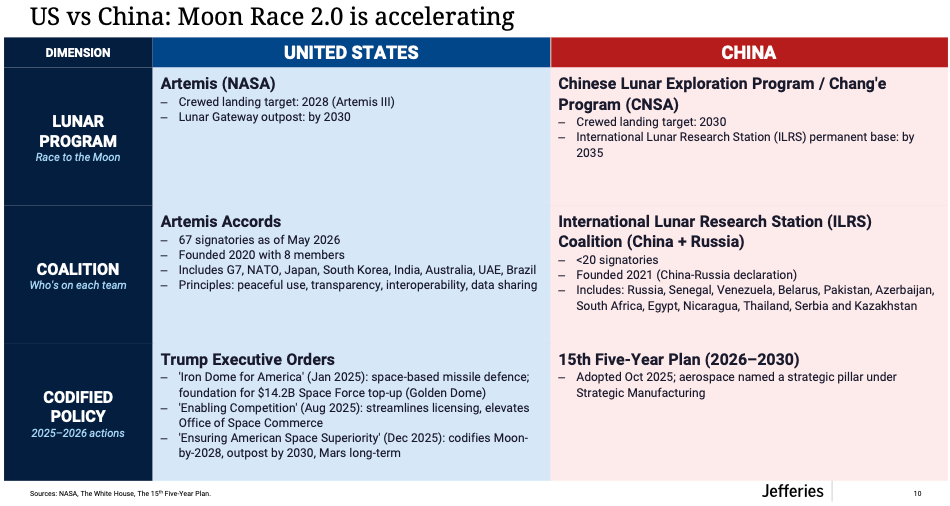
5. US vs China: Moon Race 2.0 is accelerating. The rivalry plays out across three dimensions: lunar programs, global coalitions, and codified policies.
- Lunar programs: The US targets a crewed lunar landing by 2028 and a lunar outpost by 2030; China targets a crewed landing by 2030 and an outpost by 2035.
- Global coalitions: The US-led Artemis Accords have 67 signatories, while the China-Russia International Lunar Research Station coalition has <20.
- Codified policies: President Trump has issued executive orders on Iron Dome for America, commercial space competition, and ensuring US space superiority. China's 15th Five-Year Plan also prioritizes space competitiveness.
Now, let's visualize where the space industry is headed into the 2030s:
The global space economy has reached $600bn
The space economy is set to triple to $1.8trn by 2035
The US accounts for 60% of global space spending
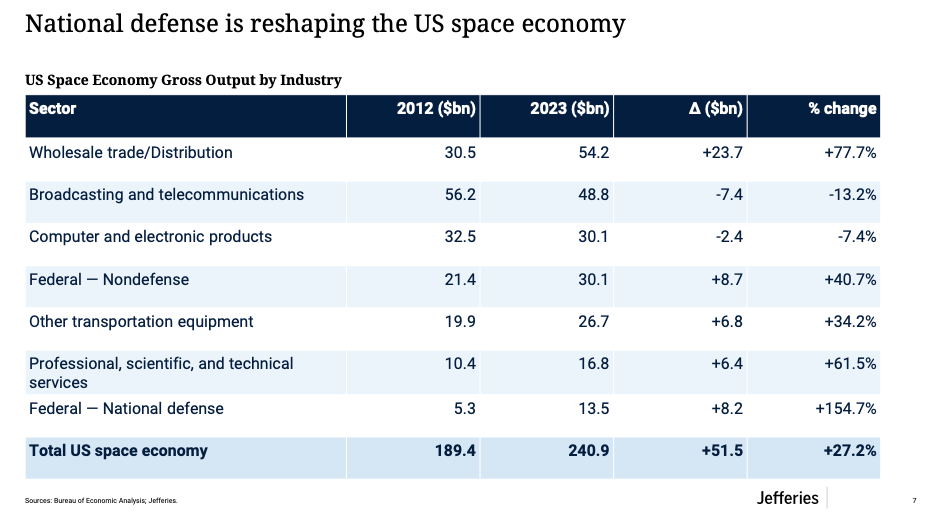
National defense is reshaping the US space economy
Space Force budget surges 40%, fueled by Golden Dome
SpaceX has captured a structural share of federal space dollars
US vs China: Moon Race 2.0 is accelerating
Professional subscribers can read more on the space industry here at our new Marketdesk.ai portal.
Related Markets
All MarketsMarket data may be delayed. Not financial advice.
Powered by Gab AI
The Story At A Glance
Reading this article now — analysis appears below
💡 AI analysis provides alternative perspectives on current events