Chinese Stocks, Yuan Drop After Dismal Data Dump: Worst Retail Sales Since COVID
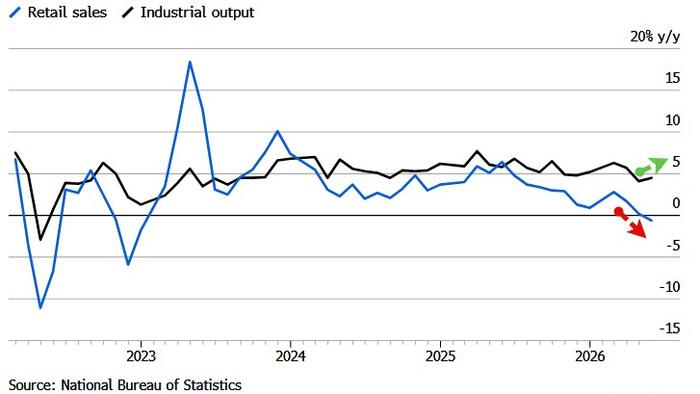
The short version
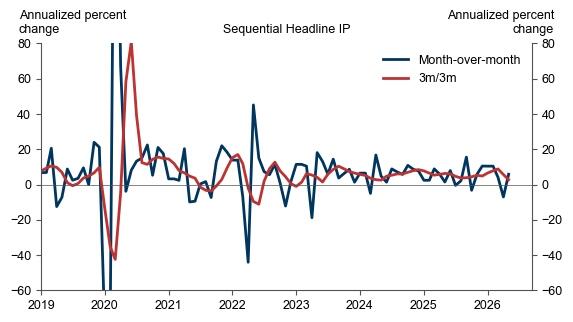
- In sequential terms, IP gained 0.2% mom non-annualized in May based on our estimates (vs. -1.1% mom non-annualized in April).
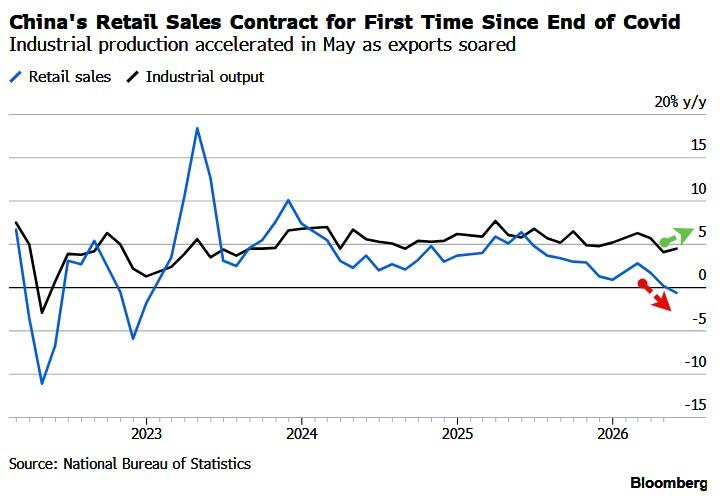
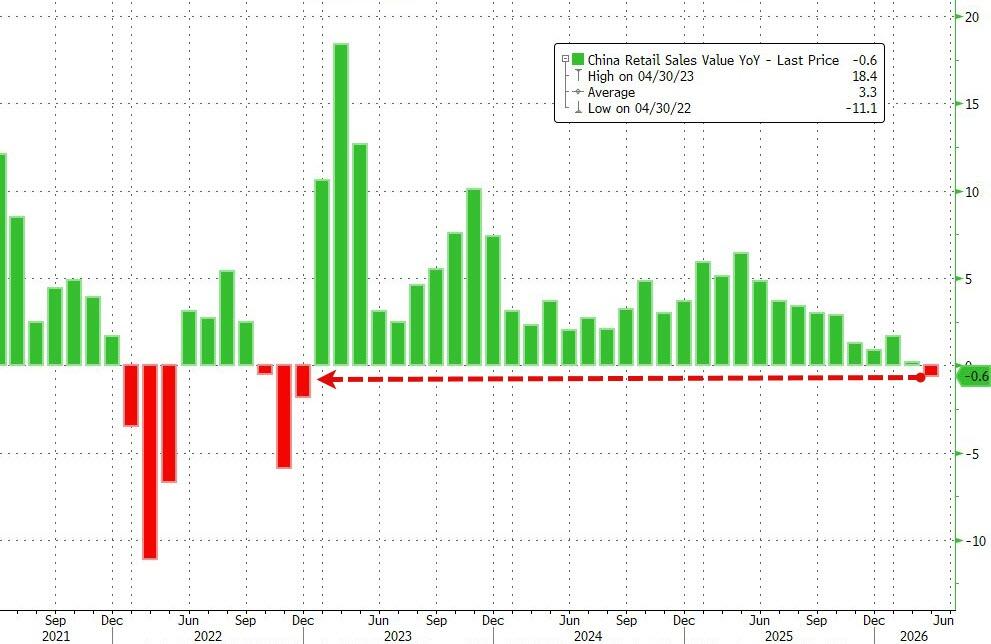
- Retail Sales Nominal retail sales growth continued to slow in May, to -0.6% yoy from +0.2% yoy in April, the lowest since December 2022 (during the COVID exit wave)…
- Under retail sales, big-ticket items led the decline .
- Car purchases, which make up about 8% of the overall figure, plunged 16% in May from a year ago.
- Excluding autos, retail sales grew 1.1% in May.
The story
China’s consumer spending and investment slumped in May to levels unseen since the pandemic, exposing risks for an increasingly two-speed economy, as Bloomberg's Chang Shu and Eric Zhu noted:
"The supply side remains robust, driven by faster-than-expected expansion in exports and AI tech sectors.
The demand side has faltered, with consumption and private non-tech investment plummeting."
Here's the details:
Industrial Production
Industrial production (IP) growth rose modestly to 4.5% yoy from 4.1% yoy thanks to stronger-than-expected exports, although automobile output growth remained weak and the ongoing global energy shock continued to weigh on chemical-related manufacturing output. In sequential terms, IP gained 0.2% mom non-annualized in May based on our estimates (vs. -1.1% mom non-annualized in April).
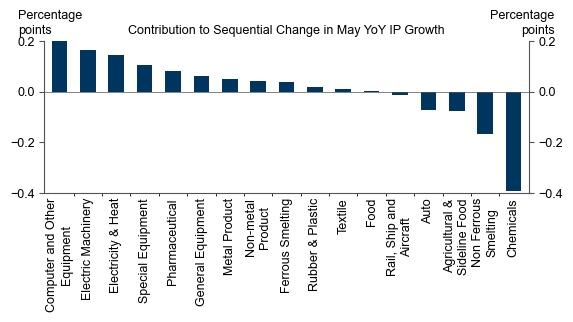
By industry, the April-to-May acceleration in year-on-year IP growth was led by faster output growth in computer & other equipment, electronic machinery, and utilities industries, more than offsetting slower output growth in chemicals and non-ferrous metal smelting industries.
Among major industrial products (different from by-industry breakdown), year-on-year growth in industrial robot output, metal cutting machine output and power generation rose to +27.9%, +10.7% and +4.2%, respectively, in May from +15.1%, +7.5% and +2.6% in April, while automobile, computer and smartphone output growth in year-on-year terms slowed to -3.2%, -19.4% and -8.8%, respectively, from -2.6%, -9.3% and +4.7%.
Retail Sales
Nominal retail sales growth continued to slow in May, to -0.6% yoy from +0.2% yoy in April, the lowest since December 2022 (during the COVID exit wave), with year-on-year growth in goods sales and restaurant sales revenue both weakening.
Under retail sales, big-ticket items led the decline. Car purchases, which make up about 8% of the overall figure, plunged 16% in May from a year ago. Excluding autos, retail sales grew 1.1% in May.
Sales of home appliances as well as construction and decoration materials also contracted at a double-digit pace.
Property
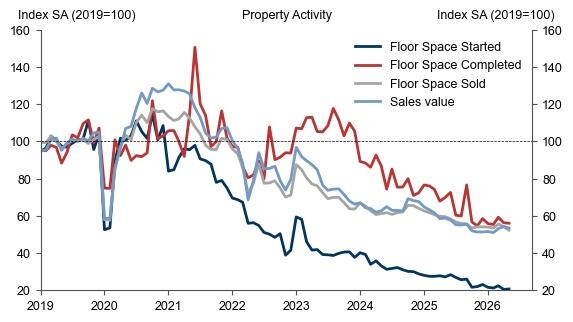
Property activity data remained under pressure in May despite recent green shoots in large cities.
Year-on-year growth in property sales registered -13.1% in volume (floor space) terms and -9.5% in value terms in May (vs. -9.5%/-7.7% in April). New home under construction and completions growth slowed to -12.3% yoy and -19.9% yoy, respectively in May from -12.1% yoy and -18.8% yoy in April. New home starts growth remained depressed at -24.6% yoy in May, despite a modest improvement from -26.6% yoy in April. NBS and private sector data both showed continued downward pressure on home prices in May, mainly in lower-tier cities.
FAI
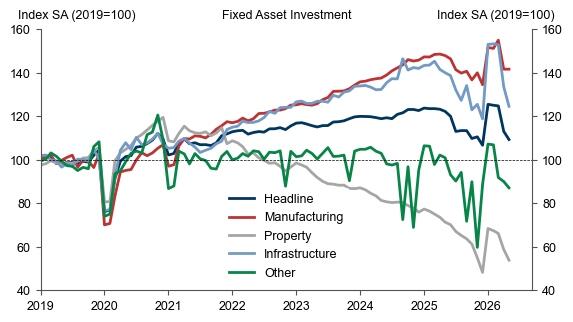
Fixed asset investment (FAI) growth fell further -10.6% yoy in May from -8.2% yoy in April on a single-month basis (Exhibit 3), reflecting both adverse weather conditions (e.g., heavy rainfall in southern and central China and a heatwave in northern China) and a still-slow pace of government bond issuance. This takes year-to-date FAI growth to -4.1% yoy in May (vs. -1.6% yoy in April).
By sector, year-on-year growth in infrastructure, property and other investment (i.e., services and agriculture-related) fell to -11.2%, -24.3% and -13.2%, respectively, in May from -5.6%, -20.1% and -10.6% in April, while manufacturing investment growth improved slightly to -4.1% yoy from -4.8% yoy. That said, we caution that the occasional NBS "statistical correction" of previously over-reported data may have exaggerated the volatility of reported FAI growth in recent quarters, as the year-on-year contraction in crude steel and cement output narrowed modestly in May.
Further evidence emerged indicating a growing divergence in the economy. Investment in high-tech industries expanded 4.5%, with capital expenditure of semiconductor and lithium battery makers up 11% and 25%, respectively.
Labor Market
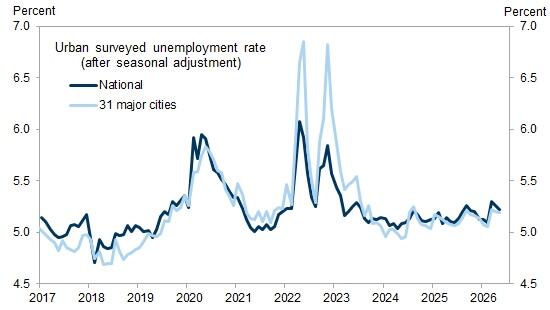
Regarding the labor market, both the nationwide and 31-city unemployment rates (not seasonally adjusted) edged down to 5.1% for May from 5.2% for April.
After seasonal adjustment, we estimate the nationwide unemployment rate inched down to 5.2% in May from 5.3% in April, and the 31-city metric remained flat at 5.2%.
* * *
NBS spokesman Fu Linghui attributed the slump in investment and retail sales to factors including heavy rainfall.
Fu also pointed to last year’s high level of spending driven by subsidies as well as the economy’s transition to new growth drivers.
“Since the second quarter, certain economic indicators slowed because of complex changes in the global environment as well as structural adjustment in the domestic economy,” said Fu in a briefing in Beijing.
“Some companies are facing difficulties. But looking at the overall trend, the momentum of the economy remains overall stable.”
Interestingly, Bloomberg notes that the worse-than-expected slump in retail sales and investment also reignited questions around their accuracy in gauging broader economic health.
The services production index, which inched up to 4.4% on year in May, has a stronger correlation with the pattern of growth in gross domestic product than retail sales, which comprised mostly goods, according to Yu Song, chief China economist at UBS Securities. Inconsistency in the fixed-asset investment data that became apparent last year also mean it might exaggerate the weakness, he said.
“Second-quarter GDP data looks to be weak, but not quite as weak as one would expect from April data,” Song told Bloomberg Television.
Some analysts estimated growth at near 4% in April, tracking below the government’s official full-year target of 4.5% to 5%.
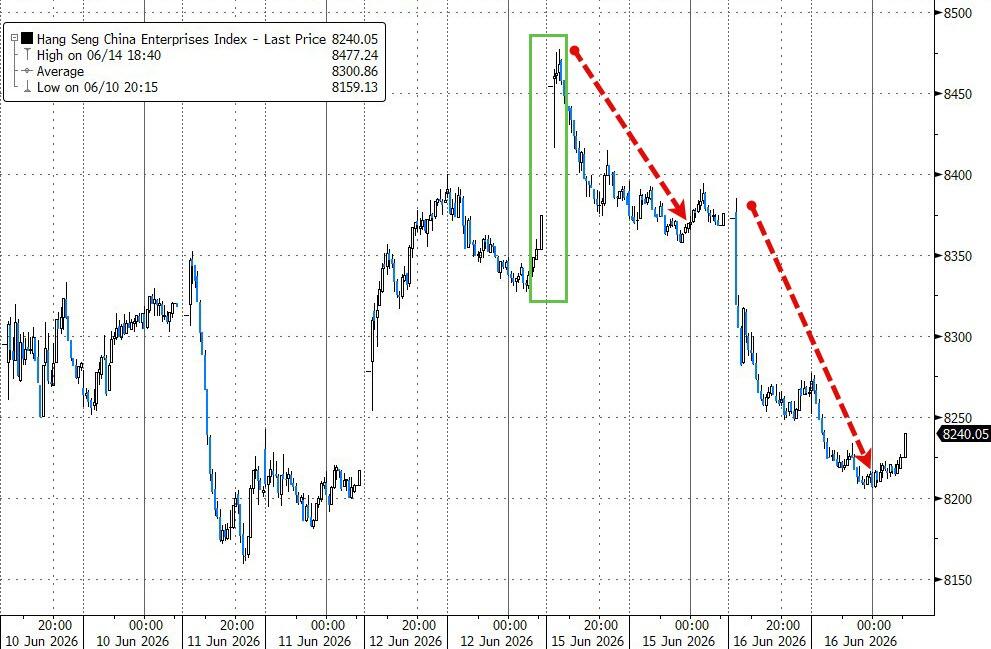
The result of all this was initial yuan weakness (a day after reaching its strongest level since early 2023) and decline in Chinese stocks, but as the session wore on, those initial dips recovered (except for Hang Seng China Enterprises)...
...as the weakness reflexively raises market-watchers hopes for supportive stimulus:
“While there are pockets of strength in tech and export-related industries, the broader economy is still struggling,” said Lynn Song, chief economist for Greater China at ING Bank NV.
“This could eventually add pressure on policymakers to ease policy.”
But without stronger demand at home, the economy is at risk of a deeper slowdown even as the US-Iran deal to reopen the Strait of Hormuz holds out the promise of stabilizing global shipping and energy prices.
Finally, Goldman sees downside risk to their Q2 real GDP growth forecast (4.0% qoq sa annualized and 4.7% yoy currently).
However, the latest development in the Middle East and recent policy communications bode well for a sequential growth improvement in Q3, especially given the significant unused government bond quota left for the remainder of this year.
Goldman sees July as an important window to monitor potential policy fine-tuning: if Q2 GDP disappoints meaningfully, there is a decent chance for policymakers to step up their easing rhetoric in the July Politburo meeting and draw on remaining fiscal buffers quickly to stabilize investment and growth.
Related Markets
All MarketsMarket data may be delayed. Not financial advice.
How this story developed
Full timelineAlto has tracked this across 5 days of coverage from 1 outlet.
- Chinese Stocks, Yuan Drop After Dismal Data Dump: Worst Retail Sales Since COVIDYou are here
Powered by Gab AI
The Story At A Glance
Reading this article now — analysis appears below
💡 AI analysis provides alternative perspectives on current events