Ship Traffic Through Hormuz Chokepoint Continues As Normalization Efforts Remain "Fragile"
The short version
- Still, the diplomatic road to a permanent peace deal remains fragile.
- For now, despite Tehran declaring on Sunday that the Strait was "closed," millions of barrels of crude continue to exit the Persian Gulf through the critical maritime chokepoint.
- Bloomberg reports that five laden oil tankers carrying a combined 8 million barrels were seen entering or moving through the strait along the southern part of the Hormuz near…
- One tanker reappeared hours later in the Gulf of Oman, marking a safe passage.
- The transits suggest CENTCOM's claim that U.S. forces can keep the Omani-side corridor of the maritime chokepoint open, despite Iran's assertion that only the northern…
The story
U.S. and Iranian negotiators concluded a lengthy initial round of technical talks, backed by Qatar and Pakistan, with early progress reported. Still, the diplomatic road to a permanent peace deal remains fragile. For now, despite Tehran declaring on Sunday that the Strait was "closed," millions of barrels of crude continue to exit the Persian Gulf through the critical maritime chokepoint.
Bloomberg reports that five laden oil tankers carrying a combined 8 million barrels were seen entering or moving through the strait along the southern part of the Hormuz near Oman's coast before switching off their transponders. One tanker reappeared hours later in the Gulf of Oman, marking a safe passage.
The transits suggest CENTCOM's claim that U.S. forces can keep the Omani-side corridor of the maritime chokepoint open, despite Iran's assertion that only the northern, Tehran-approved route is permitted.
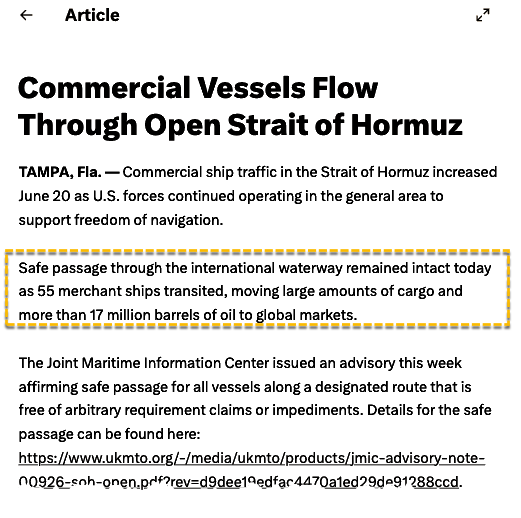
Safe passage through the international waterway remained intact today as 55 merchant ships transited, moving large amounts of cargo and more than 17 million barrels of oil to global markets," CENTCOM wrote on X on Saturday morning.
Kpler:
Hormuz uptick remains fragile
— Kpler (@Kpler) June 22, 2026
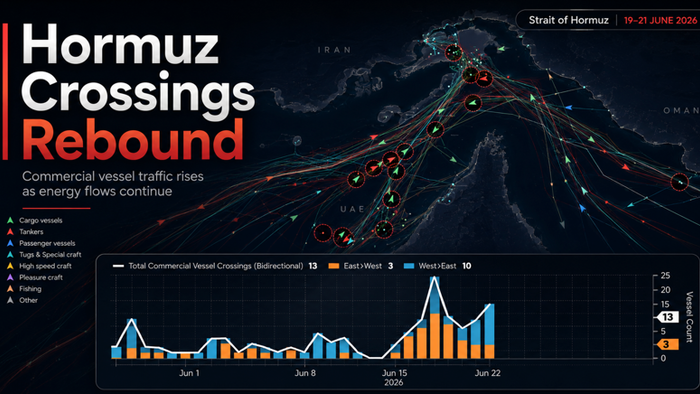
Strait of Hormuz crossings rebounded sharply over 19–21 June, with 71 confirmed transits and a weekend peak of 35 on 20 June, supported by the blockade lift and renewed free-passage signals. Commercial crossings recovered with AIS transponder ons,… pic.twitter.com/2YnT6kTnU3
Windward:
🚨 Strait of Hormuz Status Update | June 22
— Windward (@WindwardAI) June 22, 2026
Windward tracked 25 vessel transits through the Strait of Hormuz over the past 12 hours: 10 inbound and 15 outbound.
Notable traffic:
→ Multiple OFAC-sanctioned tankers linked to Iran's sanctions program transiting outbound,… pic.twitter.com/D4Czk5ygVl
Several India-linked tankers carrying roughly 6 million barrels of Iraqi and Kuwaiti crude appeared to have used the Iran-approved northern route near Qeshm Island, possibly before Iran's latest closure announcement on Sunday.
A separate report from Bloomberg says four liquefied natural gas tankers - either owned or chartered by Qatar - transited the narrow waterway as the restart of Ras Laffan, the world's biggest LNG export plant, begins to ramp up.
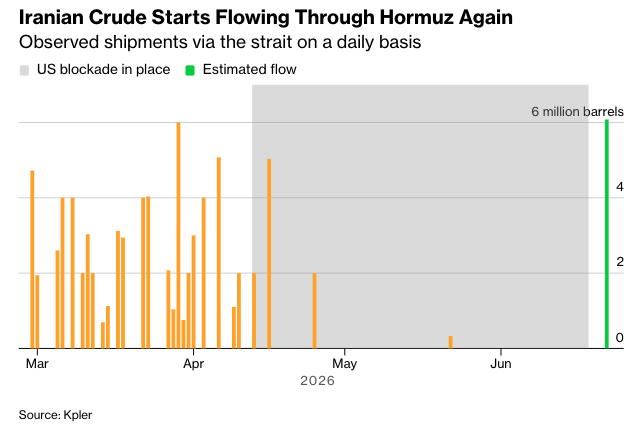
Even Iran has ramped up oil exports, as three US-sanctioned supertankers (Elva, Virgo, and Vigor) entered the Hormuz chokepoint earlier this morning. Those tankers are destined for Singapore, with likely ship-to-ship transfers slated for the end delivery in China. This comes as the US lifts the blockade on the waterway against Iran.
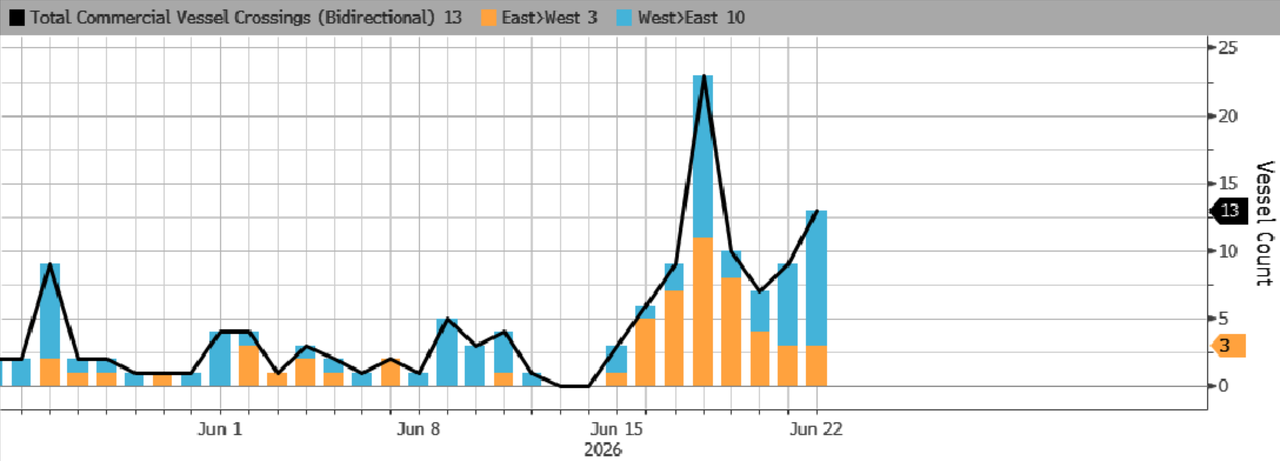
Bloomberg data shows that total ship transits (using AIS data) in the maritime chokepoint, whether east-west or west-east, have steadily increased since an interim peace deal between the US and Iran was signed earlier last week.
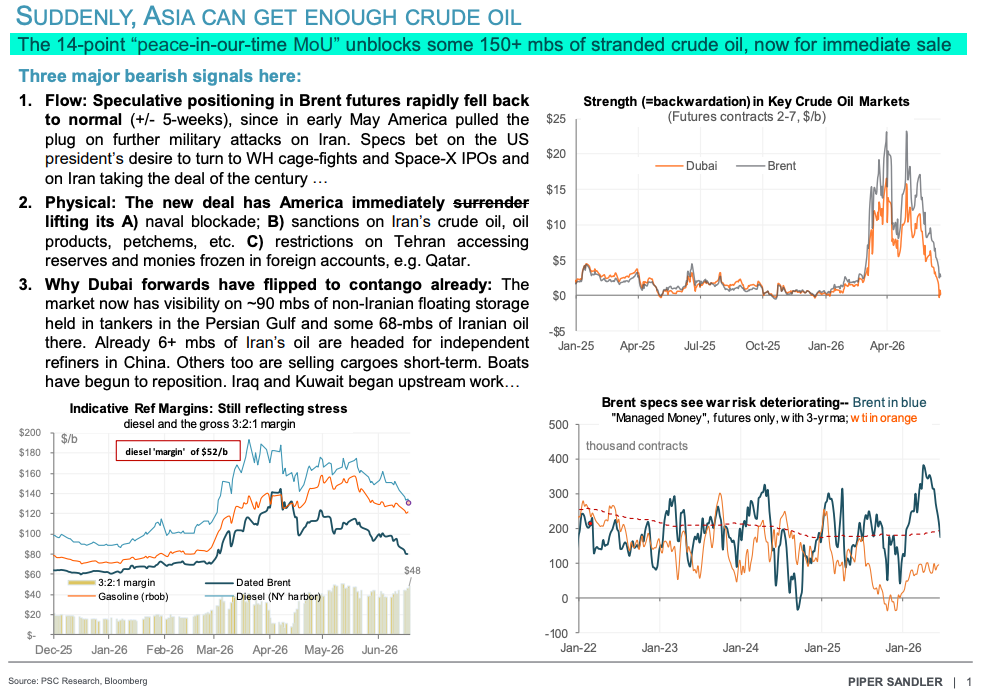
Citi analyst Luis Costa told clients earlier that "the dominant global macro driver remains the US-Iran conflict and its partial resolution. Announcement of the interim Hormuz MOU last week set off a cascading repricing across oil, EM FX, inflation expectations, and rate paths."
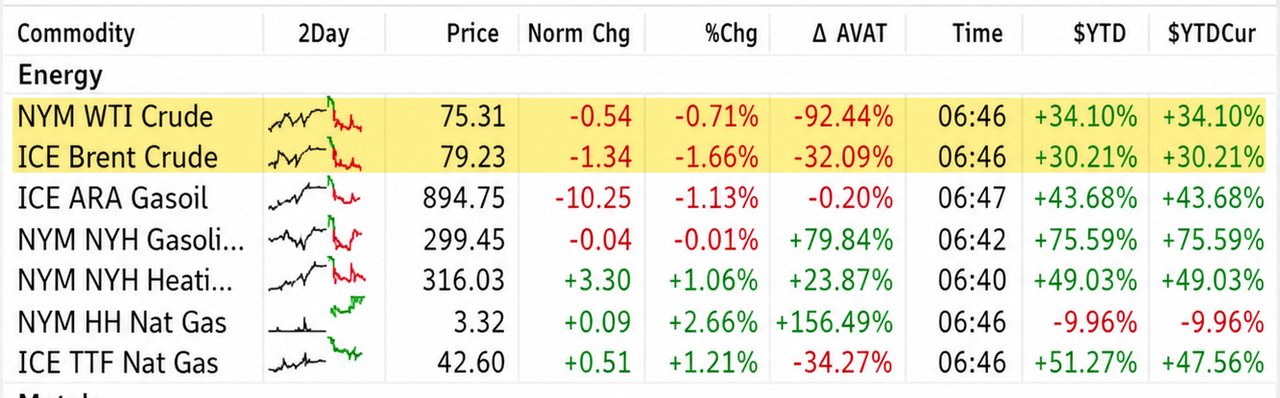
Brent crude futures traded in the $79 a barrel range early Monday, while WTI futures were around $75.
Talk on Hormuz normalization this morning comes from Piper Sandler analyst Jan Stuart: "The 14-point 'peace-in-our-time MoU' unblocks some 150+ million barrels of stranded crude oil, now available for immediate sale."
Related:
On Friday, Daan Struyven, Goldman Sachs' co-head of Global Commodities Research, told clients, "We now assume that Persian Gulf exports normalize to pre- war levels by the end of July."
Related Markets
All MarketsMarket data may be delayed. Not financial advice.
How this story developed
Full timelineAlto has tracked this across 7 days of coverage from 1 outlet.
- Ship Traffic Through Hormuz Chokepoint Continues As Normalization Efforts Remain "Fragile" You are here
Powered by Gab AI
The Story At A Glance
Reading this article now — analysis appears below
💡 AI analysis provides alternative perspectives on current events