China Sanctions 10 US Defense, Rare Earth Firms, Restricts 46 From Govt Procurement Weeks After Pentagon Blacklist
The short version
- More notably, the inclusion of critical rare earth players like MP Materials and USA Rare Earth underscores Beijing's willingness to weaponize its monopoly over the global magnet…
- A spokesperson for the Ministry of Commerce said the decisions were made in response to “malicious actions” by the US government…
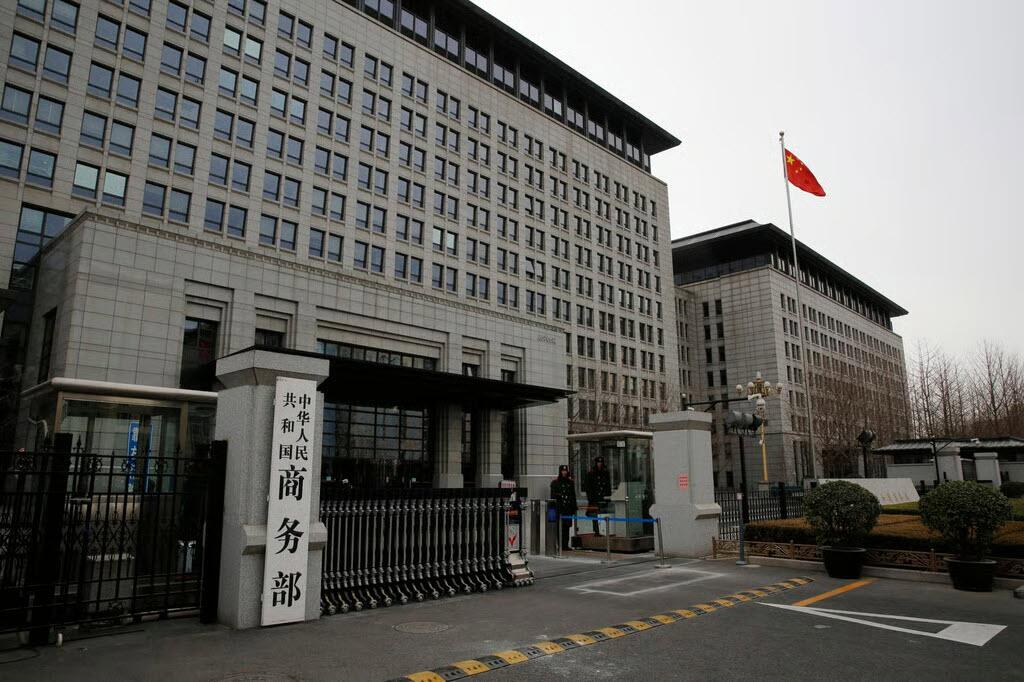
- China’s Ministry of Commerce in Beijing.
- Photo: EPA-EFE/File photo “China has decided, in accordance with the relevant laws and provisions… to include Aveox…
- The export of dual-use items to these entities is prohibited, and no export operators shall violate the above provisions,” said the commerce ministry spokesperson.
The story
China said on Monday that it will add 10 American firms to its export control list, including two rare earth firms MP Materials and USA Rare Earth, while also restricting 46 US firms from government procurement, signalling it would respond to Washington’s recent expansion of a military blacklist, even amid a broader stabilization of bilateral ties, the SCMP reported.
The Ministry of Commerce said in a statement on Monday that the 10 American firms to be added to the export control list were
- AVEOX (Simi Valley, California)
- Red Cat Holdings and Teal Drones (South Salt Lake, Utah)
- IMSAR (Springville, Utah)
- Jaia Robotics (Bristol, Rhode Island)
- Ball Aerospace & Technologies (Broomfield, Colorado)
- Oshkosh Defense (Oshkosh, Wisconsin)
- L3Harris Maritime Services (Norfolk, Virginia)
- MP Materials (Las Vegas, Nevada)
- USA Rare Earth (Stillwater, Oklahoma)
It's notable that China's commerce ministry had already imposed curbs on a number of these listed firms and their subsidiaries, both in 2024 and 2025 over US arms sales to Taiwan. More notably, the inclusion of critical rare earth players like MP Materials and USA Rare Earth underscores Beijing's willingness to weaponize its monopoly over the global magnet and rare earths supply chains.
A spokesperson for the Ministry of Commerce said the decisions were made in response to “malicious actions” by the US government, after the US Department of Defence expanded its list of “Chinese military companies”.
“China has decided, in accordance with the relevant laws and provisions… to include Aveox, Inc. and nine other US military-related entities on the export control list. The export of dual-use items to these entities is prohibited, and no export operators shall violate the above provisions,” said the commerce ministry spokesperson.
Analysts said that the measures from both sides so far were unlikely to significantly derail relations, though they also warned of the impact from any escalation.As we reported, on June 9, the Pentagon said it was adding dozens of Chinese companies - including tech giants Alibaba and Baidu - to a list of entities it says were linked to China’s military, widening a blacklist perceived as targeting sectors at the heart of US-China technological competition. The designation cut the firms off from US defense procurement; however, Baidu had quickly shot back, calling the suggestion that it is a military company "totally baseless".
So the U.S. publishes a list of Chinese Military Companies—which imposes no sanctions or restrictions on those companies, it’s just a list—and China responds with actual export controls on multiple U.S. companies. Seems like a good time for Commerce to issue the Entity List… https://t.co/3JIAMuWVfK
— Chris McGuire (@ChrisRMcGuire) June 22, 2026
The commerce ministry cited provisions of China’s laws on export control of dual-use items - products with both civilian and military applications - as well as the need to safeguard national security and fulfill "international non-proliferation obligations."
Specifically, export operators are prohibited from shipping dual-use items to the 10 firms. Organizations and individuals from any country or region are also prohibited from transferring or providing any dual-use item that originated in China to these businesses.
The notice mandated that any export currently under way that falls under the law must be stopped immediately.
Taiwan remains a sticking point in this tense ongoing diplomatic and defense tug-of-war, but Rubio has still lately confirmed that a proposed $14 billion arms package to Taiwan remains "under review" - in the wake of fierce Beijing objections.
According to the Wall Street Journal, here what was likely behind Beijing's calculus:
China’s actions on Monday “likely serve to build leverage for China in the ongoing negotiations with the U.S.,” said Henry Gao, a trade expert and professor of law at Singapore Management University. “In terms of the trade truce, this development introduces additional friction, but it does not necessarily derail the process.”
MP Materials, which enjoys financial backing from the Pentagon, is a leading U.S. miner and processor of rare earths. Although USA Rare Earth is less established as a player in the emerging industry, both companies are aggressively ramping up capacity in an attempt to break China’s stranglehold over the global supply chain of the key materials. MP Materials and USA Rare Earth didn’t immediately respond to a request for comment.
Meanwhile, the Chinese Ministry of Finance also released a statement saying it would restrict 46 US firms from government procurement, excluding those involved in China-based US-Sino joint ventures, effective immediately. The list of 46 US companies includes Lockheed Martin, Raytheon Missiles & Defence, General Atomics Aeronautical Systems, BDS (Boeing Defence, Space & Security), General Dynamics Land Systems and Javelin Joint Venture, a 50-50 partnership between Lockheed Martin and Raytheon.
Cameron Johnson, a partner at Shanghai-based consultancy Tidalwave Solutions, said the move is Beijing’s “brushback pitch” – a warning against other possible sanctions on China or its firms.
“This is a reaction to the US’ recent blacklisting by the Pentagon,” he said. “This also serves as a warning against any possible sanctions, such as ones targeting China’s open-source AI tools that are currently being discussed in the US.”
Johnson said that more trade sanctions were likely from both the US and China, as both countries attempt to increase leverage before President Xi Jinping’s visit to the US in September.
“So when they meet, they can use these measures as chips at the bargaining table,” he said.
Earlier this month, the Pentagon added technology giant Alibaba Group Holding, electric vehicle makers BYD and Nio, search engine Baidu, robot maker Unitree Robotics, networking equipment maker TP-Link and other Chinese companies in artificial intelligence, biotechnology and the solar sector to a list of “Chinese military companies”.
The designation, under Section 1260H of the National Defence Authorisation Act, can complicate firms’ access to US capital markets and government business, although it does not automatically trigger sanctions. Observers also said “reputational stigma” could affect the Chinese firms involved, and that the move could pave the way for tougher sanctions by the US.
For China, Johnson said the top leadership was also continuing to expand its export controls to blunt the impact from the US, particularly in non-proliferation compliance or in relation to activities or commodity trading it sees as detrimental to China and its companies.
Xin Qiang, a professor and deputy director of the Centre for American Studies at Fudan University, said Beijing was making it clear it would fight back against trade sanctions or designations, but that the ball is now in the US’ court.
“Beijing is making it clear it’s not afraid of tactical confrontation” he said.
Xin, however, warned that any further escalation could cast a pall over Xi’s planned September trip to the US.
“I think the next step will likely depend on whether the US continues to introduce new sanctions or confrontational measures. If so, China will certainly retaliate. If this falls into a vicious cycle, the impact will be extremely negative.”
Related Markets
All MarketsMarket data may be delayed. Not financial advice.
Powered by Gab AI
The Story At A Glance
Reading this article now — analysis appears below
💡 AI analysis provides alternative perspectives on current events