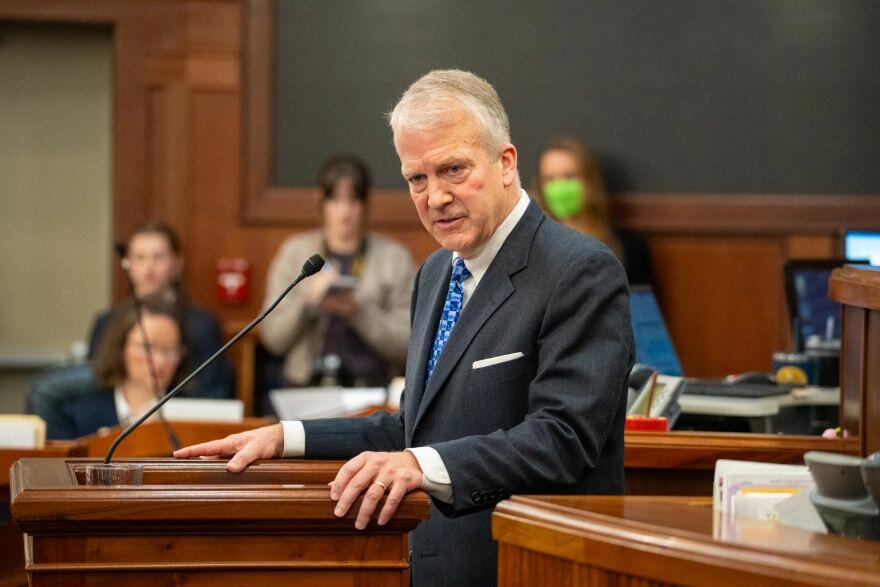
Alaska Judge Overrules Election Officials, Lets 'Fake' Dan Sullivan Stay On Ballot
.jpg?h=19bf863c&itok=VKQ8NywS)
The short version
- Senate primary ballot after he was accused of being a deliberate spoiler and struck from the ballot.
- Dan Sullivan of Petersburg announced his campaign for the U.S.
- Senate on May 29 to challenge incumbent U.S.
- Dan Sullivan. (Photo courtesy of Dan Sullivan) Superior Court Judge Thomas Matthews ruled late Friday that the Alaska Division of Elections had no legal right to disqualify Daniel…
- The Division had yanked him on June 15, calling his filing a sham designed to confuse voters and tilt the race toward Democrat Mary Peltola in November.
The story
A retired elementary school teacher from Petersburg just punched his ticket back onto Alaska's Republican U.S. Senate primary ballot after he was accused of being a deliberate spoiler and struck from the ballot.
Superior Court Judge Thomas Matthews ruled late Friday that the Alaska Division of Elections had no legal right to disqualify Daniel J. Sullivan Jr. The Division had yanked him on June 15, calling his filing a sham designed to confuse voters and tilt the race toward Democrat Mary Peltola in November. Matthews said the state basically invented a "good faith" test that doesn't exist in the U.S. Constitution, Alaska statutes, or the Division's own rules - and that's a problem when you're talking about a federal office.
In the Friday night ruling, the judge determined Dan J. Sullivan, a retired teacher from Petersburg, is an eligible candidate for U.S. Senate and that the division shall include his name on the August 18 primary ballot.
The division’s decision to disqualify Sullivan because it determined his candidacy was not filed in “good faith” was unconstitutional, Superior Court Judge Thomas Matthews ruled. “The director’s assertion that Mr. Sullivan seeks to confuse or misguide voters is not supported by a preponderance of evidence,” he wrote. -Alaska Beacon
The U.S. Constitution sets only three qualifications for senator: age, citizenship length, and state residency. States can't tack on extra hurdles, especially subjective ones about someone's motives. The judge noted the Division accepted Republican complaints at face value while brushing aside Sullivan's explanations, and he pointed out that practical fixes like printing middle initials (Dan J. versus Dan S.) exist if name similarity is the real worry.
What set this off
Sullivan, a former U.S. Forest Service employee who taught fifth grade in Petersburg, filed May 29 as a Republican. He shares the incumbent senator's first and last name - a coincidence he's called a "matter of fate." Election officials and GOP groups zeroed in on several red flags: he'd recently switched his registration to Republican, having spent decades with the now-defunct Alaskan Independence Party until it dissolved late last year; his campaign materials and website looked similar to the incumbent's; and he'd worked with a political consultant, Amber Lee, whom Republicans flagged as a longtime supporter of Democratic candidates. Officials also seized on the fact that he first emailed the Division asking to appear on the ballot as "Dan S. Sullivan" - the senator's exact name, down to the middle initial - before switching the request to "Dan J." They argued the whole package was meant to siphon votes in a primary that could decide whether Sen. Dan Sullivan faces a tougher general election.
The opposition came from the top: Lt. Gov. Nancy Dahlstrom opened an investigation, the Alaska Republican Party filed formal complaints, and the National Republican Senatorial Committee referred Sullivan to the Federal Election Commission, claiming his candidacy broke federal law.
Sullivan's response was straightforward: he's unhappy with the incumbent's record after 12 years and wants to give voters another choice. He says he followed every rule, paid the fees, and met the qualifications - and he flatly rejects the idea that he's a Democratic plant. Asked by the Associated Press whether he'd had any contact with Peltola's campaign, he said "zero, none, zilch." Peltola's camp and state Democrats have denied the spoiler accusation too, and when the Division actually pulled him, it didn't point to any proof of coordination - it rested the call on his supposed lack of "good faith." His small Southeast Alaska hometown has largely rallied behind him.
Matthews didn't buy the Division's claim that it had broad power to police "ballot fairness" by removing candidates it disliked. He ordered Sullivan's name on the August 18 primary ballot. The state immediately moved to appeal to the Alaska Supreme Court, which has until Tuesday to settle the matter - right up against the deadline for printing ballots.
For now, the "other" Dan Sullivan stays in. Alaskan voters might have to do a little extra homework to tell the two apart, but the judge made clear that's not grounds to disqualify someone who otherwise qualifies.
Related Markets
All MarketsMarket data may be delayed. Not financial advice.
Powered by Gab AI
The Story At A Glance
Reading this article now — analysis appears below
💡 AI analysis provides alternative perspectives on current events