Deflation Is Not The Villain - The Overleveraged Fiat System Is
.jpg?itok=gl85r9YH)
The short version
- While mainstream economists, the financial media, academia, and other gatekeepers of the rotten fiat currency system howl about the dangers of deflation…
- First, it is important to define our terms.
- The correct and true meaning of inflation is an increase in the money supply.
- So the correct and true meaning of deflation is a decrease in the money supply.
- But that is not what most people mean when they refer to deflation, because the money supply rarely contracts in a fiat monetary system.
The story
Authored by Nick Giambruno via International Man,
It is important to clarify something here.
While mainstream economists, the financial media, academia, and other gatekeepers of the rotten fiat currency system howl about the dangers of deflation, it is worth taking a moment to consider whether it is really such a bad thing.
First, it is important to define our terms.
The correct and true meaning of inflation is an increase in the money supply. So the correct and true meaning of deflation is a decrease in the money supply. But that is not what most people mean when they refer to deflation, because the money supply rarely contracts in a fiat monetary system. When most people say deflation, they mean a general fall in prices.
One of the biggest popular misconceptions in economics is that a general fall in prices is a "bad thing."
It is an enormous misnomer. Falling prices caused by increases in productivity are actually a good thing. Who does not want to see their money go farther?
Technology is naturally deflationary. It drives down costs, increases efficiency, and makes goods and services cheaper over time.
In an honest monetary system, that would mean falling prices and rising purchasing power. In other words, your money would buy more as technology advances.
But that is not how the current system is designed to work. In fact, it does the opposite. It is like running on a treadmill that keeps accelerating.
In a fiat currency system, deflationary increases in productivity are more than offset by inflation, which benefits people who own stocks, houses, and other assets that rise with inflation, and hurts those who depend on wages denominated in the debased currency.
In short, in a fiat currency system, the benefits of deflationary technology primarily accrue to asset holders, because the forced inflation created by central banks pumps up asset values.
If we were living under an honest, hard-money monetary system, where the benefits of technology would not be offset by central banks debasing the currency, those gains would accrue more evenly across the population.
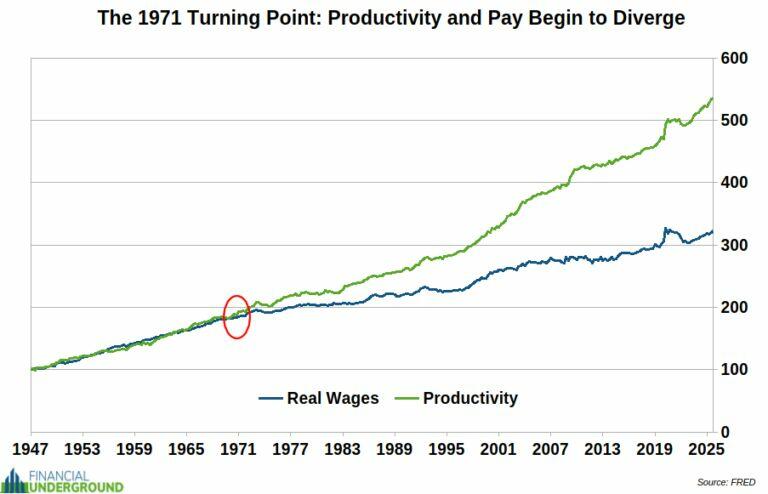
That is why I think the chart below is instructive.
It is a long-term view of real wages versus productivity.
The two tracked together well for decades, showing that as productivity increased, real wages did too. In other words, most people benefited from increases in productivity through higher real wages.
Then something changed around 1971, when that strong positive correlation broke. It was the year the US government cut the dollar's last link to gold and the dollar became a pure fiat currency.
Since 1971, there has been a growing gap between productivity and real wages.
If you could transport yourself back to the early 1970s, just as the divergence between productivity and real wages began, and ask people what they thought 2026 would look like, they might have said something like The Jetsons - flying cars, advanced technology, and a society in which everyone was better off.
They probably would not have believed you if you told them that, in reality, people would be worse off in many ways in 2026 than they were in the early 1970s, despite enormous technological progress. We may not have flying cars or The Jetsons, but there have still been significant advances. Yet people's standard of living has declined in many ways.
Today, many people are bewildered by how people could be worse off now than they were then. The answer is in this chart, which shows that the fiat system and currency debasement are the problem.
Despite advances in technology, the shocking level of currency debasement has not merely kept pace with the natural deflation that comes from increased productivity, but has vastly outpaced it... which is why people are, in many ways, worse off today than they were in the early 1970s. That prosperity has been stolen by inflation and fiat currency.
Since 1971, productivity has continued to increase, largely thanks to advances in technology, but those gains have not translated into growth in real wages as they had in the past under an honest money system. That is because under a fiat currency system, the central bank - the Federal Reserve - has created significantly more inflation than the gains in productivity, which meant real wages did not keep up.
However, those productivity gains from advancing technology did not just disappear. They were redirected somewhere else. They accrued primarily to asset holders, as wage earners chased rapidly depreciating fiat currency.
In short, the fiat currency system is a mechanism for transferring wealth created by technological productivity gains to asset holders and politically connected insiders closest to the money printer.
Frankly, it is a disgusting, dishonest system that operates at the expense of honest people.
But that is the nature of the monetary system we are all forced to live under. And it is wise to acknowledge it, understand it, and take action to protect yourself.
And now, with AI bringing a mind-bending level of productivity gains, this dynamic is about to go into overdrive.
I suspect we will see the gap in the chart above explode even further as AI, and future breakthrough technologies, produce the biggest productivity gains in human history, even as the US government is forced to create the largest amount of inflation in history to try to keep the debt-ridden fiat system going in the face of this historic disruption.
In other words, as technology becomes exponentially more deflationary and debt grows exponentially larger, the central bank's response will have to become exponentially more aggressive.
That means more debasement of your purchasing power to fight the very force that should be making your life cheaper.
Clearly, you want to be an asset owner in this environment so you can protect yourself from currency debasement and also benefit from tech-driven productivity gains.
But what assets should you own? I will get to that soon.
If we lived under an honest monetary system anchored in hard-to-produce money like gold, I think there would be far fewer worries about AI automation and disruption. That is because we would not live under a debt-ridden fiat system in which the government is forced to debase the currency. That would mean increases in productivity from technology would benefit far more people, as their money would go farther, prices would generally fall, and the cost of living would decline. And the government would not try to offset that with inflation.
In such a world, I do not think AI would be nearly as controversial, because it would be seen as making the average person wealthier by reducing the cost of living.
So technological deflation that increases productivity and lowers prices is most certainly not a bad thing, as the fiat economists would have you believe. It is a wonderful thing and should create more abundance and make most people wealthier... in an honest monetary system.
That is why the whole framing around this issue needs to be challenged. It is not technology that is the problem. It is the fiat currency and the highly leveraged system that is the problem.
It is also why you see charlatans promote things like universal basic income (UBI) as a solution to the supposed AI problem.
The solution to the non-problem of technological increases in productivity is most certainly not a UBI, but rather an honest hard-money monetary system in which everyone generally benefits from increases in productivity - not just asset holders and politically connected insiders closest to the money printer.
Throwing the plebs a few crumbs with a UBI to help prop up a failing debt-based fiat currency scam is not a real solution. But thankfully, there is a real solution.
It starts with understanding the monetary, economic, and political forces driving this crisis - and taking practical steps before the next major wave of instability hits.
The fiat system is already under enormous pressure from sky-high debt, endless money printing, and accelerating technological disruption. The people who understand what is happening will be in a far better position than those who are blindsided by it.
That is why I put together a free special report focused on practical solutions - the top three strategies to help protect your money, preserve your freedom, and prepare for what comes next.
Related Markets
All MarketsMarket data may be delayed. Not financial advice.
How this story developed
Full timelineAlto has tracked this across 2 days of coverage from 1 outlet.
- Deflation Is Not The Villain - The Overleveraged Fiat System IsYou are here
Powered by Gab AI
The Story At A Glance
Reading this article now — analysis appears below
💡 AI analysis provides alternative perspectives on current events