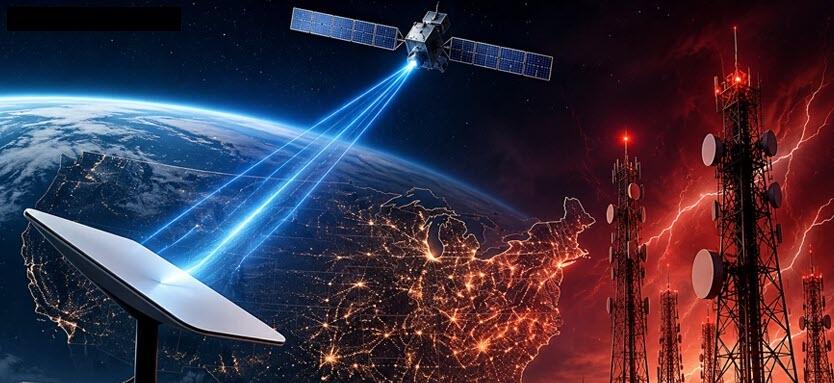
Is The SpaceX Asteroid About To Impact The TelCo & Cable Dinosaurs?
The short version
- Authored by Simon Duff via BondVigilantes.com, SpaceX’s IPO was a gargantuan event by any measure: US$75 billion proceeds raised, over US$2 trillion enterprise value…
- Few other companies can rival its industrial span and potential seismic impact on consumers and competitors.
- SpaceX’s valuation is driven by its sci-fi AI segment replete with space-based data centres and moon bases.
- However, its more immediate impact maybe felt in the more down to earth world of telecom.
- SpaceX’s cash cow is the Connectivity segment where it operates a constellation of 9,600 low earth orbit (“LEO”) satellites under the Starlink brand.
The story
Authored by Simon Duff via BondVigilantes.com,
SpaceX’s IPO was a gargantuan event by any measure: US$75 billion proceeds raised, over US$2 trillion enterprise value, and an almost US$29 trillion total addressable market to feast on. Few other companies can rival its industrial span and potential seismic impact on consumers and competitors. SpaceX’s valuation is driven by its sci-fi AI segment replete with space-based data centres and moon bases. However, its more immediate impact maybe felt in the more down to earth world of telecom.
SpaceX’s cash cow is the Connectivity segment where it operates a constellation of 9,600 low earth orbit (“LEO”) satellites under the Starlink brand.
These provide broadband and in-fill mobile voice & data services to consumers in predominantly remote areas where terrestrial broadband and mobile networks are patchy or absent.
In addition, Starlink offers broadband services to ships and aircraft where terrestrial networks are entirely absent.
In 2025, the Connectivity unit generated US$3 billion free cash flow (EBITDA less capex) from almost 9 million broadband and over 6 million mobile global subscribers and from its corporate contracts with airlines and ship operators.
By way of comparison, the 5 largest US telecom & cable players generated almost US$111bn free cash flow (EBITDA less capex) and had approximately 95m broadband subscribers and 275m mobile postpaid subscribers.
Looking at those stats you would be forgiven for thinking that US telecom & cable operators don’t have all that much to worry about. The problem is that this is just the beginning for controlling shareholder and CEO Musk who has proved himself a visionary with Olympian levels of ambition and matching access to capital.
Using the latest and largest Starship rockets, Musk plans to launch 10,000 next generation V3 satellites from late 2026. Each of these satellites will have 1 terabit of capacity, which is 10x the capacity of the current V2 satellites. This ramped capacity will boost current median download speeds (225Mbps) to levels on a par with fibre and cable terrestrial alternatives. It will also allow pricing to come down (vs the current US$66 average cost per month). True, there are issues around the need for “line of sight” from the dish to the satellite in dense urban areas and practical difficulties around installation in multi dwelling unit (MDU) housing blocks. But these are portions of the market and hence a break rather than a block on roll out and uptake.
Obviously, the incumbent operators will not sit there like lemons waiting to be squeezed. Instead they can try to lock in their bases via converged broadband and mobile bundles, often at a discount (as both AT&T and Verizon’s recent offers implied). Or they can simply cut their standalone broadband pricing. Either way, the risk is broadband subscriber losses, or revenue per subscriber decline, or a combination of both. And this would be in a market that no longer benefits from immigration or housing build tailwinds that historically increased the total available economic pie in the US. Most exposed to this risk are the US’s dominant broadband providers: the cable operators. Both Comcast and Charter equity have fallen approx. 30% & 70% in the last year, respectively, with the pace of decline picking up notably as the SpaceX IPO bandwagon rolled into town.
However, does Musk stop there?
If we can think of an incumbent bundled defensive play then we are pretty darned sure that Musk can too. So how would he counter the incumbents’ counter? In short, by going mobile. At present, the party line from the telecom operators is that Starlink’s “direct to device” (D2D) service is a pure complementary in-fill service to supplement mobile operators’ existing coverage and nothing more. However, their behaviour suggests otherwise. All three players (Verizon, AT&T and T-Mobile) have been clear that they will not offer Starlink a “virtual network” agreement enabling Musk to re-badge and re-sell their mobile service.
Similarly, all three were swift to announce a D2D JV that would enable them to present a united front to Starlink on future negotiations.
Assuming the US mobile players hold this line and are allowed to do so by regulators, then Starlink has two options if it’s serious about offering mobile beyond remote areas: build or buy a terrestrial network. To build its own mobile network Starlink would need spectrum and terrestrial infrastructure (towers, fibre backhaul, network radios). Starlink already has access to 65 Mhz of terrestrial spectrum (different from the spectrum it uses to offer broadband) that was acquired from Echostar. Although dwarfed by the incumbents’ spectrum holdings, Starlink’s network would be relatively empty and upcoming auctions offer the chance to supplement these holdings. Furthermore, Echostar (a 3% SpaceX shareholder) could play a complementary role as either an acquisition target or partner that brings with it a range of network related assets/agreements that could facilitate a Starlink mobile network roll out. Not least of which is a multi-year AT&T national roaming deal that AT&T has been tight-lipped on confirming or denying a change of control break clause to prevent Starlink exploiting this valuable contract.
And Echostar is not the only option. When Musk was recently asked if he could consider buying Verizon he said that “it was not out of the question”. To be clear, Verizon’s market capitalisation is less than 10% of SpaceX’s and also brings with it valuable FCF (YE25: US$20bn). Lastly, we don’t think it is any co-incidence that the rumour mill has been spinning with regard to German incumbent Deutsche Telekom buying out its 54% owned subsidiary, T-Mobile USA. If Musk is going to be on a shopping spree you probably want to own 100% of what he might want to buy and T-Mobile USA offers the best mobile network, deepest mobile spectrum portfolio and the least “redundant” broadband exposure of all the US players. Unfortunately AT&T is probably overly endowed in this latter area with 38m fibre homes passed and hence unlikely to be of interest to SpaceX. All in all, we see the potential for a single mobile player being acquired as cold comfort to the US telcos relative to the potential step change in the competitive dynamic across the broader ecosystem.
And who is best insulated from all this potential disruption?
From an industrial perspective, towers look well positioned.
If the US goes to four networks, demand for space on the towers will increase whilst, if SpaceX acquires an incumbent, tower demand should at least remain steady no matter how squeezed the incumbent operators’ margins become.
From a geographical perspective, a combination of Europe’s lower pricing from years of fierce competition & regulation, SpaceX’s lack of terrestrial spectrum, and Europe’s higher urban and MDU density make it a much harder market to attack.
Ironically, European telcos that have long played second fiddle to their US counterparts on competitive dynamics, growth rates and FCF generation might now heave a sigh of relief and actually be thankful for the harsh regulation and competitive dynamics they previously railed against.
Related Markets
All MarketsMarket data may be delayed. Not financial advice.
Powered by Gab AI
The Story At A Glance
Reading this article now — analysis appears below
💡 AI analysis provides alternative perspectives on current events