US Adds Only 57K Jobs, Missing Estimates, As Unemployment Rate Slides On Plunge In Workers
The short version
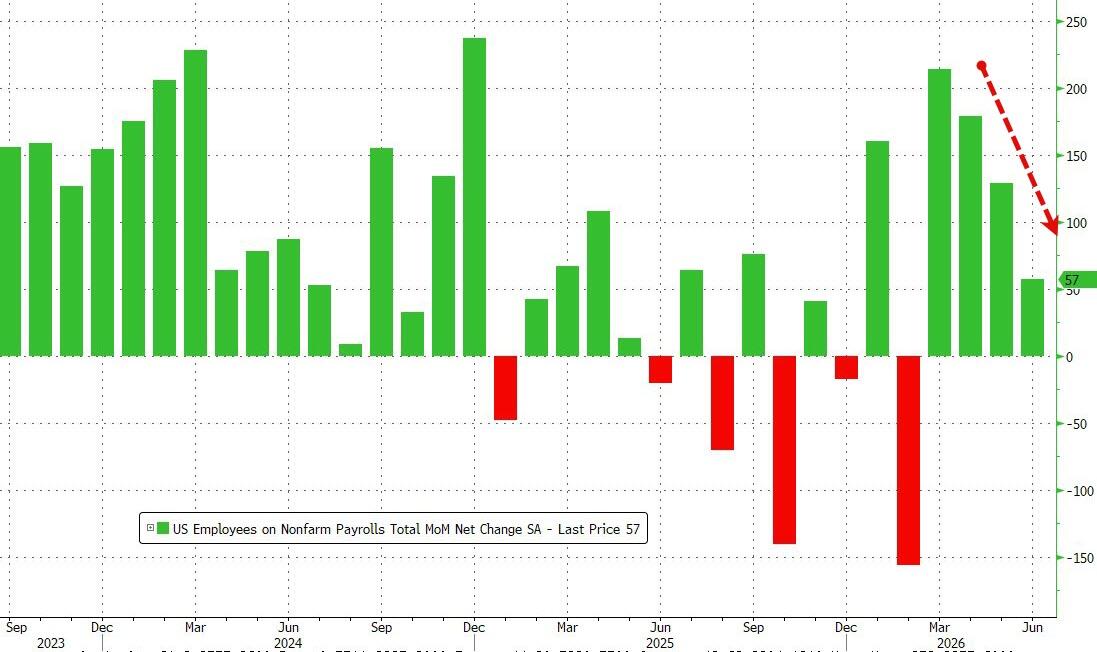
- " Well, they got it because moments ago the BLS reported that in June the US added just 57K workers, half the 113K expected…
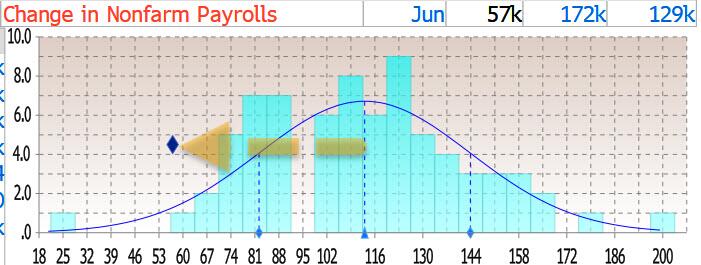
- Except for an outlier 25K forecast from Citi, the jobs print was below all forecasts, a 2 sigma miss to estimates.
- And yes, negative revisions are back: April jobs revised down by 31,000, from +179,000 to +148,000 May jobs revised down by 43,000, from +172,000 to +129,000.
- With these revisions, employment in April and May combined is 74,000 lower than previously reported as Trump once again goes back to using the Biden playbook.
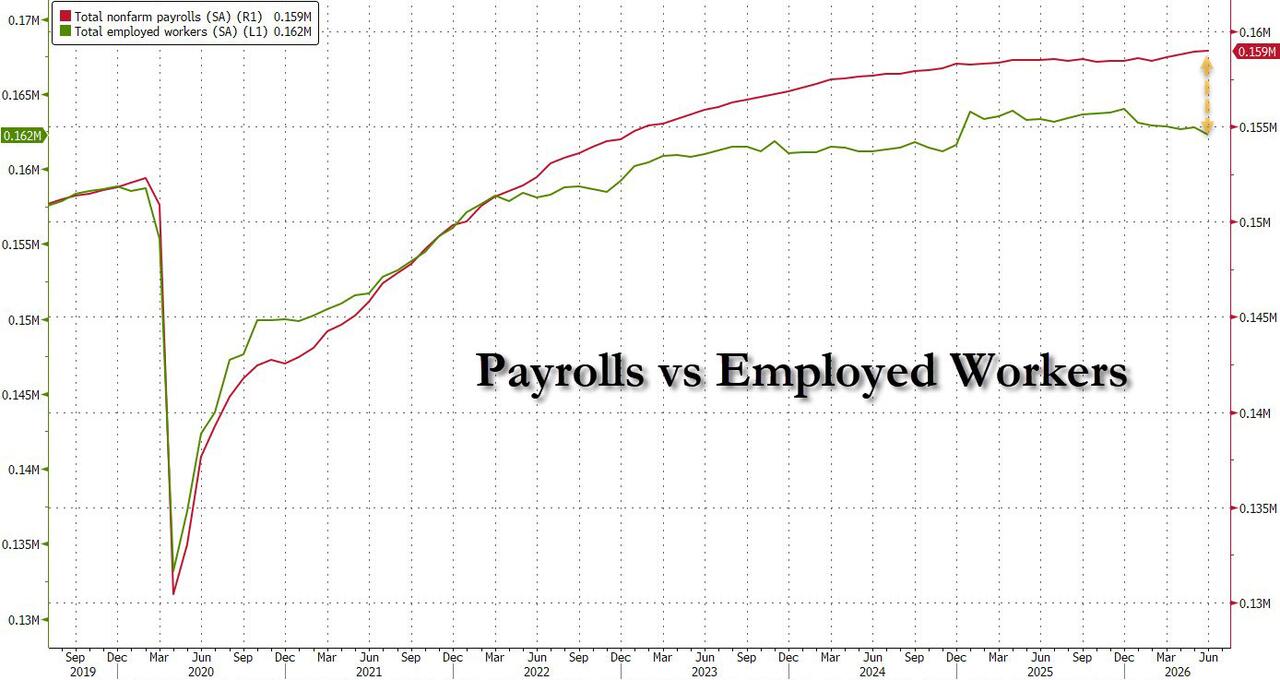
- Remarkably, while the number of payrolls rose by 57K, the number of actually employed people plunged by 507K to 162.264MM…
The story
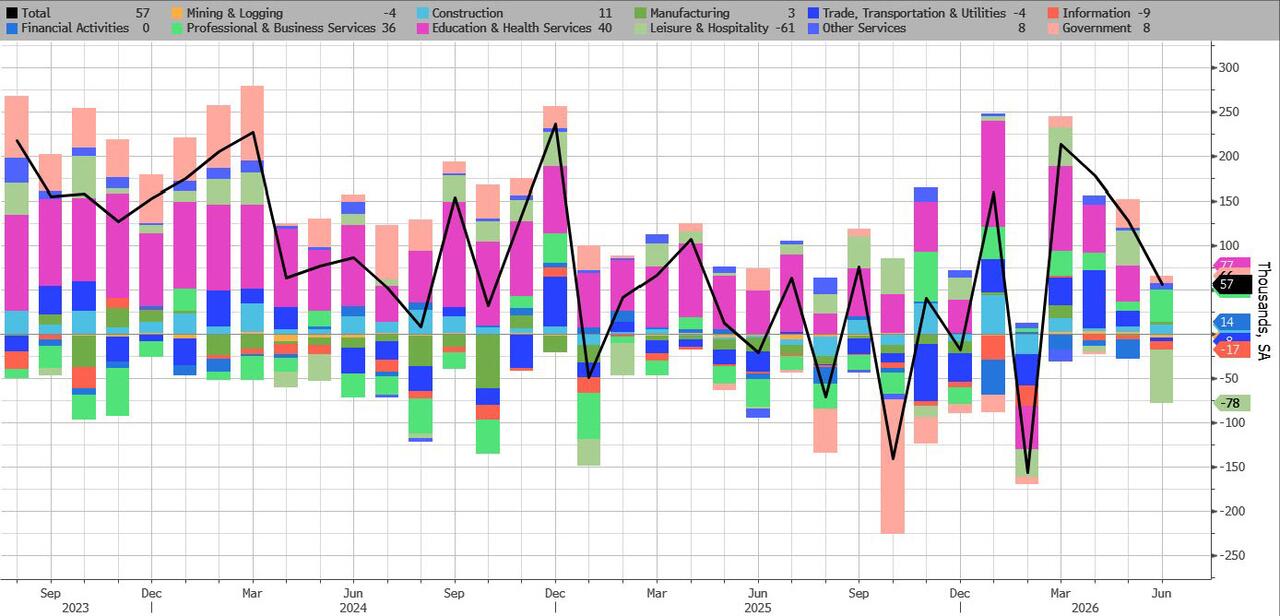
In our jobs preview post we quoted Goldman Delta One head, Rich Privorotsky, who said that "equities marginally want something weaker than consensus: with no forward guidance, hot NFP means hikes in play, which is unfriendly for pockets of equity risk." Well, they got it because moments ago the BLS reported that in June the US added just 57K workers, half the 113K expected, and the worst monthly print since the big February drop.
Except for an outlier 25K forecast from Citi, the jobs print was below all forecasts, a 2 sigma miss to estimates.
And yes, negative revisions are back:
- April jobs revised down by 31,000, from +179,000 to +148,000
- May jobs revised down by 43,000, from +172,000 to +129,000.
With these revisions, employment in April and May combined is 74,000 lower than previously reported as Trump once again goes back to using the Biden playbook.
Remarkably, while the number of payrolls rose by 57K, the number of actually employed people plunged by 507K to 162.264MM, which means the staggering gap between workers and payrolls is once again blowing out.
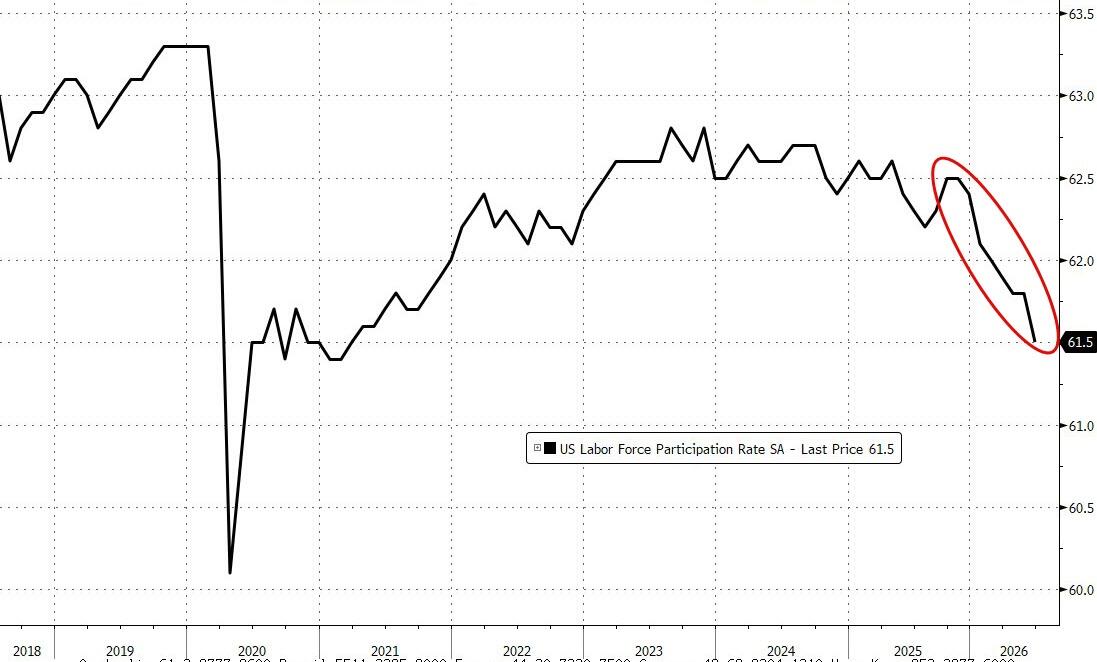
Just as ominously, the labor force participation rate plunged from 61.8% to 61.5%...
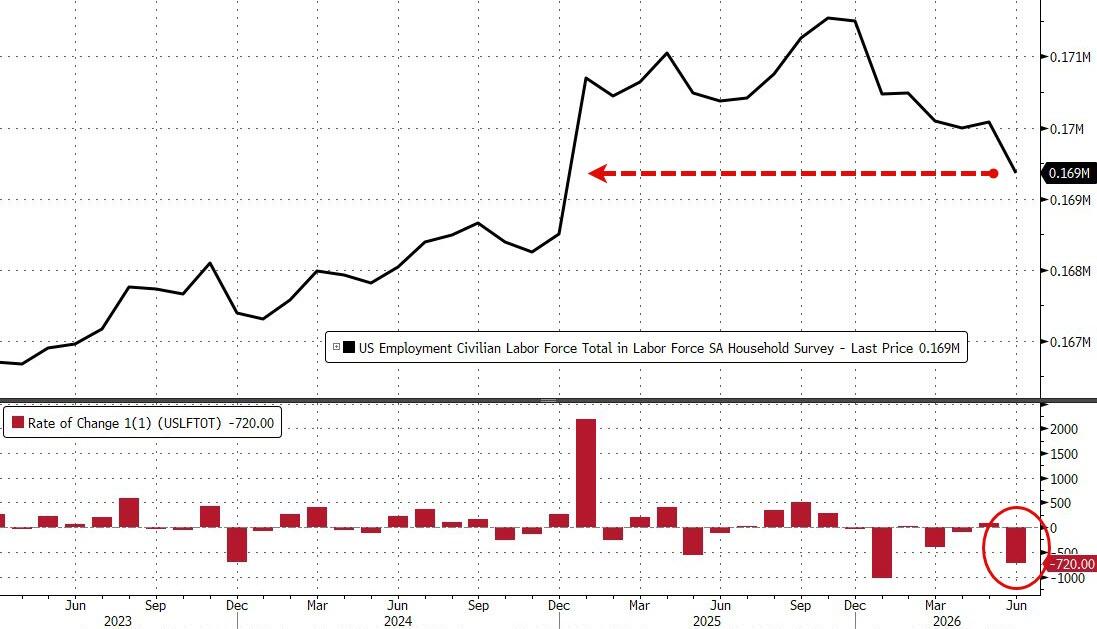
... driven by a massive 720K drop in the civilian labor force, which dropped to 169.358K from over 170 million...
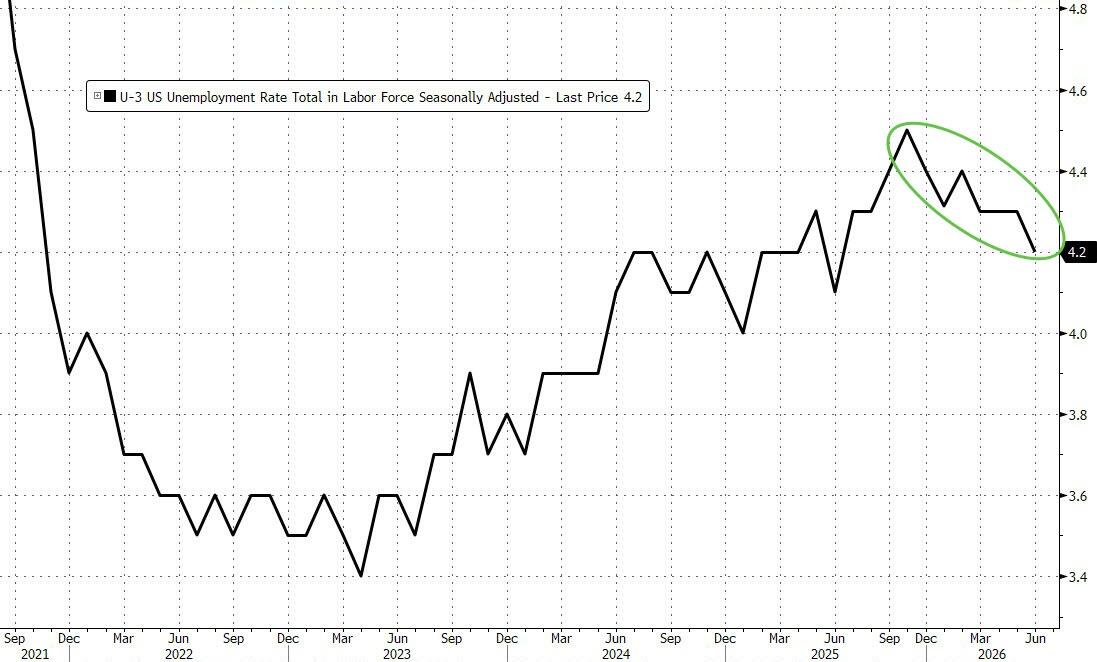
... and which pushed the unemployment rate lower to 4.2% from 4.3%.
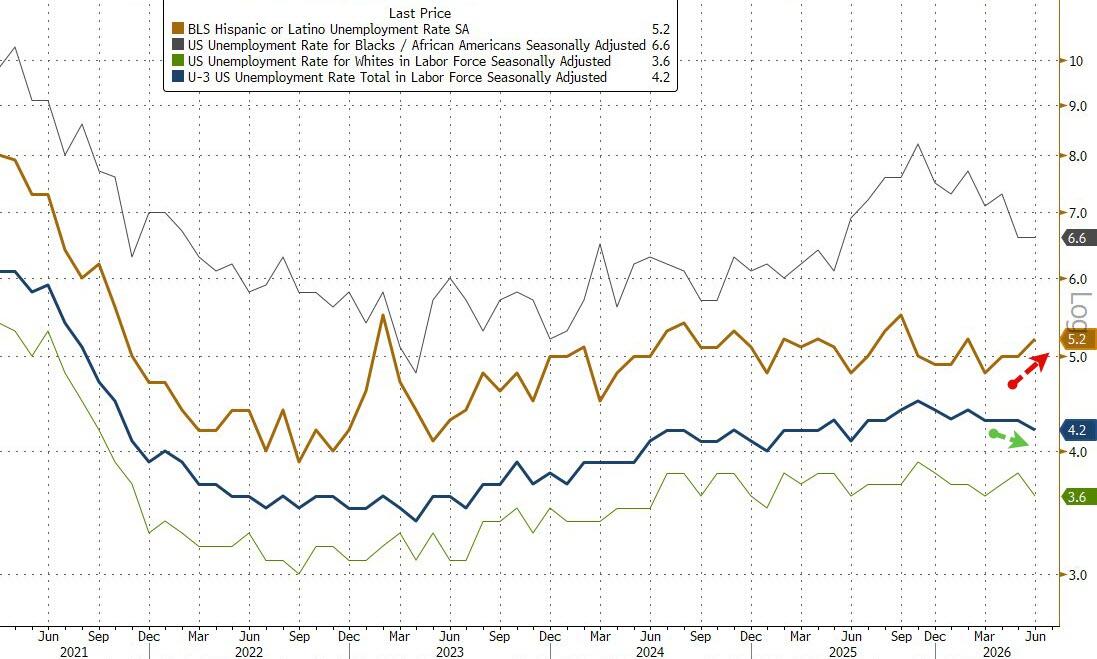
By race, the unemployment rate saw a modest increase in Latino unemployment rate. Among the major worker groups, the unemployment rates showed little or no change in June for adult men (3.9%), adult women (3.7%), teenagers (14.6%), and people who are White (3.6%), Black (6.6%), Asian (3.9%), or Hispanic (5.2%), although those have increase for 3 months in a row now.
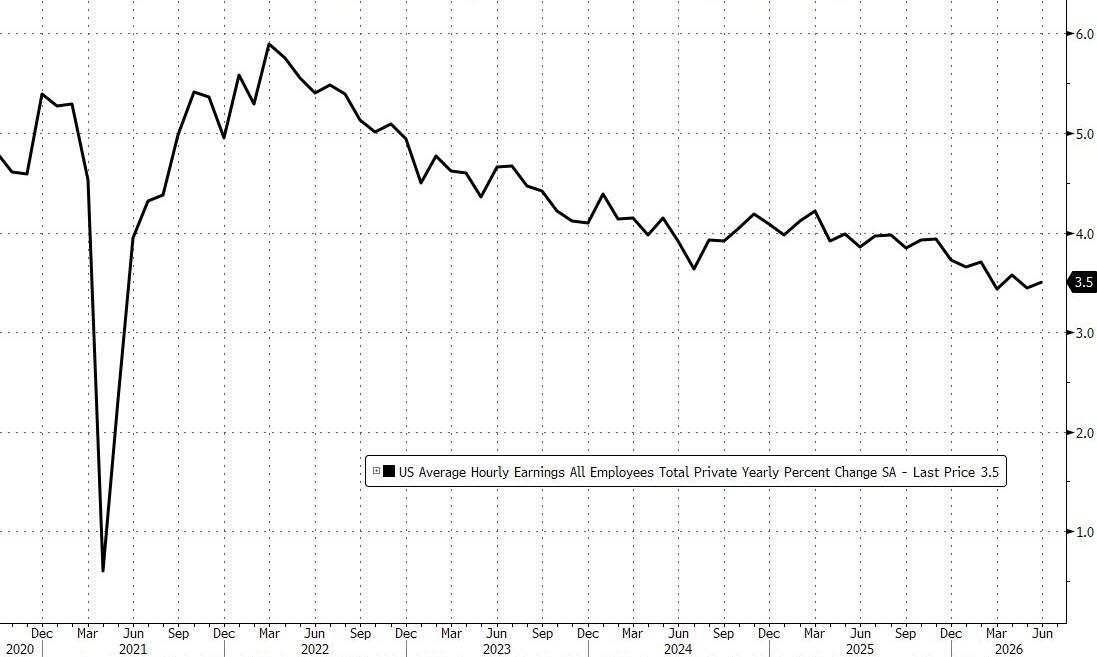
Looking at wages, there were no surprises here, with a 0.3% increase in average hourly earnings, as expected, resulting in a 3.5% increase in annual hourly earnings, also as expected.
Broken down:
- Average hourly earnings for all employees on private nonfarm payrolls rose by 13 cents, or 0.3 percent, to $37.64. Over the year, average hourly earnings have increased by 3.5 percent. In June, average hourly earnings of private-sector production and nonsupervisory employees rose by 7 cents, or 0.2 percent, to $32.38.
- The average workweek for all employees on private nonfarm payrolls was unchanged at 34.3 hours in June. In manufacturing, the average workweek edged down to 40.3 hours, and overtime edged up to 3.2 hours. The average workweek for production and nonsupervisory employees on private nonfarm payrolls declined by 0.1 hour to 33.7 hours.
Some more details from the jobs report:
- The number of long-term unemployed (those jobless for 27 weeks or more) changed little at 1.9 million in June but is up by 286,000 over the year. The long-term unemployed accounted for 27.3 percent of all unemployed people in June.
- The labor force participation rate decreased by 0.3 percentage point to 61.5 percent in June, and the employment-population ratio edged down by 0.2 percentage point to 59.0 percent. Both measures changed little over the year after accounting for annual population control adjustments.
- The number of people employed part time for economic reasons changed little at 4.7 million in June. These individuals would have preferred full-time employment but were working part time because their hours had been reduced or they were unable to find full-time jobs.
- In June, the number of people not in the labor force who currently want a job changed little at 6.0 million. These individuals were not counted as unemployed because they were not actively looking for work during the 4 weeks preceding the survey or were unavailable to take a job.
- Among those not in the labor force who wanted a job, the number of people marginally attached to the labor force changed little at 1.8 million in June. These individuals wanted and were available for work and had looked for a job sometime in the prior 12 months but had not looked for work in the 4 weeks preceding the survey. The number of discouraged workers, a subset of the marginally attached who believed that no jobs were available for them, was essentially unchanged in June at 477,000.
Taking a look at the composition of jobs,
- Employment in professional and business services continued to trend up in June (+36,000). The industry has added 172,000 jobs since a recent low in October 2025.
- Social assistance added 25,000 jobs in June, primarily in individual and family services (+17,000). Over the prior 12 months, social assistance had added an average of 16,000 jobs per month.
- In June, employment in health care continued its upward trend (+22,000) but at a slower pace than the average monthly gain over the prior 12 months (+38,000). In June, hospitals added 9,000 jobs.
- Leisure and hospitality employment declined by 61,000 in June, reflecting weaker than usual seasonal hiring. Thus far in 2026, employment in the industry has shown little net change.
- Employment showed little or no change over the month in other major industries, including mining, quarrying, and oil and gas extraction; construction; manufacturing; wholesale trade; retail trade; transportation and warehousing; information; financial activities; other services; and government.
And visually:
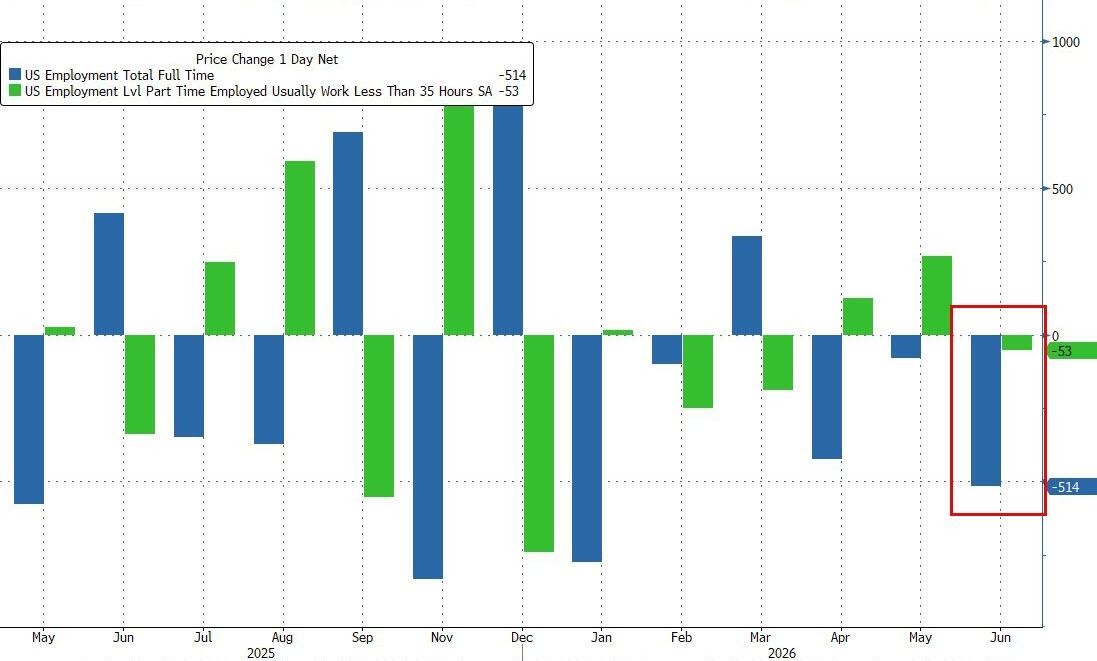
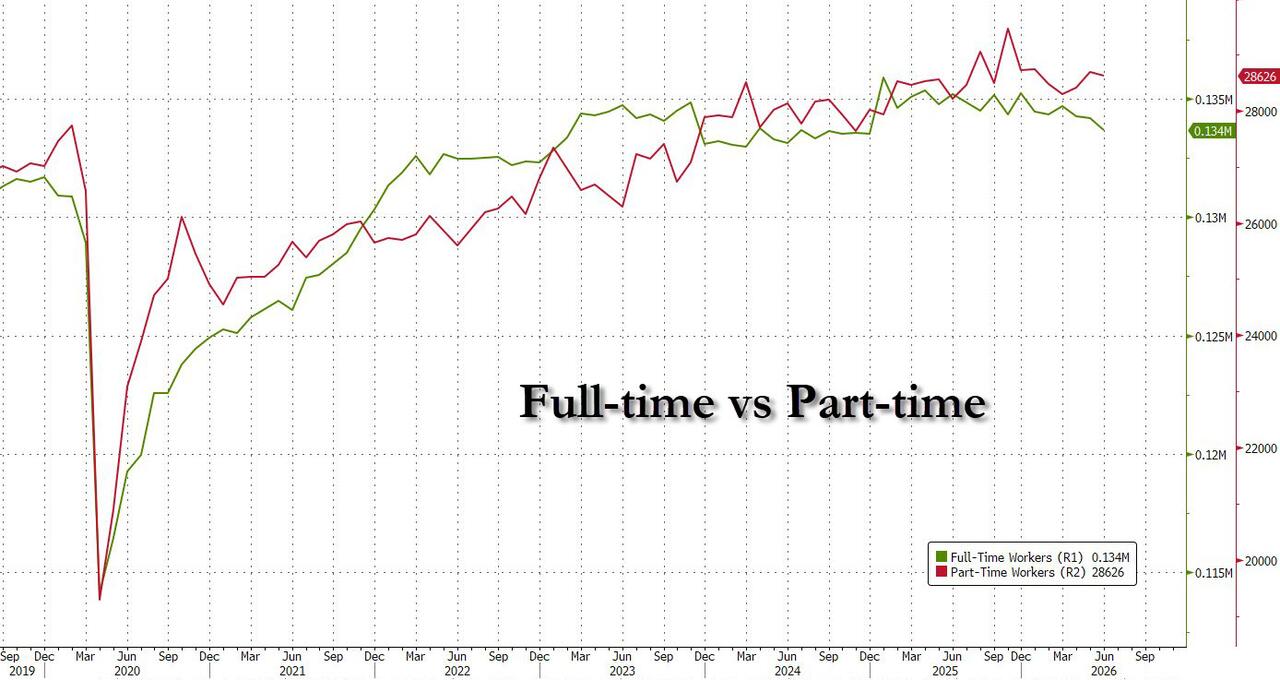
Last but not least, the most damning aspect of the jobs report was once again below the surface, where we find that that while part-time jobs dropped by 53K in June to 28.626MM, the number of full-time workers collapsed by a whopping 514K, confirming once again that the composition of the US labor market remains terrible.
This means that the number of full-time jobs is now at levels last seen in 2024.
The market reaction: in response to the weaker than expected number, odds of a rate hike tumbled although with no forward guidance from the Fed, it is unclear how Warsh will interpret the data.
Related Markets
All MarketsMarket data may be delayed. Not financial advice.
How this story developed
Full timelineAlto has tracked this across 3 days of coverage from 1 outlet.
- US Adds Only 57K Jobs, Missing Estimates, As Unemployment Rate Slides On Plunge In WorkersYou are here
Powered by Gab AI
The Story At A Glance
Reading this article now — analysis appears below
💡 AI analysis provides alternative perspectives on current events