First $1 Billion, Now $50 Million: Khanna Says Wealth Tax "Must Not Stop At Billionaires"
The short version
- The vehicle is Elizabeth Warren's Ultra-Millionaire Tax Act, which Khanna notes he has cosponsored every single year it's been introduced.
- And before anyone reaches for the estate planner: Khanna wants the levy to pierce irrevocable trusts , with the tax billed to the grantor who set them up - because parking a…
- Former Microsoft executive Steven Sinofsky summed up the reveal in eight words: " Just like that, no longer a billionaires tax.
- Newsom, opposing it, countered on June 26 with a national "billionaires' tax" - which, in its original form, applied to anyone worth $100 million or more…
- Six days later, Khanna planted the flag at $50 million.
The story
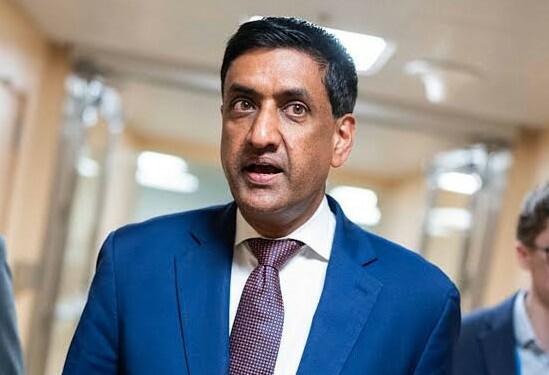
Rep. Ro Khanna (D-CA) - fresh off endorsing California's November ballot measure to seize 5% of billionaire wealth - published a Substack essay Wednesday titled, no really, "Why I Support a Billionaire Wealth Tax."
He makes it roughly a dozen paragraphs before explaining that it isn't one.
"The tax should not stop at billionaires, it must reach centimillionaires," Khanna writes, before spelling out exactly what that means: every fortune of $50 million and up, hit with a 2% federal levy on wealth above that line - every year, forever, on top of everything else you already pay. The vehicle is Elizabeth Warren's Ultra-Millionaire Tax Act, which Khanna notes he has cosponsored every single year it's been introduced.
And before anyone reaches for the estate planner: Khanna wants the levy to pierce irrevocable trusts, with the tax billed to the grantor who set them up - because parking a fortune in a trust, in his telling, shouldn't take it off the government's books.
Former Microsoft executive Steven Sinofsky summed up the reveal in eight words: "Just like that, no longer a billionaires tax."
Just like that, no longer a billionaires tax. https://t.co/05wt4D9WX6 pic.twitter.com/xgA0vpnK6w
— Steven Sinofsky (@stevesi) July 3, 2026
Pirate Wires' Mike Solana was less diplomatic, characterizing the scheme as an annual asset seizure in which the government tallies everything you own and demands a cut on top of your existing tax bill - now openly targeting anyone worth $50 million. His prediction for where the ratchet stops: "this ends with your 401k."
khanna's 'billionaire wealth tax,' which is not a tax but an asset seizure in which he tallies everything you own, then demands a percentage *on top* of what you're taxed — every single year — is already targeting anyone worth $50 million or more. this ends with your 401k. https://t.co/jt7VtK1j4w pic.twitter.com/IH9vxcBxKG
— Mike Solana (@micsolana) July 3, 2026
For those keeping score at home, the threshold discourse has traveled a long way in a short time:
The measure headed to California voters in November is a one-time 5% tax on the state's roughly 250 billionaires. Newsom, opposing it, countered on June 26 with a national "billionaires' tax" - which, in its original form, applied to anyone worth $100 million or more, language that was quietly scrubbed after multiple outlets quoted it as we reported. Six days later, Khanna planted the flag at $50 million.
None of this is exactly new, of course. The Warren bill has carried the $50 million line since she rolled it out in 2019, and Biden's 2022 "Billionaire Minimum Income Tax" kicked in at $100 million households. The branding always says billionaire, but the fine print ios a slippery slope.
Then there's inflation... The bill's $50 million threshold is a flat statutory number that hasn't moved since 2019 - meaning inflation has already quietly cut the real threshold by more than a fifth. The creep shows up in the sponsors' own math: when the bill debuted, backers said it touched the top 0.05% of American households; the 2026 reintroduction, per the same Saez-Zucman analysis the sponsors tout, now reaches 260,000 households - the top 0.15%. Same words, triple the coverage, five years. Asset inflation does the broadening automatically. Congress just has to sit still.
The escalator, meanwhile, is pre-drafted: buried in the bill is a provision doubling the top rate to 6% automatically in any year that qualifying trigger legislation is on the books.
And anyone curious where a "normalized" wealth tax eventually settles can consult the countries that already normalized one. Norway's kicks in around $160,000 of net worth. The Netherlands taxes deemed returns on assets above roughly €57,000. Swiss cantons start in the low six figures. The European wealth taxes that stayed rich-only - France, Sweden, Germany, Austria, Denmark - were repealed as revenue duds. The ones that survived did so by reaching the middle class. The slippery slope is quite literally the only way these things 'work.'
Khanna spends a portion of the essay taking intramural shots at Newsom, dismissing the governor's version as an income tax billionaires will never feel - since they take no salary, borrow against their stock, and pass fortunes to their kids without selling a share - while boasting that he and Bernie Sanders tax the wealth itself, to the tune of a claimed $4.4 trillion.
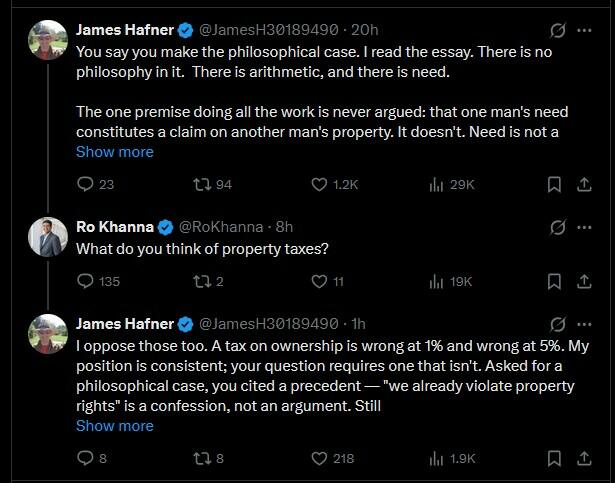
The replies were not kind. Christopher Rufo suggested Washington recover the estimated half-trillion dollars a year lost to fraud before inventing new revenue streams. The most-liked response, from James Hafner, noted that the essay's "philosophical case" never actually argues its one load-bearing premise - that one man's need constitutes a claim on another man's property. "There is arithmetic, and there is need," Hafner wrote of the piece's actual contents.
Khanna's comeback - asking Hafner what he thinks of property taxes - was promptly ratioed, sitting at 135 replies to 11 likes at press time.
Except - property taxes are local, visible, and appealable; they pay for the pothole crew, the 2 a.m. patrol car, and the school down the street - and when assessments outran paychecks, voters famously revolted and capped them. Khanna's essay actually frames the California fight as Proposition 13 in reverse, which is a remarkable self-own: he's marketing the sequel to a movie that ended in a taxpayer revolt, triggered by precisely the dynamic critics warn about - paper valuations rising faster than the cash available to pay the levy.
The federal version offers none of the offsetting virtues. The Ultra-Millionaire Tax deposits into the general fund; the child-care-and-community-college wish list lives in the press release, not the bill text. What the bill text does contain is enforcement - just not of the spending. It orders the IRS to audit at least 30% of everyone subject to the tax, every single year. It hands the agency expanded authority to assign values to private businesses, farmland, art, and anything else that's hard to price. It wires in FATCA-style third-party reporting. And should you decide you've had enough of the annual appraisal and leave, it imposes a 40% exit tax on net worth above $50 million on your way out the door. In other words: relentless annual oversight of the taxpayers, and none whatsoever of where the money goes. Even Khanna seems to grasp the trust problem - he launched a state-fraud probe in December, conceding taxpayers "need to have a receipt" for what their money funds - which rather makes Rufo's point: by his own estimate Washington loses half a trillion a year to fraud, and the remedy on offer is an audit of your art collection.
All of which lands a little awkwardly next to this week's Free Beacon report detailing how Khanna's own family fortune - courtesy of centimillionaire father-in-law and auto-parts magnate Monte Ahuja - is sheltered through the very sort of irrevocable trusts the congressman now wants taxed to the grantor. Per the Beacon, Khanna's minor children hold trust stakes in three private golf clubs and multiple hedge funds, the family occupies a $6 million, marble-clad Washington home with a private elevator, and the congressman's financial disclosures run to 333 pages of conveniently non-searchable tables.
What it does say, in writing, is what the fine print has said all along: the number was never $1 billion. This week it's $50 million. Ask again next cycle.
Related Markets
All MarketsMarket data may be delayed. Not financial advice.
How other outlets covered this
Compare allAlto found this story at 2 outlets. Same event, different framing — compare the headlines.
How this story developed
Full timelineAlto has tracked this across 9 days of coverage from 2 outlets.
Powered by Gab AI
The Story At A Glance
Reading this article now — analysis appears below
💡 AI analysis provides alternative perspectives on current events