Japan Bankruptcies Surge To All-Time High As A Result Of Plunging Yen
The short version
- A weak yen certainly helps big JP firms profits (while hurting households) so there is a clear weak yen constituency inside the LDP.
- However, a limit to the yen's weakness is now emerging, and it goes to the growing damage on the country's households noted in point 2 above.
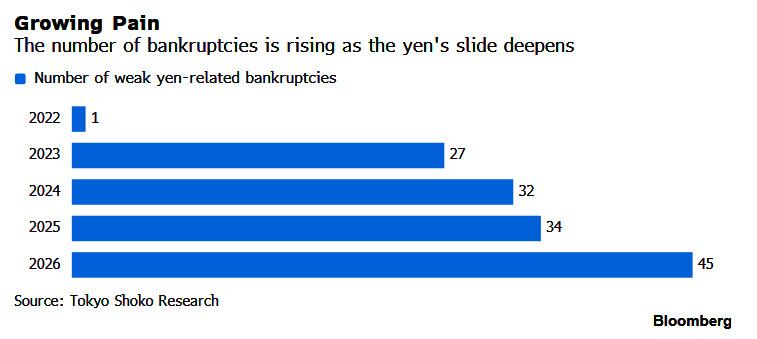
- As Bloomberg reports, Japan’s weak currency caused the most bankruptcies for the first half of a year since 2022, underscoring the growing economic costs of the currency’s slump.
- Forty-five firms failed from January to June for that reason, up more than 30% from a year earlier, according to a report by Tokyo Shoko Research published last Wednesday .
- The figure was the highest since 2022, when the data firm started counting companies that specifically cite currency weakness in filing for bankruptcy.
The story
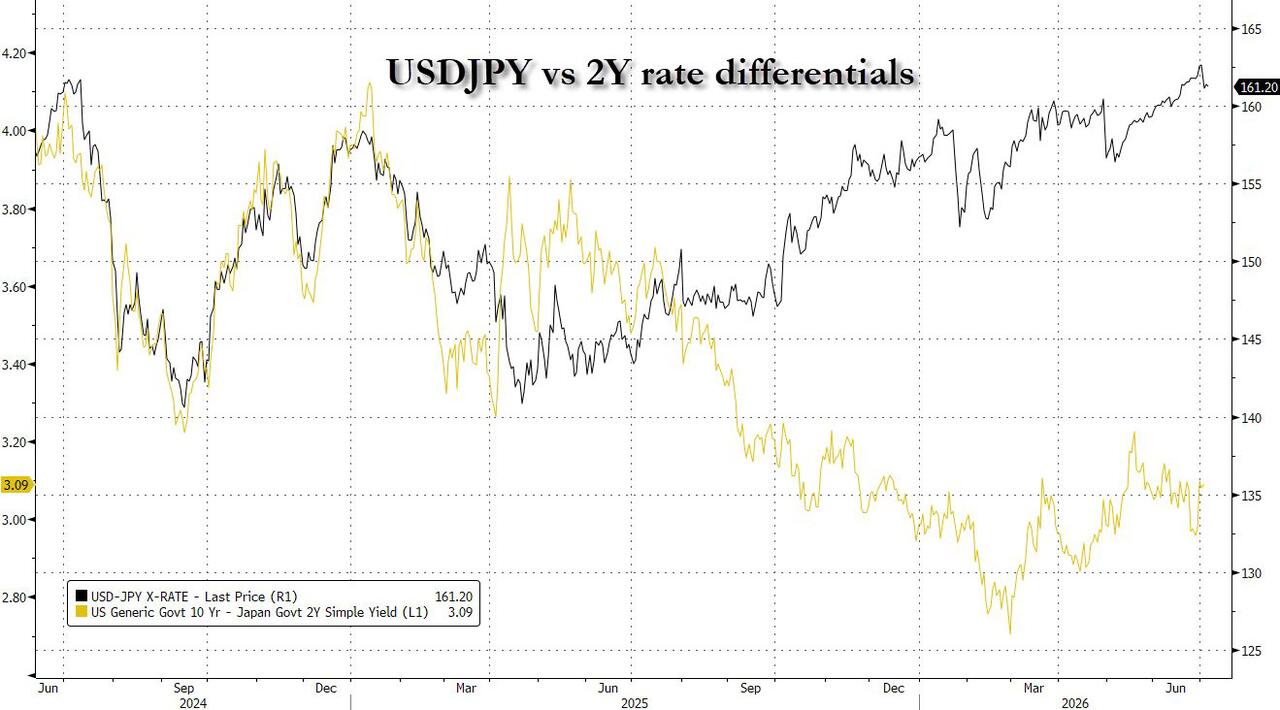
In recent months one of the more frequent questions in FX trading has been the relentless collapse in the yen, which recently sank below a 40 year low despite rate differentials stubbornly headed in the opposite direction, and is increasingly flirting with levels which on previous occasions always prompted BOJ intervention.
Among the reasons cited for the chronic weakness of the Japanese currency have been the following three:
- Real short-term rates in Japan are negative, which is why Ueda has been slow to hike
- There is a growing perception that Japan's PM Takaichi doesn't want a higher rates or a stronger yen. A weak yen certainly helps big JP firms profits (while hurting households) so there is a clear weak yen constituency inside the LDP. Japanese financial institutions are also short the yen generally
- JP financial institutions (notably lifer insurers) see the upfront cost of hedging (the nominal ST rate differential) and have made a mint on unhedged fx assets, and they have been reluctant to change their position just because the yen looks exceptionally undervalued.
Effectively a feedback loop has emerged, whereby the weaker yen leads to an even weaker yen, and despite token resistance by the BOJ - the latest long overdue rate hike being an example - the market clearly anticipates further weakness in the currency, and is pushing it to new lows.
However, a limit to the yen's weakness is now emerging, and it goes to the growing damage on the country's households noted in point 2 above.
As Bloomberg reports, Japan’s weak currency caused the most bankruptcies for the first half of a year since 2022, underscoring the growing economic costs of the currency’s slump.
Forty-five firms failed from January to June for that reason, up more than 30% from a year earlier, according to a report by Tokyo Shoko Research published last Wednesday. The figure was the highest since 2022, when the data firm started counting companies that specifically cite currency weakness in filing for bankruptcy.
The findings suggest the smaller firms that employ most of Japan’s workers are finding it increasingly difficult to withstand the yen’s prolonged weakness, casting a shadow over the nation’s economy, even as large-cap exporters benefit.
The data also strengthen the case for continued interest-rate hikes from the Bank of Japan. While higher borrowing costs alone would typically push more firms toward insolvency, closing the gap with US rates could help support the yen.
The yen has steadily weakened against the dollar in recent years as US interest rates climbed to combat pandemic-era inflation while Japanese rates were negative to break free of deflation. While the rate differential has since narrowed, a rally in the dollar and high oil prices from the war in Iran are pressuring the yen.
The yen hit a new 40 year low of 162 per dollar on Thursday, before rising higher amid some speculation that Japan's financial authorities may finally seek to rein it in. While the weaker currency has boosted exporters’ earnings, it has also driven up import costs, squeezing profit margins across a broad range of import-dependent industries, and has also helped sustain the worst inflation in Japan's recent history.
The conflict in the Middle East has also drastically boosted costs. A price index for raw materials and merchandise purchases among a broad range of smaller firms surged in the second quarter, according to a survey by the Organization for Small & Medium Enterprises and Regional Innovation. The Bank of Japan’s producer price index has also jumped in recent months.
Tokyo Shoko Research’s report showed bankruptcies were particularly concentrated in the wholesale sector. One example was Tokyo-based Merry Time Foods, an importer of crab, shrimp and tuna from other parts of Asia. The company went bankrupt in May, citing deteriorating profitability due to the weak yen and political instability in its supplier countries.
The research firm said in the report that currency-related bankruptcies are likely to remain elevated for some time, particularly among wholesalers, retailers and manufacturers with limited pricing power.
According to Bloomberg, the strain has been acute for small- and mid-sized businesses, who are more affected by higher borrowing costs than their larger counterparts. They’re also contending with mounting wage hike pressures amid persistent labor shortages. Smaller firms often have limited ability to pass higher costs onto customers due to intense competition.
“The weak yen is one contributing factor,” said Yoshihiro Sakata, manager at Tokyo Shoko Research. “Combined with inflation and rising labor costs, it is creating a cumulative burden on businesses.”
Another source of pressure on smaller businesses may be foreign-exchange hedging, including the use of so-called reverse knockout options, according to Yuji Saito, executive adviser at SBI FXTrade. Such products are widely sold by regional banks as structured hedging products, particularly to small and regional importers seeking to minimize upfront option premiums.
Once the exchange rate reaches a preset knockout level, the option expires and the hedge ceases to provide protection. Companies needing dollars must then either purchase them in the spot market, enter into a new hedge - often at less favorable levels - or leave themselves exposed to further currency moves.
“The weaker the yen gets, the more importers roll into increasingly risky option structures,” Saito said. “Once the knockout level is breached, they are forced to buy dollars in the spot market, creating a negative spiral that puts even more downward pressure on the yen."
Analysts estimate that remaining reverse knockout levels are clustered between 163 and 170 yen per dollar, territory that many firms didn’t think the currency would reach as intervention from the central bank would likely be forthcoming due to the adverse economic impact of such unprecedented currency collapse.
“The number of knockouts could increase if the yen weakens further,” said Hiroyuki Machida, director of Japan FX and commodities sales at Australia & New Zealand Banking Group. “The situation is becoming significant for companies that are unable to pass on higher costs.”
Related Markets
All MarketsMarket data may be delayed. Not financial advice.
How this story developed
Full timelineAlto has tracked this across 2 days of coverage from 1 outlet.
- Japan Bankruptcies Surge To All-Time High As A Result Of Plunging YenYou are here
Powered by Gab AI
The Story At A Glance
Reading this article now — analysis appears below
💡 AI analysis provides alternative perspectives on current events