American Nuclear Energy: The Highest Ambitions And The Highest Costs
The short version
- The firm goes on to reiterate their projection that global nuclear capacity could at least double and potentially triple by midcentury under net-zero scenarios…
- But, that's about as far as the happy feelings go.
- From there, it's a review of the disturbing cost of construction for nuclear energy in the US.
- This isn't the first time McKinsey has laid out the case for the incredibly wide gap that needs to be filled in terms of investments and skilled labor to support a nuclear future.
- Our readers should recall their recent report projecting up to $170 billion of required investments for the domestic nuclear fuel chain just to support the US commercial reactor…
The story
McKinsey published its take on the nuclear sector titled "Nuclear power: A renaissance in the making." The report starts by highlighting the bull cases for nuclear, such as AI data center demand, electrification, onshoring, decarbonization goals, and energy security concerns.
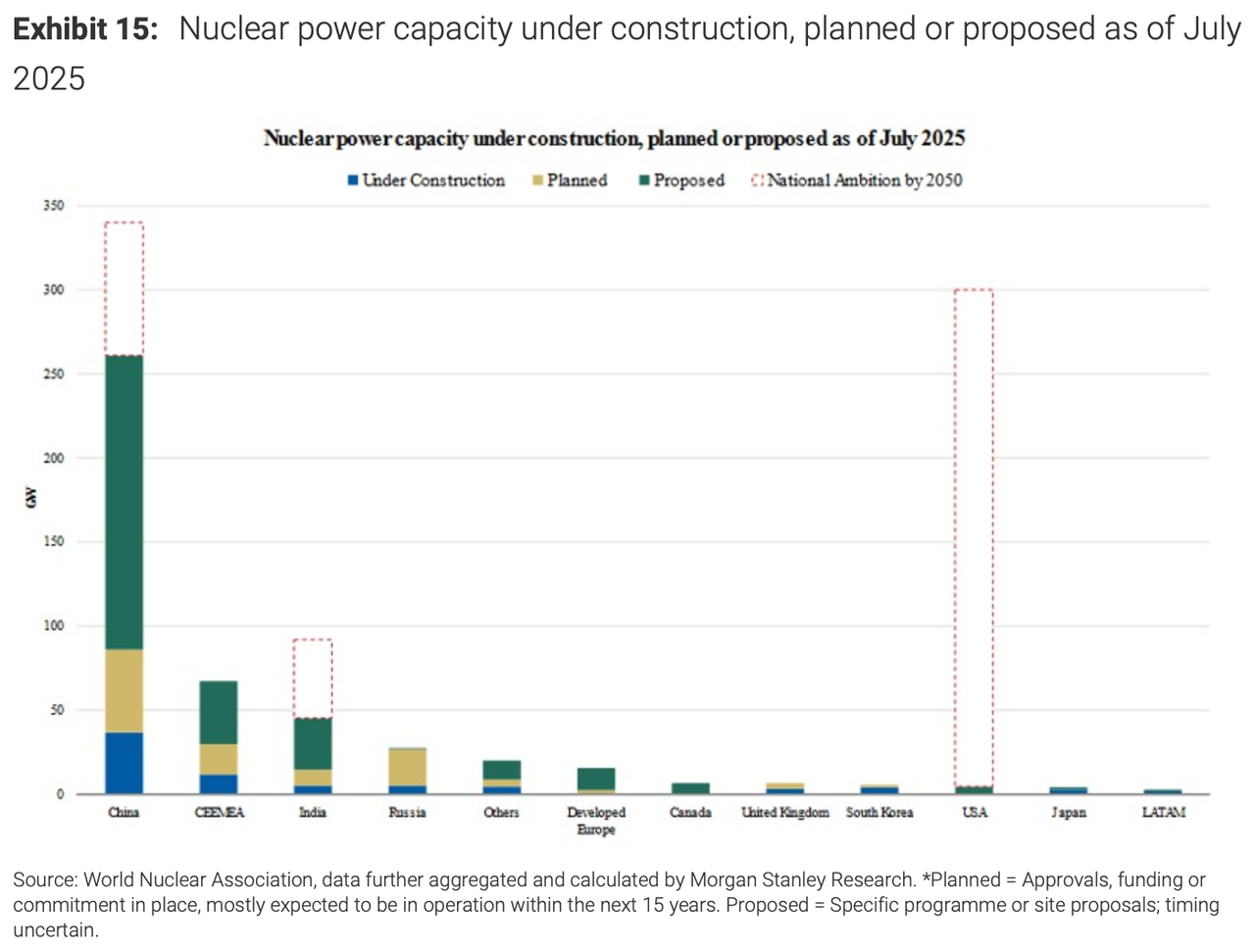
The firm goes on to reiterate their projection that global nuclear capacity could at least double and potentially triple by midcentury under net-zero scenarios, reaching as high as 1,200 gigawatts.
But, that's about as far as the happy feelings go. From there, it's a review of the disturbing cost of construction for nuclear energy in the US.
This isn't the first time McKinsey has laid out the case for the incredibly wide gap that needs to be filled in terms of investments and skilled labor to support a nuclear future. Our readers should recall their recent report projecting up to $170 billion of required investments for the domestic nuclear fuel chain just to support the US commercial reactor fleet.
While that report was followed up a few weeks later by Centrus Energy and Oklo announcing an agreement for domestic uranium enrichment to supply reactors in Ohio, a solution for actually expanding fuel chain capacity has yet to be presented.
So far, the US has done one thing in the nuclear industry better than any country in the world: Talking...
The problem outside of Asia has been glaringly identified as a lack of ability to coordinate the large consortium of companies required to construct large reactor plants. The ability to coordinate these mega-projects used to be in-house at the major US utilities, but that staff has increasingly atrophied over the recent decades as McKinsey lays out the difference between East and West enterprises:
“Historically, the “owner engineer” model in which utilities maintained strong in-house engineering and project-delivery capabilities was a major source of execution strength, particularly in the United States as well as in France and Japan. Over time, many utilities reduced internal engineering capacity and largely lost these capabilities. Today, European programs are led mainly by state-backed utilities that rely on government-supported financing; US plants are owned and operated by private utilities, backed by federal financing support and overseen by a federal safety regulator, and Chinese projects are vertically integrated state-owned enterprises that span fuel, equipment, construction, and operations.”
Vertically-integrated central planning setups apparently have its advantages in the nuclear renaissance…
The US certainly has no lack of demand for nuclear energy, and also no lack of federal support for getting it built. We've repeatedly covered these data points as the U.S. has pledged over $17 billion for new reactors from the DoE, up to $80 billion for nuclear in coordination with the DoC, and recent announcements to finish what was started at the VC Summer plant in South Carolina.
This begs the question of why is there no steel getting put in the ground? McKinsey points to construction costs:
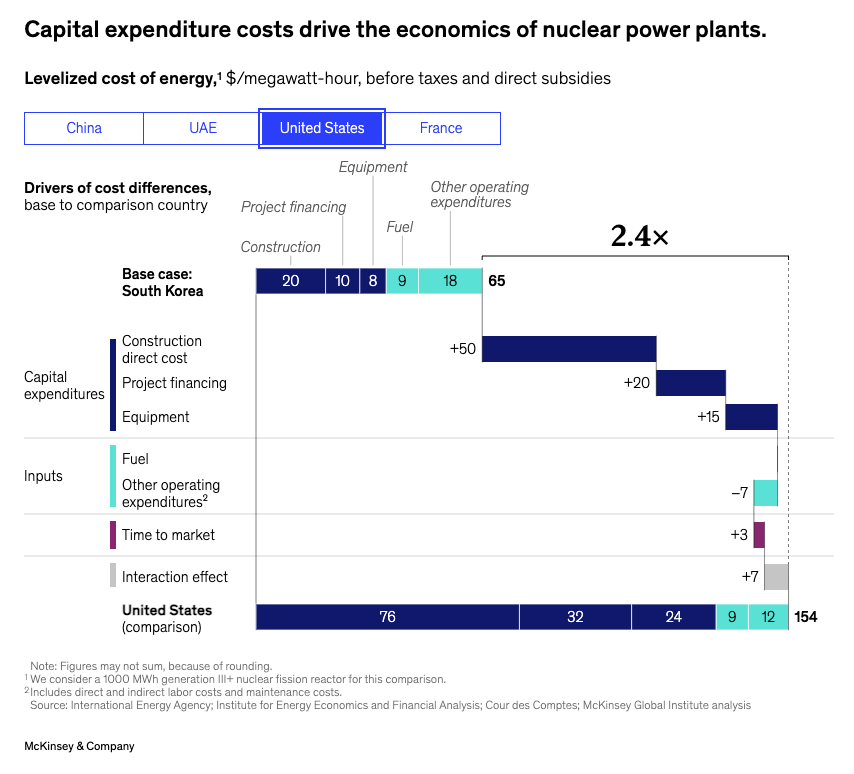
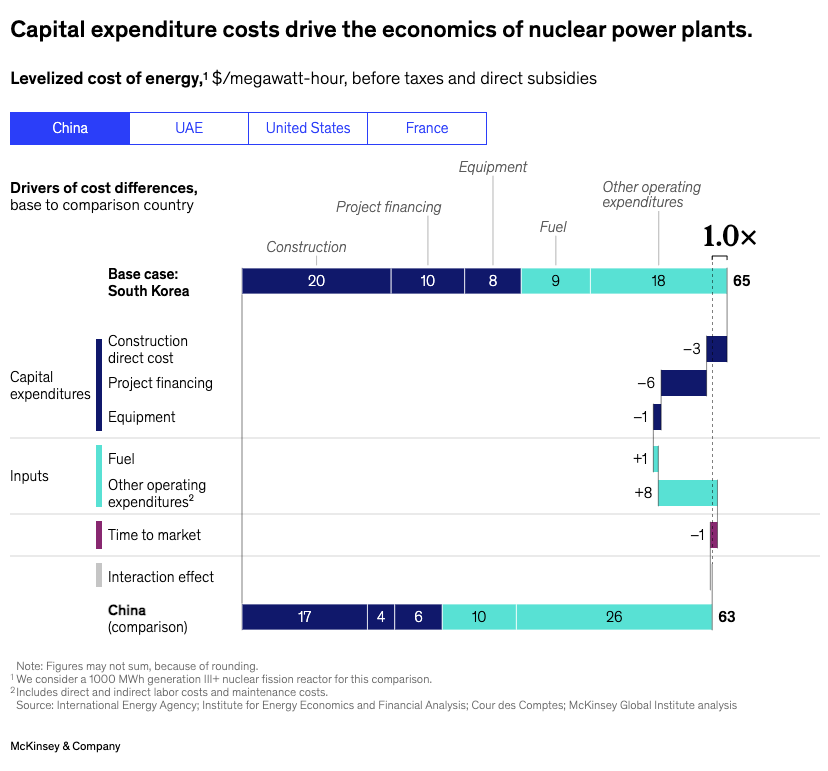
“Construction costs account for the largest share of levelized cost differences between countries and this cost is composed of direct construction costs and the cost related to capital expenditure inefficiency … Compared to the South Korea benchmark, total construction costs add $50 to $60 per megawatt-hour to projects in France and the United States, while in China, these costs are approximately $3 less due to lower materials and labor costs.”
We've pointed this out repeatedly. The US simply does not have the headcount required to meet these ambitious goals of building out AI and new reactor plants…
And then there is the issue of where the US gets 300,000 engineers to build all this missing power supply by 2030 https://t.co/a18crhqZ4v pic.twitter.com/tinW8SHDwM
— zerohedge (@zerohedge) October 14, 2025
McKinsey sums up what the status of the US construction industry means for costs:
“Compared to South Korea, US construction labor costs adjusted for productivity are about 80 percent higher, and US concrete prices are roughly 200 to 250 percent higher.”
When it comes to determining what it takes to win and find the efficiency enjoyed by the South Korean nuclear industry, the playbook is incredibly straightforward. Just have the same people build the same thing over and over and over again…
“For instance, the Emirates has deployed a proven Korean design and associated requirements and regulations. That project also illustrates how programs that set design early, build multiple identical units on a single site, and keep the same Tier 1 suppliers from unit to unit reduce construction hours and rework. As teams repeated identical scopes, indirect services and owner’s costs fell sharply at the Barakah plant, helping reduce costs from construction of the first unit to the fourth by roughly 40 percent.”
The US wants to win the nuclear race, but it has shown itself (so far) to be incapable of organizing the builder-buyer consortiums required to execute.
Related Markets
All MarketsMarket data may be delayed. Not financial advice.
How this story developed
Full timelineAlto has tracked this across 4 days of coverage from 1 outlet.
- American Nuclear Energy: The Highest Ambitions And The Highest CostsYou are here
Powered by Gab AI
The Story At A Glance
Reading this article now — analysis appears below
💡 AI analysis provides alternative perspectives on current events