NYC Tower Owner Prepares To Rebuild 15 Floors After I-Beam Failure
Fears of a possible collapse at a condo tower under construction near Grand Central Terminal had abated by the end of the week, but the incident only signals the massive engineering challenges tied to Manhattan's office-to-apartment conversion boom.
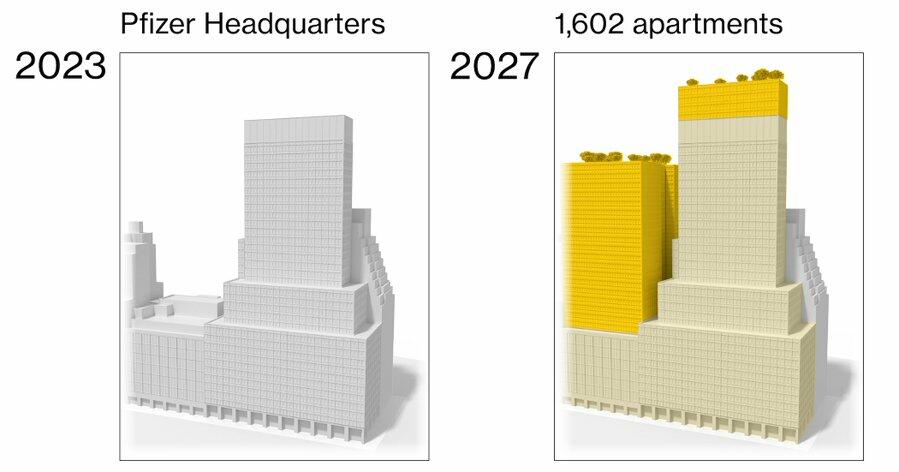
The former Pfizer headquarters at 235 East 42nd Street, being converted by David Werner and Nathan Berman's Metro Loft Management into more than 1,600 residential units, has become a high-profile example of the risks of repurposing aging office towers into housing at scale to achieve socialist NYC Mayor Zohran Mamdani's strategy to address the metro area's housing shortage.
Engineer: “The concrete beams in our residential conversion of the Pfizer Building are buckling. The building could collapse! Did you correctly account for the weight of the additional floors we added?”
— tedfrank (@tedfrank) July 8, 2026
ChatGPT: “You’re absolutely right! I see the issue now—in using the Euler… pic.twitter.com/Wh3pABw84f
Metro Loft CEO Nathan Berman told Bloomberg in an interview that 15 stories were added to part of the building, and that two columns beneath were insufficiently reinforced, leading to a failure that caused some of the 15 cantilevered floors above to sag.
Via Bloomberg
Berman said Metro Loft now plans to replace the facade, slabs, and steel on those floors: "We are prepared to rebuild that portion of the building."
"It will be reskinned, everything will be leveled, fixed in place, and it will be brand new," he said.
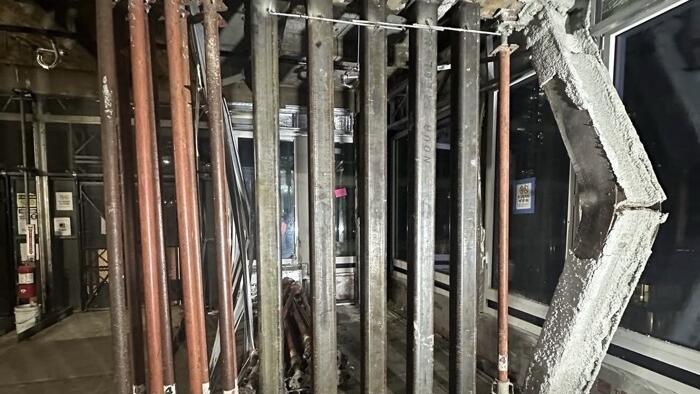
Tuesday morning's column failure prompted evaluations of the building and surrounding structures, as well as street closures for fear the building would collapse. Since then, crews have been working to install temporary supports.
New York City's Department of Buildings has released a new image showing the emergency works to stablise the 37-storey tower at 235 East 42nd Street after structural beams were seen buckling on its 21st floor.
— The B1M (@TheB1M) July 8, 2026
In a statement, the Department said: "Crews working through the night… pic.twitter.com/R1U5su2h2r
James LaFave, a professor of civil engineering at the University of Illinois Urbana-Champaign, told the outlet, "Engineers rationally overestimate what they think the loads would be, underestimate how strong they think elements would be to simplify it, and therefore you would end up with a substantial margin of safety."
LaFave noted, "For something to have caused the level of buckling seen in that column there, it's not some small perturbation from expectation that would make that happen. It's something substantial."
Related Markets
All MarketsMarket data may be delayed. Not financial advice.
💡 AI analysis provides alternative perspectives on current events