IEA Warns Escalation In US-Iran Hostilities Could Upend Oil Surplus Forecast

The short version
- Since the reopening of the Strait of Hormuz, tankers have rushed to exit the Persian Gulf, including millions of barrels of Iranian crude that Tehran couldn’t move past the U.S.…
- As a result, global oil supply rebounded by a massive 4.1 million barrels per day (bpd) to 98.8 million bpd in June, amid a partial recovery in Gulf production, the IEA said.
- For context, Asia accounted for 2/3 of the peak demand drop.
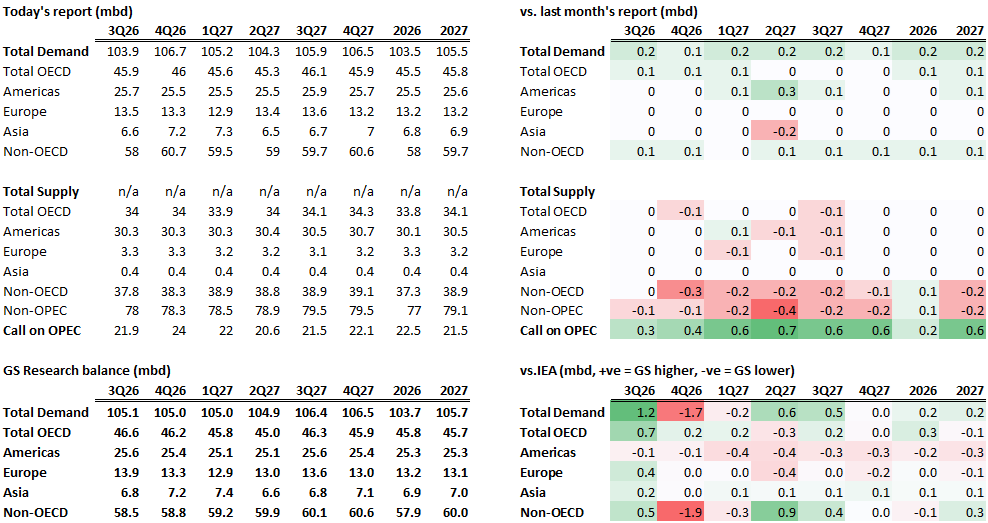
- Overall, demand forecast increased slightly vs. last month report with 2026 now -1mbd YoY and 2027 +2mbd YoY (vs. -0.7mbd and +2.1mbd GS Research forecasts).
- On supply, June increased by 4.1mbd MoM to 98.8mbd, although still 9.4mbd below pre-war levels.
The story
Despite the tentative recovery of oil flows through the Strait of Hormuz and the first build-up in global stocks since the war began, this week’s re-escalation of the U.S.-Iran hostilities could flip the outlook for an oil market surplus for next year, the International Energy Agency said on Friday.
Oil prices have plunged since the United States and Iran signed the memorandum of understanding (MoU) in the middle of June, with North Sea Dated prices down by $31 per barrel in June to $68 a barrel by early July, their lowest since January and $2 per barrel below pre-war levels, OilPrice reported.
And while the oil market is still expected to move to significant surplus towards the end of the year, IEA said that this is heavily predicated on the assumption that tanker flows through the Strait will gradually recover: “An escalation in hostilities on 7-8 July, however, clouds the outlook and could upend the forecast that sees the market flipping to a surplus next year,” the IEA said in its closely watched Oil Market Report for July.
Since the reopening of the Strait of Hormuz, tankers have rushed to exit the Persian Gulf, including millions of barrels of Iranian crude that Tehran couldn’t move past the U.S. blockade between mid-April and mid-June. As a result, global oil supply rebounded by a massive 4.1 million barrels per day (bpd) to 98.8 million bpd in June, amid a partial recovery in Gulf production, the IEA said.
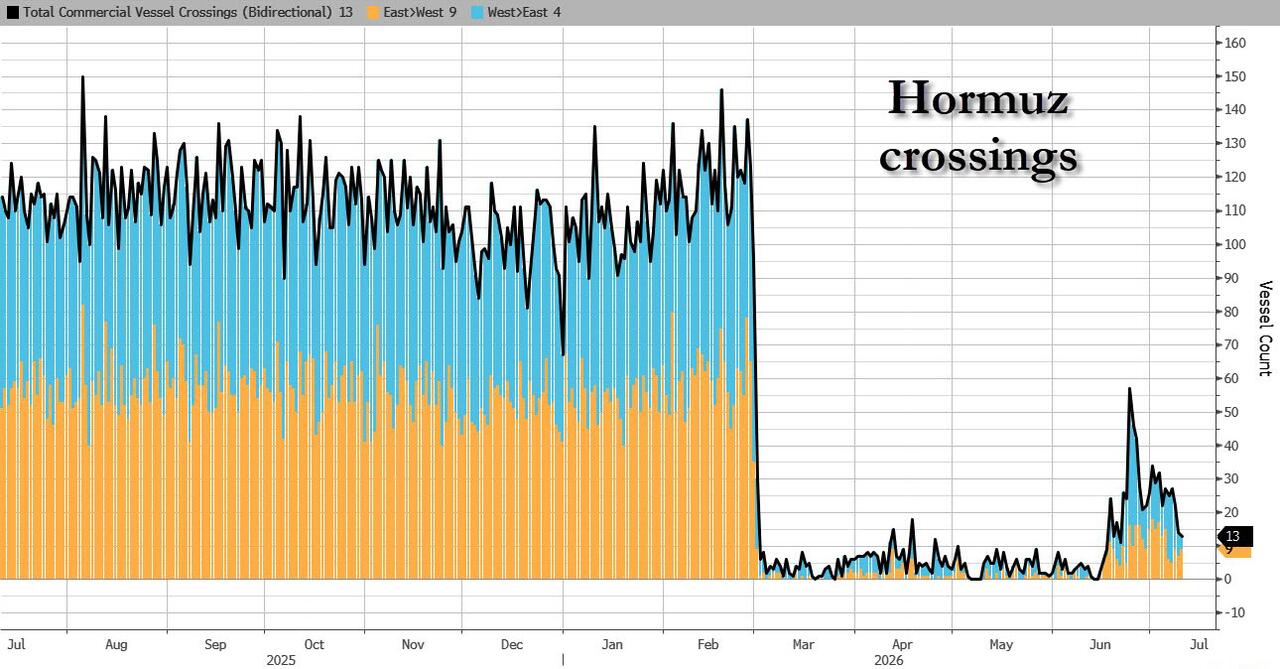
However, global oil output remained about 9.4 million bpd below pre-war levels, with supply on track to decline by an average of 3.7 million bpd to 102.6 million bpd in 2026, “contingent on a swift de-escalation of renewed hostilities.” Meanwhile tanker crossings have slowed to a trickle, while insurers are reportedly demanding a pound of flash, with Reuters reported that “war insurance for ships inside the Gulf has already ticked higher towards 3% of a vessel’s value, up from 2% at the end of last week.” Meanwhile, quotes for coverage as high as 5% are still circulating.
At the same time, global demand - which was hit by demand destruction when crude prices topped $100 early this year - is starting to recover from the lows seen in the second quarter, with annual declines easing from 4.8 million bpd in April-June to an expected yearly drop of 1.7 million bpd in the third quarter, the IEA reckons.
Despite the wave of crude managing to clear the Strait of Hormuz in recent weeks, product supply and deliveries are much slower to rebound, with the markets still tight, the agency noted.
“The disconnect between apparently well supplied crude oil markets and tight product markets underpinned a rally in cracks and refinery margins to four-year highs by early July,” said the IEA.
“While concerns over jet fuel shortages have eased in recent weeks after refiners pushed output to new highs, diesel and gasoline markets have tightened, with gasoline cracks moving sharply higher.”
Here are the key highlights from the report:
- On demand, there has been significant sequential improvement with +1.2mbd YoY growth forecast in 4Q vs. -1.7mbd YoY in 3Q and -4.8mbd YoY in 2Q. For context, Asia accounted for 2/3 of the peak demand drop. Overall, demand forecast increased slightly vs. last month report with 2026 now -1mbd YoY and 2027 +2mbd YoY (vs. -0.7mbd and +2.1mbd GS Research forecasts).
- On supply, June increased by 4.1mbd MoM to 98.8mbd, although still 9.4mbd below pre-war levels. Focusing on the Gulf, total June exports increased 6.5mbd MoM to 16.1mbd vs. 24mbd pre-war average. In particular, it is worth noting that UAE (who recently left OPEC+) produced record volumes in June with further growth expected.
- Inventory data showed 21mb increase in June, the first increase in four months following 360mb decline from March to May. The IEA said that 69% of the proposed 400mb emergency inventory release has been completed, with uncertainty over the timing of release of the balance.
- A recovery in world oil demand is underway, with consumption set to rise from its May nadir on seasonal trends and as pent-up demand is released in line with a rebound in product supplies. Annual contractions ease from 4.8 mb/d in 2Q26 to 1.7 mb/d in 3Q26, followed by a rise of 1.2 mb/d in 4Q26, for an overall decline of 1 mb/d this year. Forecast growth of 2 mb/d in 2027 results in a two-year pace of expansion well below historical trends.
- Global oil supply rebounded by a sharp 4.1 mb/d to 98.8 mb/d in June, as a resumption of flows through the Strait of Hormuz underpinned a partial recovery in Gulf production. World output was nevertheless some 9.4 mb/d below pre-war levels, with supply on track to decline by an average of 3.7 mb/d to 102.6 mb/d in 2026, contingent on a swift de-escalation of renewed hostilities. If transit volumes improve, oil supply will expand by 7.5 mb/d next year.
- Refined product cracks and margins surged to four-year highs in early July, as increased crude supplies pushed oil prices sharply lower, while product markets remained tight. Global refinery runs rose by 1.5 mb/d in June, down 6 mb/d y-o-y, with Middle East export refineries yet to restart, Russian throughputs curtailed by attacks and Asia still running at reduced rates. Global runs are expected to decline by 2.4 mb/d this year and rebound by 3.1 mb/d in 2027.
- Global observed oil inventories rose for the first time in four months in June, by 21 mb, as sharply higher oil on water volumes more than offset continued draws in onshore tanks. Following a decline of 73 mb in May, total OECD stocks fell by a further 62 mb in June, of which an estimated 44 mb came from government stock releases. Non-OECD crude stocks eased by 37 mb in June, led by a 41 mb draw in China.
- Benchmark crude oil prices continued to spiral lower in June, erasing all of their wartime gains, as tanker traffic out of the Gulf picked up and market focus shifted to the prospect of oversupply. North Sea Dated crude plunged by $22/bbl m-o-m, to around $68/bbl, with prompt time spreads reverting to contango. Prices rose after the ceasefire agreement was breached on 7-8 July, with Dated trading around $77/bbl at the time of writing.
Here is the full visual recap, courtesy of Goldman
Related Markets
All MarketsMarket data may be delayed. Not financial advice.
How this story developed
Full timelineAlto has tracked this across 4 days of coverage from 1 outlet.
- IEA Warns Escalation In US-Iran Hostilities Could Upend Oil Surplus ForecastYou are here
Powered by Gab AI
The Story At A Glance
Reading this article now — analysis appears below
💡 AI analysis provides alternative perspectives on current events