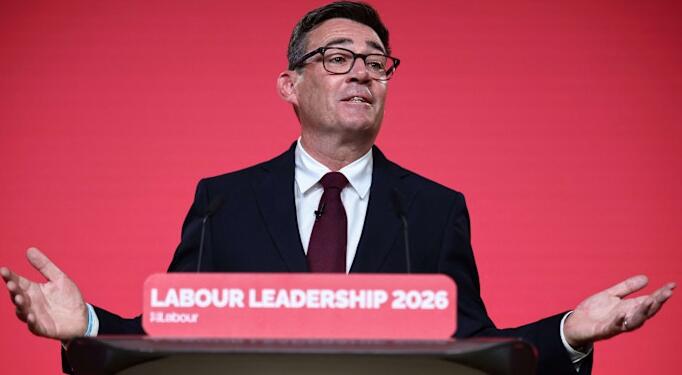
How Long Will Burnham Last?
The short version
- Authored by Mark Littlewood via DailySceptic.org, Over the past decade our political system has chewed through and spat out Prime Ministers at a faster rate than Premier League…
- As Andy Burnham enters 10 Downing Street, why would we think there is any reason he will do much better – in terms of longevity – than his immediate predecessors?
- I’m keeping my eyes peeled for a bookmaker offering odds on Burnham being removed from office before the next election rather than at it.
- They have passed their judgement at the ballot box and are usually unimpressed when the powers-that-be decide to second guess that decision.
- More generally, ditching an incumbent leader against their will gives the impression of chaos and instability.
The story
Authored by Mark Littlewood via DailySceptic.org,
Over the past decade our political system has chewed through and spat out Prime Ministers at a faster rate than Premier League football teams burn through managers. As Andy Burnham enters 10 Downing Street, why would we think there is any reason he will do much better – in terms of longevity – than his immediate predecessors? I’m keeping my eyes peeled for a bookmaker offering odds on Burnham being removed from office before the next election rather than at it.
As the Labour Party slowly coalesced around a consensus that Starmer simply had to go there was an oft repeated refrain of, ‘We have to get this right first time if we are going to do it, we only have one chance.’
The theory here seems to be that ditching a leader – however unpopular – and finding a fresh one is not the sort of thing that the electorate approve of. They have passed their judgement at the ballot box and are usually unimpressed when the powers-that-be decide to second guess that decision.
More generally, ditching an incumbent leader against their will gives the impression of chaos and instability. It gives such an impression precisely because chaos and instability are typically what have brought about the decision to make a change.
The circumstances around removing a Prime Minister are always different but can be broadly batched into three categories – they are based on aesthetics, ideology or health. The last two are easier to explain to the public than the first. Margaret Thatcher was removed for ideological reasons – she was unwilling to retreat on the hugely unpopular poll tax and was also pursuing a European policy that a large chunk of her party disapproved of. On the basis of needing to wholly reset our approach to the EU, David Cameron jumped and Theresa May was pushed.
These sorts of switches of leader seem to have a fair chance of working. Indeed, each of Thatcher’s, Cameron’s and May’s successors went on to retain office at a General Election.
But changing Prime Minister just on the basis that the outgoing leader wasn’t very good and without a clear and explicit shift in an area of policy seems fraught with electoral danger. Callaghan and Brown went on to lose elections having entered office mid-term. Both had different approaches to their predecessor but there wasn’t a single, specific and explicable change in policy.
Similarly, the switch from Johnson to Truss and then swiftly onto Sunak didn’t appear to improve the standing of the Conservatives amongst the electorate. In fact, it probably worsened it.
Burnham finds himself in the same vague, messy scenario. He didn’t launch a coup against Starmer because he fundamentally disagrees with him on, say, the war in Iran or Net Zero or membership of the ECHR. Instead, it’s simply based on Labour’s abysmal poll ratings, Starmer’s catastrophic approval ratings and the hope that a fresh approach to ‘comms’ can somehow revive the party’s fortunes.
It’s early days (indeed, we are not yet even in the early days of a new administration as I write these words), but the evidence of recent polls suggests little or no Burnham bounce for Labour.
The governing party remains stubbornly stuck on only around 20% in the polls. If there was a wave of national enthusiasm – or even a noticeable trickle – about Burnham entering Downing Street, one would have expected some sort of uplift in the polls in anticipation of it happening. So far, nothing.
Burnham’s supporters will insist – or at least hope – that once we see their man in action as our actual PM the electorate will warm to him. He is certainly a more charismatic politician and a better communicator than Starmer, but I’m sceptical that this will meaningfully move the dial of public opinion.
If our new Prime Minister has a markedly different economic strategy to that of the last two years, I’ve yet to hear it (or at least I’m yet to understand what the various vague analyses and prescriptions put forward actually amount to).
He lamented a “series of wrong turns in the 1980s” – his teenage years – which, he believes, sent the country on the path to ruin.
“Political power was centralised and economic power was privatised,” he said in his coronation speech as Labour leader on Friday.
“The country surrendered control of the essentials, housing, water, energy, transport and left people exposed to higher costs.”
He lumps the Thatcher years and everything that followed, Tory or Labour, as “four decades of the neoliberalism that began in the 1980s [which] have not been kind to the places that built our party”.
His solution is “control” – more state ownership, more diktats from politicians.
All of this suggests to me that we are likely to continue on the pathway of taxes being dialled up, growth being low, debt increasing and public spending ballooning (particularly welfare spending). I suspect if there is any Burnham honeymoon at all, it will be very brief.
If this is so, what happens if in a year or so the Labour Parliamentary party is still staring down the barrel of electoral oblivion? Having decided to twist rather than stick when it came to Starmer, might the same apply to Burnham? In such a scenario, it will likely be too late to change policy direction in any dramatic fashion – the party will be locked in as a government that seeks to tax and spend to the maximum. However, desperate folk in politics are prone to throw the dice. Having set the precedent of throwing the captain overboard because the polling numbers look bleak it can easily become habit-forming. Historically, the Conservatives have had a much greater propensity for regicide than Labour, but there’s no persuasive reason why the latter couldn’t adopt the same psychopathy.
This is why I’m looking forward to a book opening on Andy Burnham’s departure date, even if it seems a bit mean-spirited to do so right at the start of his reign.
If I can find 3/1 or longer that he will be out by the end of 2028, I will certainly be snapping up those odds.
How other outlets covered this
Compare allAlto found this story at 9 outlets. Same event, different framing — compare the headlines.
- The Guardian — WorldLabour asks Met police to launch criminal inquiry into Reform UK donations after undercover report – UK politics live3 days ago
- ZeroHedgeFutures Swing As Global Bond Yields Follow Oil Tick For Tick4 days ago
- Google NewsUkraine-Russia war latest: Moscow warns UK ‘playing with fire’ over plans to help Kyiv produce missiles - The Independent10 days ago
- NPRThe UK will help Ukraine make long-range missiles by sharing classified tech information13 days ago
- BreitbartNew UK Prime Minister Burnham Leaves London, Begins Work from Home Promiseabout 1 month ago
- Al JazeeraMore than 100 UK millionaires ask new PM Andy Burnham to tax them moreabout 2 months ago
- The American ConservativeBurnham’s First Speech as Labour Leader Long on Promises, Short on Detailsabout 2 months ago
- APAndy Burnham prepares for a UK Labour leadership contest that may be a coronation3 months ago
How this story developed
Full timelineAlto has tracked this across 27 days of coverage from 4 outlets.
Powered by Gab AI
The Story At A Glance
Reading this article now — analysis appears below
💡 AI analysis provides alternative perspectives on current events