Futures Swing As Global Bond Yields Follow Oil Tick For Tick

The short version
- As of 8:00am ET, S&P futures are down 0.1%, off session lows, while Nasdaq futures rise 0.4% after Dell shares jumped after the company boosted its annual sales forecast by $25…
- In premarket trading, Semis / Memory are weaker and AVGO is -53bp with earnings after the Close today.
- Mag7 are mostly lower as are Software names with Hardware buoyed by earnings.
- Defensives and Energy gain while Cyclicals drop.
- According to JPM's Market Intel team, which on Monday turned Neutral on stocks (from Bullish), equities will continue to struggle until crude / rates stabilize.
The story
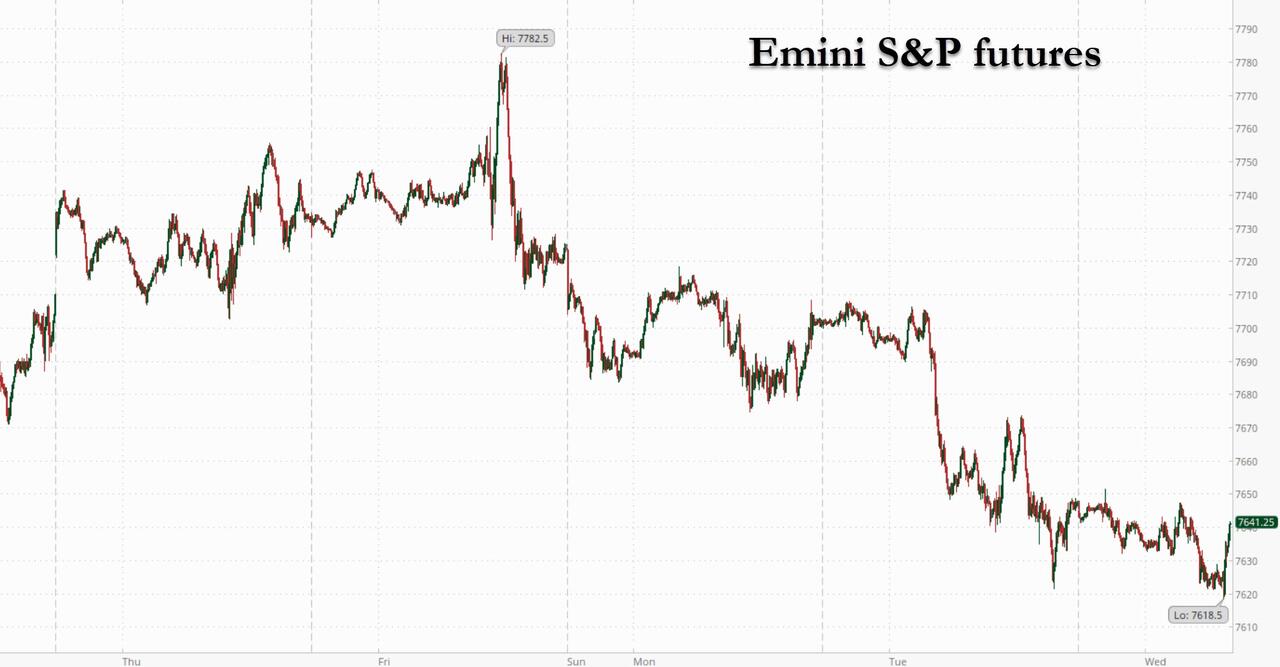
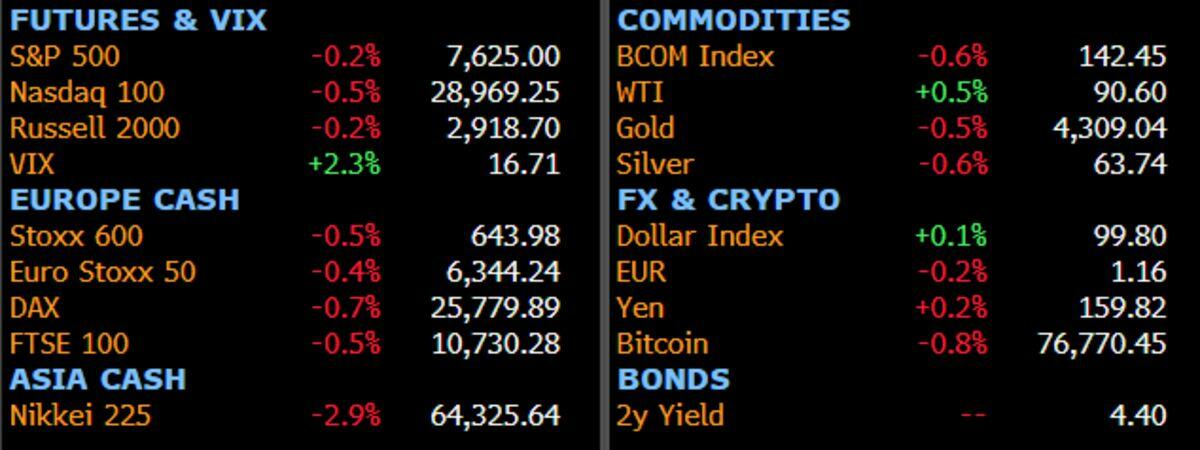
US equity futures are lower with Tech underperforming as oil prices / bond yields move higher (although off session highs), both in response to an acceleration in "kinetic hostilities" in the Middle East. As of 8:00am ET, S&P futures are down 0.1%, off session lows, while Nasdaq futures rise 0.4% after Dell shares jumped after the company boosted its annual sales forecast by $25 billion. In premarket trading, Semis / Memory are weaker and AVGO is -53bp with earnings after the Close today. Mag7 are mostly lower as are Software names with Hardware buoyed by earnings. Defensives and Energy gain while Cyclicals drop. According to JPM's Market Intel team, which on Monday turned Neutral on stocks (from Bullish), equities will continue to struggle until crude / rates stabilize. Europe’s Stoxx 600 retreated 0.7%, while Asian stocks fell the most in two weeks. WTI trades around $90/bbl as the yield curve steepens, having erased gains from Bessent’s "Treasury Twist". The Dollar is also higher as the Debasement trade continues to struggle. Commodities are mostly lower with Energy the lone bright spot and Ags underperforming Metals; keep an eye on gold to see if $4,300 acts as support. Today’s macro data focus is on the August ADP employment change (8:15am) and July factory orders (10am). Fed calendar is blank apart from Beige Book release at 2pm
In premarket trading Mag 7 stocks are mixed (Alphabet +0.1%, Apple +0.2%, Tesla +0.1%, Nvidia -0.1%, Meta -0.2%, Amazon -0.2%, Microsoft -0.4%)
- Credo Technology (CRDO) falls 9%, suggesting that the communications equipment company’s second-quarter revenue forecast beat was not good enough to impress investors after the stock’s 44% rally this year.
- Dell Technologies (DELL) jumps 8% after the company boosted its annual sales forecast by $25 billion due to surging demand for servers to run artificial intelligence tasks.
- EyePoint (EYPT) slips 3% after TD Cowen downgraded the drug developer to hold, citing a challenging regulatory path following a trial failure for an eye disease drug.
- FuelCell (FCEL) tumbles 15% after the power plant builder reported revenue for the third quarter that missed the average analyst estimate.
- G-III Apparel (GIII) falls 10% after the clothing company posted disappointing second quarter sales and provided a third quarter revenue forecast that also missed expectations.
- GitLab (GTLB) surges 21% after the software company boosted its revenue guidance for the full year, beating the average analyst estimate.
- Knife River (KNF) falls 2% after JPMorgan analyst Adrian Huerta cut the recommendation on the building materials company to underweight, writing that he doesn’t expect a “meaningful change” in public funding in Oregon, its largest market.
- MongoDB (MDB) is down 12%, with growth in the software company’s Atlas product seen coming in below elevated expectations. However, analysts are broadly positive on the results overall, which topped expectations, while the full-year forecast was raised.
- Sprinklr (CXM) falls about 2% after reported second-quarter revenue that was slightly weaker than expected; the software company’s stock has soared about 55% off a June low, as of its last close.
In other corporate news, Nvidia is in advanced talks to acquire artificial intelligence startup Hugging Face in a transaction that may total about $14 billion. Artificial intelligence coding startup Cognition AI is set to close a new round of funding that would vault its valuation to about $47 billion. GitLab shares rally as much as 20% in premarket trading after the software company beat second-quarter expectations and boosted its full-year forecast.
Brent crude hovered near $94 a barrel and WTI traded around $90 (although it has since dipped below) after Washington carried out its second round of attacks against Iran in three days. US diesel prices hit the highest since April. Bonds fell in most major markets, with the 30-year Treasury yield trading at 5.28%, near the 19-year high hit before Treasury Secretary Scott Bessent’s recent intervention. Chipmakers were under pressure in premarket trading even after Dell surged on a strong revenue forecast.
The latest rally in energy prices is compounding worries about persistent inflation, pushing up the premium traders demand for bonds already straining under heavy government spending and corporate demand. Traders put the odds of rate hikes this month at more than 50% for three major central banks, including nearly 70% for the Fed.
“The new baseline seems to be that the Fed will, after all, hike rates in September,” wrote Chris Turner at ING Groep NV. “Fed Chair Kevin Warsh has made it reasonably clear that inflation is not falling quickly enough to target and, given a reasonably strong economy, the Fed will need to act.”
While the selloff in bonds is showing few signs of letting up, the relatively modest moves in yields have offered traders some assurance. The retreat has been orderly and broad-based, rather than driven by credit risks or liquidity stress, said Stephan Kemper at BNP Paribas Wealth Management Germany.
“It suggests the market is pricing a higher-for-longer rate path, not a credit event or recession,” Kemper said. The key to lower yields lies in inflation expectations, he said, adding that any relief on longer-dated rates could “trigger a strong move higher in equities as fundamentals remain very strong.”
Dell became the latest company to reinforce optimism around the AI trade. The company increased its annual sales forecast by $25 billion in a further sign of surging demand for servers to run AI tasks. The stock — already the third-biggest boost to the S&P 500 after a 240% rally this year — jumped another 9.3% in premarket. Shares of HP Enterprise, which reports earnings after the market close, also rose, advancing 5.2%.
Yet, there are signs that investors are addressing lingering worries about high AI-linked valuations by expanding exposure. Around 115 S&P 500 stocks are on Evercore ISI’s “negative beta” list, where the rolling six-month one-day percentage change is inverse to the benchmark. The share has crossed levels last seen in the dot-com bust in 2000-2001, suggesting that “investors have proactively sought diversification” rather than waiting for a “bubble burst,” strategist Julian Emanuel writes.
Robust signals from Corporate America are offering equities a measure of support. Corporate cash piles are back to record highs despite the surge in AI spending, according to analysis by Societe Generale SA. Investors have also continued to pour money into equities, with global stocks attracting about $1.1 trillion this year, the strongest inflows since 2021, according to data from HSBC Holdings Plc.
While stock markets have remained relatively resilient, “that’s likely going to change once Treasury yields and Japanese yields break through current resistance levels,” said Patrik Lang at Global Gate Asset Management. “Positioning is a bit stretched, and short-term indicators are at overbought levels,” he said. “All of that points, regardless of the fundamental situation, to consolidation in the coming weeks.”
Elsewhere, governing Council member Joachim Nagel indicated that the European Central Bank will raise borrowing costs next week, though he stayed wary on what comes after that. Bank of Japan Board Member Hajime Takata, one of the bank’s most hawkish members, also left the door open for an outsized interest-rate increase.
European stocks are heading for a third day of declines, while futures are also pointing to a lower open on Wall Street as rising bond yields continue to deter investors. Higher oil prices continue to play a role, with Brent crude futures at around $95 a barrel. European natural gas futures have risen close to 3%. Here are the biggest movers Wednesday:
- Deutsche Bank shares rise as much as 2.5% to trade at a new 15-year high after Goldman Sachs analysts upgraded the German lender to buy, predicting it to deliver faster earnings growth than the wider sector from 2027
- InterContinental Hotels shares gain as much as 2.4% after UBS upgraded the hotelier to buy, to reflect an “attractive opportunity,” with the stock now trading at a discount or a lower-than-historical premium to certain peers
- Syensqo rises as much as 3.7% as private equity firms including Blackstone and Apollo Global Management consider bids for the chemical company’s performance and care division, according to people familiar with the matter
- TT Electronics jumps as much as 13% after the maker of electronic components for performance-critical applications posted stronger 1H profit growth than expected and said annual earnings are expected to be above current expectations
- PGE rises as much as 2.8% after Poland’s largest utility posted strong preliminary 2Q earnings that confirmed it’s benefiting from rising power prices, and its large coal production is helping insulate it from gas supply risks
- Lottomatica shares fall as much as 11.5%, the biggest intraday drop since May 2023, after the Italian gaming group announced an all-share deal to acquire Spanish rival Cirsa
- GEA Group shares fall as much as 3.6% after the company’s biggest shareholder, Kuwait Investment Authority, offered part of its stake in the German firm at a discount to the previous close
- GB Group shares tumble as much as 5.7%, briefly hitting their lowest level since 2014, after being downgraded at Berenberg in wake of the identity verification and fraud prevention company lowering its guidance last month
Asian stocks fell, following US peers lower as renewed concerns over rising oil prices and global bond yields fueled worries about the outlook for interest rates. The MSCI Asia Pacific Index dropped as much as 2.1%, snapping a six-day rally, with technology driving broad-based declines. South Korea’s Kospi slid 4% and Japan’s Nikkei fell 2.9% while benchmarks fell 1% or more in Taiwan, China and Australia. New Zealand stocks bucked the region’s broader losses and rose after the nation’s central bank raised its key interest rate for a second straight meeting in an effort to head off inflation. A rate decision is due Thursday in Malaysia.
Nick Ferres, chief investment officer at Vantage Point Asset Management, sees reason for caution. “Our sense is that the level of rates is near the point where it starts to pressure public, private balance sheets and equity valuations,” he said. “There is downside risk to risk assets in the near term.”
In FX, The Bloomberg Dollar Spot Index is up almost 0.1%. The yen is outperforming, rising 0.2% against the greenback after BOJ’s Hajime Takata left the door open for an outsized interest-rate increase.
Treasury futures edge higher in early US session, paring small declines that lifted 2- to 10-year yields to fresh YTD highs. US 10-year yield is little changed around 4.80%, earlier rising just shy of 4.82%, with German and UK counterparts higher by 4bp and 5bp respectively; US 2s10s spread is around 1bp steeper on the day, near middle of Tuesday’s range. Bunds and gilts remain under pressure following Treasuries’ late Tuesday slide: UK 10-year yields are up ~6 bps to 5.28%, the highest since 2007, and German 10-year yields are nearing 3.4%, having not topped that level since 2011. Muting Wednesday’s price action so far, oil’s advance stalled as investors weigh latest breakout of US-Iran hostilities. Japanese front-end yields climbed during Asia session after BOJ board member Hajime Takata left the door open for an outsized interest-rate increase as well as back-to-back hikes. IG dollar issuance slate includes several deals already; five offerings totaled $6 billion on Tuesday.
In commodities, WTI crude oil futures are down 0.5%, S&P 500 futures 0.2% as intensifying US-Iran hostilities support oil near top of recent ranges. Precious metals and Bitcoin are down.
US economic data calendar includes August ADP employment change (8:15am) and July factory orders (10am). Fed calendar is blank apart from Beige Book release at 2pm
Market Snapshot
Top Overnight News
- Iran has gone about seven weeks without shipping meaningful crude exports through the Strait of Hormuz, as a U.S. naval blockade succeeds where years of sanctions failed by cutting off one of Tehran's main sources of foreign-currency earnings. Unlike previous sanctions campaigns, when Iranian crude continued reaching buyers despite restrictions, the current blockade has stopped fresh crude cargoes reaching China, Tehran's only major remaining oil customer, increasing pressure on government finances and foreign-currency reserves. Reuters
- Fighting between the US and Iran over control of the Strait of Hormuz intensified after a period of relative calm, triggering a fresh jump in oil prices. The US military carried out strikes targeting radar systems and mine-laying capabilities along Iran’s southern coast, and Iran retaliated with drone and missile volleys on US bases across the Middle East: BBG
- The U.S.-Canada trade standoff is threatening to stretch past the midterm elections. The White House is shrugging off the threat. With a week to go before Canada imposes its retaliatory tariffs, aimed at key industries in states like Ohio and Texas with competitive Senate elections, tensions between Washington and Ottawa are at a steady simmer, with no sign of de-escalation. Politico
- Russia since 2023 has been helping Iran develop advanced supersonic cruise missiles, and Putin has vowed to continue to provide support to Iran. FT/Washington Post
- Bank of Japan Board Member Hajime Takata, one of the central bank’s most hawkish members, left the door open for an outsized interest-rate increase as well as back-to-back hikes, indicating he might push for a faster pace of tightening. The BOJ has raised its benchmark interest rate in quarter-point increments in the most recent three moves, while spacing the moves roughly six months apart. The size and frequency may change as circumstances evolve. BBG
- Governor Kazuo Ueda said on Tuesday that the Bank of Japan will debate raising interest rates including in September with a focus on whether inflationary risks were heightening, signaling a strong chance of a hike this month. Reuters
- The Reserve Bank of New Zealand raised interest rates Wednesday, warning that risks for higher inflation remain in play for the economy. The central bank raised the official cash rate by 25 basis points to 2.75%, in line with market expectations. BBG
- A closely followed measure of artificial intelligence token prices touched fresh lows this week, the latest sign of deflating prices in an increasingly competitive landscape.
- Anthropic is releasing a new version of its powerful Fable artificial intelligence model that it says is better at coding and science tasks, as well as more economical. BBG
- OpenAI is to restrict Astra model after rating it a critical cyber risk: WSJ.
- Dell became the latest company to reinforce optimism around the AI trade. The company increased its annual sales forecast by $25 billion in a further sign of surging demand for servers to run AI tasks. BBG
Iran News
- US President Trump posted "I’m not trying to force Iran to the bargaining table, as ABC Fake News reported. I couldn’t care less if they sign a worthless, to them, agreement. I like our position now much better, with almost total control of the Hormuz Strait, and their economy totally collapsing. They are just playing out the inevitable."
- US Treasury Secretary Bessent said Iran doesn't control the Strait of Hormuz and the US took out Iranian radar along the strait, as well as got 17mln bbls of crude out on Monday. Bessent said that China pays Iran in yuan and when yuan cannot be converted to dollars, Iran starves, while he said they are in an acceleration phase of Iran bankruptcy and maybe Iran will lash out more kinetically.
- US Central Command said forces successfully completed a wave of strikes against Iranian military targets on September 1st in which they struck targets including air defence sites, radar systems, maritime assets and facilities, mine laying capabilities, and communications sites.
- US strikes on Iranian targets on Tuesday included two Iranian government tankers under a new 'tanker for tanker' approved by US President Trump to deter Iranian attacks on tankers, according to Axios. Furthermore, US officials said around 100 targets were attacked during the strikes, while it was separately reported that the US assessed Iran was planning to expand attacks against commercial ships.
- Pakistan's foreign ministry said Army Chief Munir visited Tehran and generated substantial momentum on the Strait of Hormuz issue and that Pakistan is positive about all parties returning to the negotiating table.
- Iran's IRGC said two tankers were blown up and stopped a few hours ago after striking mines in the Strait of Hormuz. IRGC also warns of additional penalties for shipping companies.
- IRGC said it targeted US bases in Erbil, Iraq with missiles and drones. Iran's army also launched drone attacks on the US base in Bahrain, while Kuwaiti air defences confronted attacks by hostile drones. Additionally, the IRGC said it attacked a US Marines base in Jordan known as Camp Tibtain with missiles and claimed that a large number of US forces were killed in the attack. However, US and Jordan officials reported no casualties.
- Russia has been secretly helping Iran develop advanced supersonic cruise missiles, according to FT.
A more detailed look at global markets courtesy of Newsquawk
APAC stocks were pressured as the risk-off mood persisted following a surge in oil prices and upside in yields, triggered by the latest exchange of US-Iran strikes, while President Trump warned that the "biggest attack of them all... is waiting in the wings" and that there will be very little left of Iran. ASX 200 was dragged lower by underperformance in miners, materials, resources and tech stocks, while better-than-expected GDP data was overshadowed by the geopolitical escalation in the Middle East. Nikkei 225 fell amid pressure from mining and tech, while there were comments from US Treasury Secretary Bessent, who called on Japan to stop reflation and shift from Abenomics to Takaichi-nomics. KOSPI led the declines in the region with tech stocks hit alongside the higher yield environment. Hang Seng and Shanghai Comp conformed to the broad downbeat mood amid weakness in some auto names following monthly sales updates and with the mainland not helped after the PBoC's open market operations amount was at zero.
Top Asian News
- US Treasury Secretary Bessent said he emphasised the importance of sound formulation and communication of monetary policy to anchor inflation expectations in a meeting with BoJ Governor Ueda. Furthermore, he expressed strong support for Japan's decisive market and monetary steps to address the substantial undervaluation of the yen, while he noted the role of yen weakness in contributing to domestic inflationary pressures in Japan.
- US Treasury Secretary Bessent said Japan should stop the reflation now and that Abenomics is done, stating that Abenomics has worked and it is time for Takaichi-nomics. Bessent also commented that Japan is one of the most vibrant economies of the world now and that it succeeded in reflating, but now needs to shift.
European bourses trade lower again on Wednesday, as the US and Iran exchange strikes for a second consecutive night. US CENTCOM said forces successfully completed a wave of strikes against Iranian military targets, while Iran's IRGC said it targeted US bases in Iraq and launched drone attacks on the US base in Bahrain. Sectors have a slight negative tilt. Banks top the sector pile, with Travel & Leisure and Telecoms rounding out the sector outperformers. To the downside is Autos, followed by Media and Retail. An update from STOXX is lifting Nokia (+1.0%) this morning, after announcing that the Finnish telecom giant, alongside Engie (-0.3%), will join the Euro Stoxx 50. This will be effective September 21st, replacing Volkswagen (-2.7%) and Wolters Kluwer (-2.7%) in Europe's blue chip index.
Top European News
- Spanish Unemployment Change (Aug) 44.419K vs. Exp. 15.4K (Prev. 19.517K).
FX
- Mixed action in FX today with G10s continuing the bias seen throughout the week, USD is stronger against most peers as yields fail to moderate, NZD to the greatest extent but JPY outperforming (USD/JPY -0.4%).
- JPY is stronger in all major crosses with performance pronounced in EUR/JPY after pressure in the early European morning. The cross fell to a 184.55 base before paring some of the move back above the 21 and 59 DMA. No specific headline driver but known hawk Takata implied that the BoJ could possibly hike 50bps in September or deliver back-to-back hikes “need to consider a broad range of options, not just a 25bps hike each time”. However, it is worth putting these remarks in the context of Takata being a hawkish dissenter and him wanting a policy rate of 2.00% at a rapid pace; such an outcome would be unlikely to sway the rest of the board. On top of this, Governor Ueda provided some remarks overnight. He more-or-less provided two-way commentary, and ultimately did not dissuade market bets of a hike in September.
- RBNZ failed to impress hawkish expectations in its policy meeting where the OCR was raised by 25bps to 2.75% as expected. While flagging further tightening, the bank highlighted downside risks to the economy and rate projections showed less expected tightening than markets expect, with the OCR projection for December 2026 seen at 2.81% (OIS Implied Rate: 2.99%), September 2027 at 3.12% (OIS Implied Rate: 3.48%) and December 2027 3.15% (OIS Implied Rate 3.75%). As such, NZD was pressured against all G10 currencies, NZD/USD -1.1% to a 0.5825 base just below the 50DMA and will likely look to the 13th August low @0.5821, NZD could remain offered in this dim risk environment, especially if market pricing narrows compared to MPC rate projections.
- AUD was lifted after stronger-than-expected Australian GDP data, albeit remains weaker against the stronger Buck. AUD/NZD +1% testing the 1.2258 June high at the time of writing.
Fixed Income
- Global fixed benchmarks are mixed this morning. USTs (-1 tick) are mildly pressured, whilst Bunds (-52 ticks) and Gilts (-60 ticks) extend on recent pressure. Whilst USTs appear to be taking a breather following the recent downside, Bunds and Gilts continue to be subject to hefty selling, amidst higher energy prices and ongoing fears surrounding fiscal/debt sustainability.
- USTs currently hold within a 107-09 to 107-14 range. For the short-end, focus will no doubt be on key domestic data which will help decide between whether the Fed opts to hold or hike at its September meeting. The US Jobs Report is due this Friday, and the CPI late next week; a hot report on both fronts will likely see money markets extend their bets of a hike this month (currently seen at 68%).
- The US yield curve is ever-so-slightly steeper this morning. The US10yr (4.80%) remains at elevated levels, with focus on whether it can move towards the 5.00% mark. That would likely require a significant escalation on the geopolitical front and/or hawkish NFP/CPI reports to cement a September move. Even if that does not come to fruition, the 10yr may remain above the 4.75% mark until the geopolitical situation materially improves.
- Bunds and Gilts are ultimately pressured by elevated European gas prices, which are the highest in three years. There has been a lack of material newsflow dictating price action this morning, with only ECB’s Makhlouf and Nagel on the wires. The former said that the ECB should be ready to lift rates further, adding that inflation and growth metrics make him “uneasy”.
- For Gilts, the first PMQs under PM Burnham draws focus, for potential updates on the cost of living, fiscal space and other key themes.
- Australia sells AUD 900mln in 1.25% May 2032 bonds: b/c 4.21x, avg. yield 4.8949%.
Commodities
- WTI Oct and Brent Nov futures are flat/subdued following the prior day’s ~5% rise. WTI resides towards the bottom of a USD 89.92-92.29/bbl range (vs yesterday’s USD 86.13-90.97/bbl band), while Brent sits towards the lower end of a USD 94.53-97.04/bbl range (vs yesterday’s USD 90.70-95.45/bbl range). Aside from geopolitics (summarised below), data from the API also showed that US crude inventories reportedly drew down by 2.6mln bbls in the latest week (exp. -0.8mln), which would mark the first decline in five weeks.
- Dutch TTF remains elevated as Europe continues stockpiling for winter against the backdrop of supply issues from the Middle East, with the front-month contract towards the lower end of a EUR 73.20-75.33/MWh range (vs yesterday’s EUR 69.69-74.40/MWh band). European gas storage is said to be about 65% full, the lowest seasonal level in records dating to 2009.
- Metals feel no reprieve from the subdued intraday oil prices, which remain at elevated levels, whilst DXY also holds an upward bias. Gold has extended its decline as higher oil prices, bond yields and inflation concerns lifted Fed tightening bets. Spot gold is off lows as oil eases but remains under its 100 DMA (USD 4,361/oz) in a USD 4,283-4,336/oz range at the time of writing. Copper falls for a second day as higher oil prices and renewed geopolitical tensions raised global growth concerns. 3M LME copper remains above 14k/t in a current USD 14,098.55-14,226.00/t range.
- In geopolitics, US-Iran tensions escalated sharply after the US launched a fresh wave of strikes on around 100 Iranian military targets near the Strait of Hormuz. Iran responded with missile and drone strikes against US bases across various regions. On diplomacy this morning, Pakistan's Foreign Ministry remains positive about all parties returning to the negotiating table. More recently, Iran's IRGC said two tankers were blown up and stopped a few hours ago after striking mines in the Strait of Hormuz - although this prompted no reaction at the time of writing.
- US Private Inventory Data (bbls): Crude -2.6mln (exp. -0.8mln), Gasoline +0.3mln (exp. -2.4mln), Distillate -0.3mln (exp. -1.3mln), Cushing +0.2mln.
- US Energy Secretary Wright said 17mln bbls of oil transited through the Strait of Hormuz on Monday.
- Russia reportedly suspended grain export duties through 2026, RIA reported.
Trade/Tariffs
- US Treasury Secretary Bessent said at the G20 press conference that the days of settling for sub-par growth are over and he had hoped to announce a unanimous joint communique, although all but China reached a consensus. Furthermore, he said it is unsustainable to have a non-market economy export surge and that it is clear China was the dissenter at G20.
- G20 Chair statement was issued after China opposed joint communique language on trade policy, while the statement noted that the global economy remained resilient in the face of multiple shocks, including ongoing wars and conflicts, while the G20 is concerned by continued disruptions to energy trade and stress-free navigation through the Strait of Hormuz. It also stated that advancing growth is a key priority across G20 economies and working to address impediments to growth, including regulatory and administrative burdens, while G20 finance leaders urged countries to avoid unnecessary export restrictions to ensure supply chains function normally.
Central banks
- BoJ Governor Ueda said he discussed with central banks the need to communicate for appropriate monetary policy to achieve price stability as the global environment changes, while he said he held talks with Bessent, but did not comment on the details of their meeting and stated they held productive discussions on various topics. Ueda also refrained from commenting on day-to-day market moves or on markets pricing a strong chance of a September rate hike, although he stated that data released since the July meeting has been broadly in line with the projections in the quarterly report and that their basic monetary policy stance is largely unchanged from July. Furthermore, he said monetary conditions remain accommodative, so we would like to continue increasing rates, and stated that they have raised the policy rate five times so far, so need to carefully assess how the cumulative impact could affect the economy, but will also take upside price risks into account when deliberating policy.
- BoJ's Takata (hawkish dissenter) said he believes the BoJ needs to conduct rate hikes nimbly after gauging the degree of accommodation in domestic financial conditions, in addition to examining developments overseas. Takata also commented on the need to take a flexible approach to policy and that Middle East pressures could push inflation above target. Takata later stated that they need to consider a broad range of options, not just a 25bps hike each time while a different response is needed from the normal semi-annual pace of tightening.
- RBNZ raised the OCR by 25bps to 2.75%, as expected, with the MPC reaching a consensus on the decision, while the Committee judged that gradually removing monetary stimulus is appropriate to return inflation to the 2% target mid-point while supporting growth and employment. RBNZ said the decision reduces the risk that the OCR needs to increase by more later and that future policy decisions will depend on the Committee’s judgement of the balance of risks to medium-term inflation. In terms of the projections, the OCR is seen at 2.81% in December 2026 (prev. 2.84%), 3.12% in September 2027 (prev. 3.11%), 3.15% in December 2027 (prev. 3.15%) and at 3.28% in September 2029. RBNZ Minutes stated that the future OCR path is not pre-determined and indicators of medium-term inflation are consistent with inflation returning to the target.
- RBNZ Governor Breman said she expects economic growth to strengthen and broaden, while she noted that OCR projections are relatively in line with prior forecasts and that they are moving the OCR up towards neutral and it is still accommodative, but noted uncertainty regarding the neutral rate. Furthermore, she said they may need to take some time to assess the stance of policy and are not on a preset course, with the rate hike timing highly uncertain, although stated there will likely be a further OCR increase and will assess the impact of hikes already done.
- ECB's Makhlouf said the central bank must be prepared to lift interest rates further and that the combination of eurozone inflation above 3% and robust growth makes him uneasy, according to FT.
- ECB's Nagel said that markets see a more than 95% chance of a September rate hike and that markets understand rather well the ECB's way of reacting.
Geopolitics
- Russian President Putin said Russia has blocked a large enemy force in eastern Ukraine and keeps striking Ukrainian ports and energy facilities, while it is preparing massive strikes on Ukraine's energy targets. Putin also commented that Ukrainian President Zelensky's threat to close Russian airspace is state terrorism and that Moscow will respond, as well as noted that Ukrainian strikes caused real damage, but it is not critical. Furthermore, he said rumours that Russia is planning a new mobilisation to expand the army for Ukraine are utter nonsense.
- Russia attacked Ukraine's Odessa and damaged infrastructure, according to an official.
- Russia's Deputy Security Council Chairman Medvedev said "Germany deserves a direct strike on military equipment production for Kyiv", RIA reported.
US Event calendar
- 7:00 am: United States Aug 28 MBA Mortgage Applications, prior -1%
- 8:15 am: United States Aug ADP Employment Change, est. 47k, prior 44k
- 10:00 am: United States Jul Factory Orders, est. 0.7%, prior -0.3%
- 10:00 am: United States Jul F Durable Goods Orders, est. 1.1%, prior 1.1%
- 10:00 am: United States Jul F Durables Ex Transportation, est. 0.4%, prior 0.4%
Central Bank Speakers
- 2:00 pm: United States Fed Releases Beige Book
DB's Jim Reid concludes the overnight wrap
Hot days and light mornings have suddenly morphed into chilly and dark ones as I write the first EMR back from holidays. We had a lovely time hiking, zip-wiring, white water-rafting, golfing and abundantly eating. I'm not sure if the final activity has influenced the fact that none of the new school clothes we ordered for them fit. Ahead of tomorrow's back to school this is a problem I've left my wife to resolve today! As a stone-cold boast, the best news for me this summer happened the day before we went on holiday. After 42 years of playing golf, I finally became a scratch golfer with a 2 under par round at Wentworth! This was the culmination of a 17-year journey where I moved out of London specifically to get back into golf which had proved tough living in the centre of London. It's only cost me 2 serious back operations, a couple of shoulder ones, various neck injuries, plenty of arm nerve damage, near permanent golfers' elbow, and not to mention the stress its caused on knees that have had 7 operations in 12 years. The only thing that has miraculously survived this major obsession/mid-life crisis is my marriage... just. Fingers crossed I can maintain my new +0.2 handicap and marriage for as long as possible.
As meteorological autumn begun yesterday, a chill swept through markets as rising geopolitical risk, oil prices and bond yields created a risk off start to September. It's worth starting by running through some of the fresh multi-year bond yield highs seen around the world to start the month. We saw the 10yr bund yield (+1.9bps) hitting a post-2011 high of 3.34%, the 10yr OAT yield (+3.0bps) hitting a post-2008 high of 4.20%, and the 10yr gilt yield (+8.1bps) reaching a post-2008 high of 5.22%. Meanwhile in the US, the 10yr Treasury (+4.8bps) hit a post-2023 high of 4.80%, and in Japan 10yr yields have crossed 3% for the first time in 30 years. With nominal and real yields rising, that meant equities took a decent hit as well, with the S&P 500 (-0.71%) and Stoxx 600 (-0.56%) both falling yesterday. Asia has continued the declines with the Nikkei (-2.95%) and the Kospi (-3.79%) leading losses.
The fresh catalyst for the sell-off over the last 24 hours was the jump in energy prices. That follows the latest strikes at the start of the week between the US and Iran, and it meant Brent crude (+4.60%) was up to $94.65/bbl by the close, its highest level since July, whilst European natural gas futures (+3.30%) hit a 3-year high of €72.22/MWh. This morning, oil prices are further +0.67% higher trading at $95.28/bbl as we go to print.
In terms of the latest on Iran, we heard shortly after yesterday’s European close that US was carrying out strikes on Iranian targets around the Strait of Hormuz. The US had earlier warned of retaliation for Iranian missiles launched against a US military base in Jordan over the weekend and Trump posted that if “Iran retaliates for this very justified attack, they will be hit again at a much harder and higher level”. Iran then responded with what it called a “decisive operation” against US bases in the region, with local media reporting more missile interceptions in Jordan. As a reminder, the renewed escalation has come as Iran has tried to target ships transiting the Strait of Hormuz by going dark, with the US in turn seeking to degrade Iran’s ability to disrupt these flows.
The latest commodity moves came despite Treasury Secretary Bessent yesterday saying during the G20 summit that the Strait of Hormuz will be “bypassed” in two years given that oil will be going on land pipelines, and not via Hormuz. Bessent also revealed more about his plans for economic sanctions, saying that the US knows which British Virgin accounts are tied to Iran, and that the administration will be looking at airline leasing companies in its efforts to economically isolate Iran. On Iran’s side, we heard from a foreign ministry spokesman yesterday, who said that current situation doesn’t allow for return to an MoU with the US, with the reason being that the US side had violated the agreement.
Amidst the latest developments in the Middle East, as discussed at the top, bond markets extended their losses from Monday. So in the US, the 10yr (+4.8bps to 4.80%) Treasury yield reached its highest level since October 2023, while 2yr (+5.8bps to 4.40%) reached its highest level since July 2024, shortly before the Fed began its easing cycle. And investors also priced in an increasingly hawkish Fed profile for the year ahead, with the number of hikes priced by the June 2027 meeting up +5.1bps on the day to 64bps and the pricing of a September hike up to 69%. We traded as low as 27% when I started my holiday on August 17th.
That hawkish newsflow was reinforced by Fed Governor Barr yesterday, who said the Fed should raise rates in September if “inflation appears not to be moderating sufficiently.” His comments suggested he could support a hike unless inflation showed clearer signs of easing. So on top of Chair Warsh’s comments at Jackson Hole, more centrist officials also appear to be moving towards a near-term hike.
The bond selloff did temporarily ease earlier yesterday thanks to the latest batch of US data. That included a weaker-than-expected ISM manufacturing print, which fell to 54.6 in August (vs. 55.2 expected). And the components softened also, with new orders down to 53.7 (from 56.7), and employment down to 51.2 (from a post-2022 high of 52.8). Moreover, the JOLTS report of job openings also showed a weaker picture than previously thought, with job openings only at 7.271m in July (vs. 7.313m expected). In addition, the quits rate of those voluntarily leaving their role unexpectedly fell to 1.9% (vs. 2.0% expected).
Back in Europe, worries of inflation and higher energy prices continued to dominate market moves. Gilts led the losses, but that was primarily a catch-up from the previous day’s bank holiday. So the 10yr gilt yield was up +8.1bps on the day to 5.22%. Meanwhile, the 30yr gilt yield (+7.6bps) hit a post-1998 high of 5.86% with lots of talk about the government's buffer against its own fiscal rules being slashed with the recent rise in yields. All ahead of the new leadership's first budget on October 28th.
Staying with fixed-income related themes, we also saw the Euro Area-wide flash CPI print for August yesterday. That came in at 3.3% as expected, though we already had the releases from the biggest member states except for Italy (+3.2% vs +3.4% expected) beforehand. However, Euro Area core CPI was slightly on the downside at +2.4% (vs. +2.5% expected). Interestingly, the ECB’s Simkus said in an interview that “this September hike is not going to be enough” based on the current data, suggesting that more of the ECB Governing Council members are open to keeping a hawkish signal following the hike that is fully priced for next week. Expectations of ECB hikes by December rose by +3.6bps to 49bps yesterday.
The combination of higher yields and commodities also meant that equities took a hit yesterday, with stocks falling on both sides of the Atlantic. In the US that was led by the Philadelphia Semiconductor Stock Exchange Index (-2.14%), followed by the Nasdaq (-1.03%) and Mag 7 (-0.72%). In Europe, markets closed before the news of new US strikes against Iran, so the Stoxx 600 (-0.56%), FTSE 100 (-0.32%) and CAC 40 (-0.39%) posted more moderate declines while the DAX (-1.10%) underperformed. Stoxx futures are down around half a percent as I type this morning.
In Asia, as mentioned at the top, the Nikkei and Kospi are sharply lower with the S&P/ASX 200 (-1.04%) also trading notably weaker, with stronger-than-expected GDP data reinforcing expectations of another RBA rate hike later this year. Additionally, the CSI 300 (-1.25%), the Shanghai Composite (-0.82%) and the Hang Seng (-0.96%) are also lower as I type. S&P (-0.10%) and Nasdaq (-0.26%) futures are lower following last night's sell-off.
On the monetary policy front, the Reserve Bank of New Zealand (RBNZ) raised its official cash rate by 25bps to 2.75%, marking its second consecutive rate increase as it continues its efforts to curb inflation. The move was largely anticipated amid growing concerns over renewed energy-price-driven inflation pressures. Updated RBNZ projections suggest the possibility of one additional 25bp rate hike before year-end. The central bank now expects inflation to ease to 3.9% in Q3, higher than its previous estimate of 3.3%, and forecasts inflation will return to the 2% midpoint of its target range in early 2028, later than the previously expected Q3 2027.
In Australia, the economy expanded 0.4% quarter-on-quarter in Q2, surpassing expectations of 0.3% growth. On an annual basis, GDP rose 2.1%, ahead of the consensus estimate of 1.8%. Following the data release, the Australian dollar was little changed against the US dollar, while the yield on policy-sensitive three-year government bond is currently +7.5bps to 4.79%, as investors increased bets that the RBA's tightening cycle could extend into next year.
Yesterday, Japan borrowing costs remained in the spotlight when Bessent stated that he preferred the BoJ to raise interest rates to help the yen, rather than see repeated inventions in the market. Additionally, the BOJ Governor Kazuo Ueda also indicated that the central bank would continue to consider rate increases and assess whether economic and price developments remained consistent with its outlook. 2yr JGBs are around +5bp higher this morning.
Finally, in terms of other Europe data, we did get final PMI figures, with the Euro Area manufacturing revised marginally lower (52.7 vs 52.8 prevs). A downward revision from the flash reading in France and somewhat weaker outcomes in Italy and Spain were mostly offset by an upward revision in Germany. The data further reinforces the view that recent improvement in Euro Area manufacturing remains primarily a German story, which registered the highest manufacturing output index in the region.
To the day ahead now, economic data include the US August ADP report, July factory orders, and Italy July PPI. Central Bank events include the BoC decision and Fed’s Beige Book. Broadcom and Hewlett Packard Enterprise are among the notable earnings events
Related Markets
All MarketsMarket data may be delayed. Not financial advice.
How other outlets covered this
Compare allAlto found this story at 2 outlets. Same event, different framing — compare the headlines.
How this story developed
Full timelineAlto has tracked this across 53 days of coverage from 2 outlets.
- 5 Warning Signs That America's Systems Are Under StrainZeroHedge
- Futures Swing As Global Bond Yields Follow Oil Tick For TickYou are here
Powered by Gab AI
The Story At A Glance
Reading this article now — analysis appears below
💡 AI analysis provides alternative perspectives on current events