Trump's Tariff Wall Returns With Forced-Labor Duties On 60 Countries
The short version
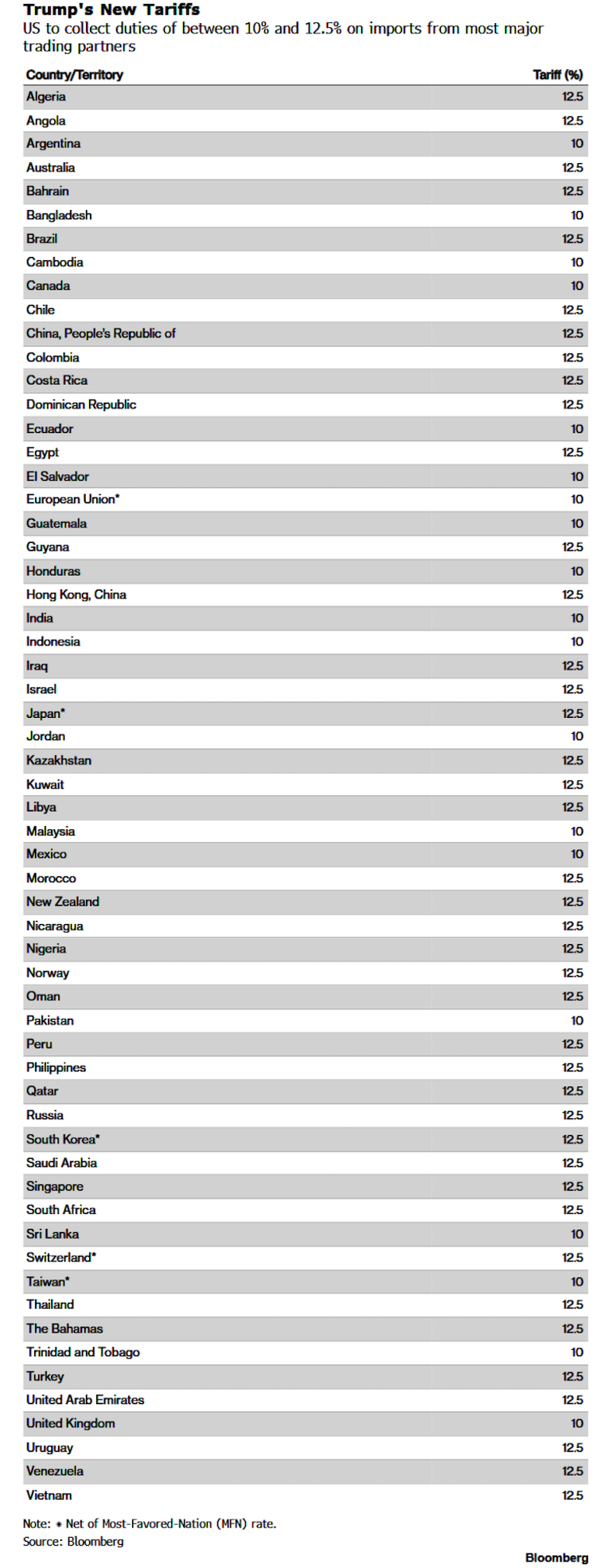
- Products from Japan, South Korea, and Switzerland will face levies of at least 12.5%, with dozens of other countries subject to a flat 12.5% tariff.
- Fuel, food, fertilizer, and products already covered by sector-specific tariffs, including automobiles, metals, and pharmaceuticals, will be exempt.
- Goods qualifying under the US-Mexico-Canada trade agreement will also be excluded.
- The tariffs take effect Friday at 12:01 a.m.
- New York time , marking the biggest move yet to restore President Trump's protectionist tariff wall since his earlier levies were struck down by the Supreme Court.
The story
The Trump administration imposed Section 301 tariffs on 60 countries accused of failing to "impose and effectively enforce" bans on goods produced with forced labor, according to a new notice from the Office of the U.S. Trade Representative.
Today, Ambassador Greer is taking action, at President Trump’s direction, under Section 301 of the Trade Act of 1974 by imposing tariffs on 60 trading partners for their failure to adopt and effectively enforce a prohibition on the importation of goods produced with forced labor.…
— United States Trade Representative (@USTradeRep) July 23, 2026
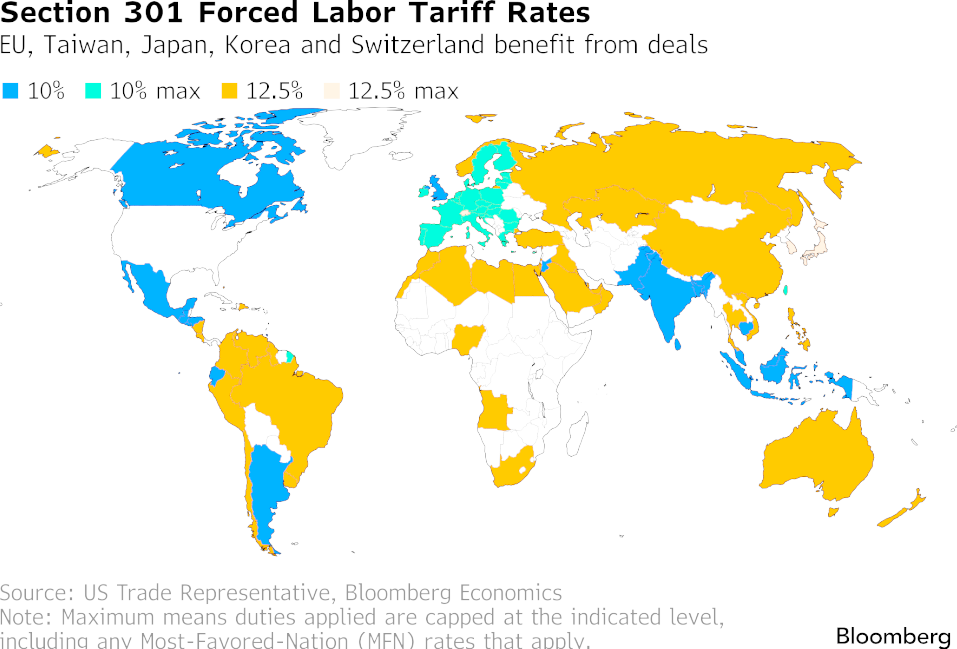
Goods from countries including Canada, Mexico, India, and the UK will face a 10% duty, while imports from the European Union and Taiwan will be taxed at least 10%. Products from Japan, South Korea, and Switzerland will face levies of at least 12.5%, with dozens of other countries subject to a flat 12.5% tariff.
Fuel, food, fertilizer, and products already covered by sector-specific tariffs, including automobiles, metals, and pharmaceuticals, will be exempt. Goods qualifying under the US-Mexico-Canada trade agreement will also be excluded.
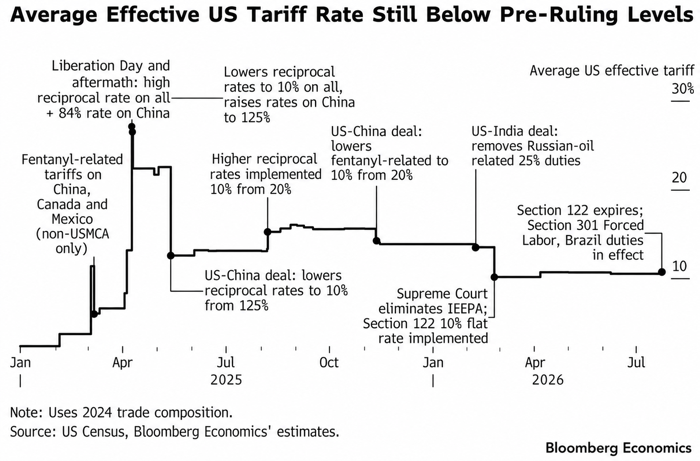
The tariffs take effect Friday at 12:01 a.m. New York time, marking the biggest move yet to restore President Trump's protectionist tariff wall since his earlier levies were struck down by the Supreme Court. After that setback, the president instituted a 10% global import tax, which expires Friday. The timing of the new levies ensures there will be no gap between the two.
"President Trump recognizes that decades of moral suasion have not eradicated forced labor from global supply chains. The United States has had a forced labor import ban for nearly a century, and rigorously enforces it; it's well past time for our trading partners to do the same," Trade Ambassador Jamieson Greer wrote in a statement.
Greer said, "Today's action will begin to correct what is both a human rights abuse and a distortive trade practice to improve the welfare of workers everywhere. I am encouraged by the trading partners who have moved quickly to adopt forced labor import prohibitions, and look forward to ensuring their effective enforcement."
Bloomberg noted that the new Section 301 levies are expected to lift the average effective U.S. tariff rate by just 0.1 percentage point to roughly 10.7%. That remains below the 13.5% rate in place before the Supreme Court's February ruling.
Ernst & Young trade expert Blake Harden was quoted by Bloomberg as saying that the Trump administration is not yet done with tariffs or with disrupting the status quo.
"There's still a lot of uncertainty hanging out there. We still have the opportunity for a lot of tariffs this year," Harden said. "Prior to this week there was sort of just a bit of a lull and maybe it felt like there was more certainty than there is. There's this thing I keep telling folks: There's a lot to come still as we get into this year."
Here's a first take from Goldman Sachs chief economist Jan Hatzius, who said the new levies should have little effect on the overall US effective tariff rate:
BOTTOM LINE: The White House released the final version of the Sec. 301 tariffs it will use to replace the current 10% Sec. 122 global tariff, which expires July 24. The details of the release suggest there should be little change to the overall US effective tariff rate. Some individual trading partners will see their ETRs move higher or lower, but generally not by much more than 1pp in either direction.
1. The White House announced a new set of tariffs to replace the current 10% global tariff under Sec. 122 of the Trade Act of 1974, which expires July 24. Following a Sec. 301 investigation into forced labor, the US Trade Representative (USTR) has released a final list of tariffs covering trading partners accounting for 95% of US imports. There would be four levels of tariffs: a 10% cap (inclusive of the preexisting MFN tariff), a 10% add-on tariff, a 12.5% cap, and a 12.5% add-on tarif
2. While the prior version of these tariffs, released in June, would have raised the US effective tariff rate (ETR) slightly (+0.25pp), the final version just released should leave the ETR essentially unchanged (-0.1pp) because of four revisions USTR made: (1) the tariff rate for several large trading partners was changed to a cap (including the MFN rate) of 10% (EU and Taiwan) or 12.5% (Japan, Korea, and Switzerland) rather than a tariff on top of the MFN rate; (2) several trading partners including Argentina, Bangladesh, Cambodia, India, Malaysia, and the UK will face a 10% rate, rather than the 12.5% proposed in the earlier version (Taiwan moves from 12.5% add-on to a 10% maximum, like the EU); (3) product exclusions for specific trading partners in recent trade deals are now reflected, and (4) some new products were added to the exclusion list for all trading partners. In general, most of the trading partners getting the lower 10% rate in the final version have a recent trade deal with the US.
3. The change in each trading partner’s tariff rate compared with the expiring Sec. 122 policy would be modest, with only a few instances of changes greater than 1pp. The EU (-0.9pp), Indonesia (-0.9pp), and Korea (-0.7pp) would see the largest declines in their US ETR as a result of the shift from Sec. 122 to the new Sec. 301 rates, while Turkey (+1.5pp), China (+1.4pp), the Philippines (+0.8pp), Vietnam (+0.8pp), Singapore (+0.6pp) and Thailand (+0.6pp) would see the largest increases.
4. The USTR did not announce any new actions related to the other Sec. 301 investigation into 16 trading partners on manufacturing overcapacity, which was started around the same time as the just-concluded investigation. While this could still come in the next few weeks, we still believe that whatever tariffs come out of that second investigation won’t take effect until after the midterm election, and we continue to expect a roughly unchanged US ETR through the end of 2026.
Meanwhile, the US Customs and Border Protection has issued refunds to importers after the Supreme Court invalidated Trump's previous tariff regime.
Related Markets
All MarketsMarket data may be delayed. Not financial advice.
How this story developed
Full timelineAlto has tracked this across 6 days of coverage from 1 outlet.
- Trump's Tariff Wall Returns With Forced-Labor Duties On 60 Countries You are here
- Futures Rebound As Brent Dips Below $100ZeroHedge
Powered by Gab AI
The Story At A Glance
Reading this article now — analysis appears below
💡 AI analysis provides alternative perspectives on current events