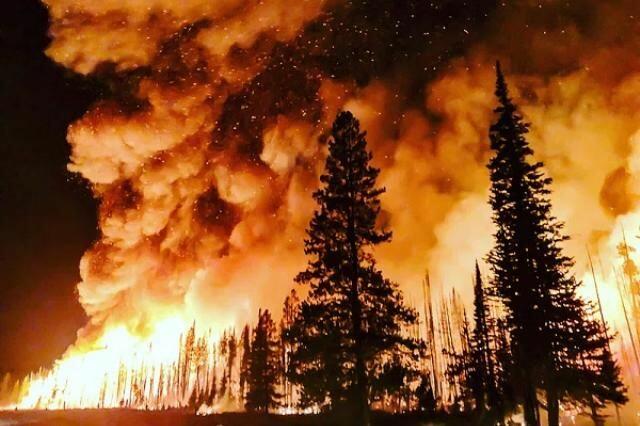
Smokey Skies Does Not Mean Global Warming

The short version
- Wildfires ignite somewhere in North America.
- Smoke drifts hundreds or even thousands of miles.
- Television stations fill the screen with hazy skylines.
- Then, before investigators have even determined how the fires started, headlines begin linking the smoke to climate change.
- As smoke from Canadian wildfires spread across parts of the Midwest and Northeast, much of the news coverage quickly shifted from reporting on the fires to treating them as…
The story
Authored by Anthony Watts via American Thinker,
Every summer seems to follow the same predictable media script.
Wildfires ignite somewhere in North America. Smoke drifts hundreds or even thousands of miles. Air quality alerts are issued. Television stations fill the screen with hazy skylines. Then, before investigators have even determined how the fires started, headlines begin linking the smoke to climate change.
This year has been no different. As smoke from Canadian wildfires spread across parts of the Midwest and Northeast, much of the news coverage quickly shifted from reporting on the fires to treating them as evidence of a worsening climate crisis. Yet one crucial fact was often left out: many of the fires responsible for the smoke were ignited by lightning, a natural cause that has existed for as long as forests have.
Lightning is not new. Smoke carried by prevailing winds is not new. What is new is the growing tendency to treat every smoky sky as proof of climate change.
That illogical leap simply isn't supported by the evidence.
One of the most striking graphics I've seen tells a story you probably haven't seen in the news. Using data from the European Commission's Global Wildfire Information System, it shows that 2026 has experienced the lowest cumulative burned area across the Americas in at least the past decade.
A second graphic, using the same global database, shows that every inhabited continent is running below its recent average for area burned this year, with Africa, the Americas, and Europe at record lows.
Those are remarkable statistics. They don't mean wildfires have disappeared or that smoke isn't a serious public health concern. They simply demonstrate that the broader wildfire picture is very different from the one often portrayed in daily news reports.
If global burned areas are unusually low, why are so many stories describing an escalating wildfire emergency and attributing it to climate change?
Part of the answer lies in how we consume news. Reporters naturally cover fires that are burning today, not forests that aren't burning. Dramatic images of smoke-filled cities attract attention. Maps showing below-average burned area rarely do. The result is a form of selection bias: the public constantly sees active disasters while receiving little context about longer-term trends. It's a variation of the old news adage, "If it bleeds it leads."
History provides even more perspective.
Another telling graph comes from fire research published by the Royal Society. Drawing on evidence from more than 800 fire-scar sites across western North America, it shows that large wildfires were substantially more common before 1900 than they are today. Fire activity declined with changes in land management, livestock grazing, settlement patterns, and organized fire suppression. In other words, today's forests are not burning at historically unprecedented levels.
The broader scientific literature reflects this. The Intergovernmental Panel on Climate Change (IPCC) in chapter 12 of their Sixth Assessment Report has concluded there is low confidence in observed global trends for fire weather and burned area. The IPCC also reports with high confidence that the global land area burned has declined in recent decades. That is a far more cautious assessment than many news reports suggest.
None of this means climate has no influence on wildfire behavior. Weather has always affected fire, and changing climate conditions may influence fire risk in some regions. But wildfire is driven by many interacting factors: ignition sources such as lightning, accidents, and even arson, wind, humidity, fuel accumulation, insect damage, forest management, decades of fire suppression, and simple bad luck. Reducing every wildfire to somehow being caused by climate change ignores most of what really determines how a fire starts and how it spreads. The smoke itself tells us even less.
Smoke is transported by normal atmospheric circulation. A relatively modest fire season can produce severe smoke episodes if winds carry the plume over densely populated areas. Conversely, enormous fires in remote regions may receive little attention if the smoke disperses harmlessly elsewhere. Smoke over Chicago, Milwaukee, or Buffalo tells us where the wind blew from. It does not tell us why the fire started, nor does it prove that climate change was the primary cause.
Good journalism should provide readers with both immediate news and historical context. Unfortunately, wildfire coverage increasingly follows a predictable formula: smoke appears, climate change is declared the culprit, and the broader evidence rarely enters the discussion.
The public deserves far better than reporting by following a script.
Wildfires are serious. Smoke poses real health risks. Those realities don't require exaggeration or selective reporting. Before every smoky summer is presented as another chapter in an inevitable climate catastrophe, readers deserve to know the full picture, including the parts that don't fit the prevailing narrative.
Because good science depends on evidence, good journalism should too.
Anthony Watts ([email protected])) is a Senior Fellow for Environment and Climate at The Heartland Institute and has over 40 years of weather reporting experience in radio, television, and print.
How other outlets covered this
Compare allAlto found this story at 2 outlets. Same event, different framing — compare the headlines.
How this story developed
Full timelineAlto has tracked this across 2 days of coverage from 2 outlets.
- Smokey Skies Does Not Mean Global WarmingYou are here
Powered by Gab AI
The Story At A Glance
Reading this article now — analysis appears below
💡 AI analysis provides alternative perspectives on current events