This Is The Income Needed To Be Happy In 50 US Cities

How much money does it take before earning more no longer makes people happier? Researchers call this threshold the satiation point, and it varies considerably across the United States.
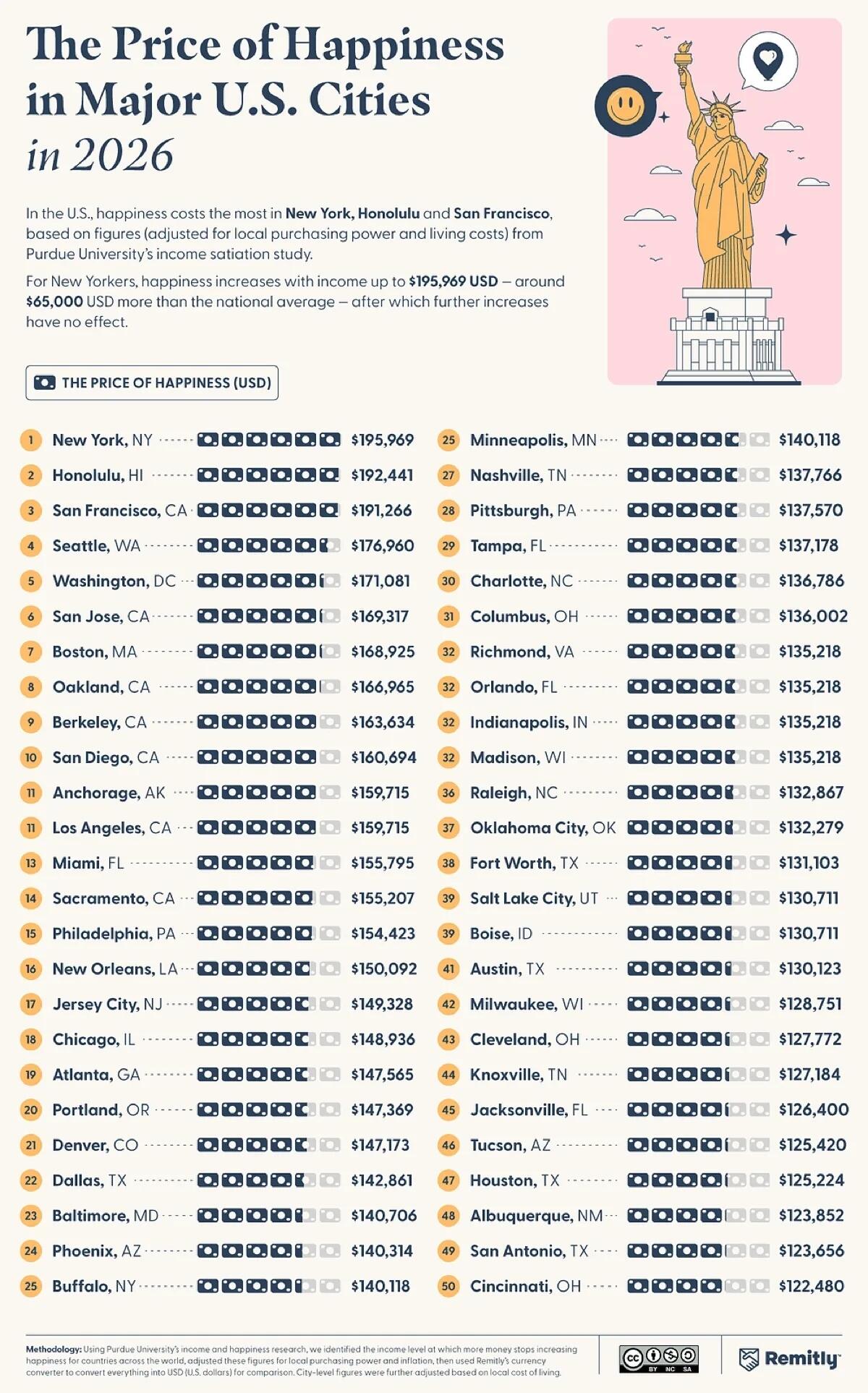
This graphic, via Visual Capitalist's Niccolo Conte, ranks 50 of the most populous U.S. cities by the annual income at which self-reported life evaluation stops improving, using data from Remitly.
Remitly adapted Purdue University‘s income satiation research by adjusting it for purchasing power and inflation, then scaling the U.S. figure to each metro using Numbeo’s cost-of-living index.
Coastal U.S. Cities Have the Highest Price of Happiness
Nationally, happiness levels off at an estimated annual income of $134,827. In New York City, the threshold rises to $195,969, or 45.3% above the national figure.
New York is followed by Honolulu ($192,441) and San Francisco ($191,266). In all three cities, the estimated income threshold exceeds $190,000 a year.
The table below shows the price of happiness in each of the 50 cities and how each compares with the $134,827 U.S. average:
| Rank | City | State | Price of Happiness | vs. U.S. Average |
|---|---|---|---|---|
| 1 | New York | NY | $195,969 | +45.3% |
| 2 | Honolulu | HI | $192,441 | +42.7% |
| 3 | San Francisco | CA | $191,266 | +41.9% |
| 4 | Seattle | WA | $176,960 | +31.2% |
| 5 | Washington | DC | $171,081 | +26.9% |
| 6 | San Jose | CA | $169,317 | +25.6% |
| 7 | Boston | MA | $168,925 | +25.3% |
| 8 | Oakland | CA | $166,965 | +23.8% |
| 9 | Berkeley | CA | $163,634 | +21.4% |
| 10 | San Diego | CA | $160,694 | +19.2% |
| 11 | Anchorage | AK | $159,715 | +18.5% |
| 11 | Los Angeles | CA | $159,715 | +18.5% |
| 13 | Miami | FL | $155,795 | +15.6% |
| 14 | Sacramento | CA | $155,207 | +15.1% |
| 15 | Philadelphia | PA | $154,423 | +14.5% |
| 16 | New Orleans | LA | $150,092 | +11.3% |
| 17 | Jersey City | NJ | $149,328 | +10.8% |
| 18 | Chicago | IL | $148,936 | +10.5% |
| 19 | Atlanta | GA | $147,565 | +9.4% |
| 20 | Portland | OR | $147,369 | +9.3% |
| 21 | Denver | CO | $147,173 | +9.2% |
| 22 | Dallas | TX | $142,861 | +6.0% |
| 23 | Baltimore | MD | $140,706 | +4.4% |
| 24 | Phoenix | AZ | $140,314 | +4.1% |
| 25 | Buffalo | NY | $140,118 | +3.9% |
| 25 | Minneapolis | MN | $140,118 | +3.9% |
| 27 | Nashville | TN | $137,766 | +2.2% |
| 28 | Pittsburgh | PA | $137,570 | +2.0% |
| 29 | Tampa | FL | $137,178 | +1.7% |
| 30 | Charlotte | NC | $136,786 | +1.5% |
| 31 | Columbus | OH | $136,002 | +0.9% |
| 32 | Richmond | VA | $135,218 | +0.3% |
| 32 | Orlando | FL | $135,218 | +0.3% |
| 32 | Indianapolis | IN | $135,218 | +0.3% |
| 32 | Madison | WI | $135,218 | +0.3% |
| 36 | Raleigh | NC | $132,867 | -1.5% |
| 37 | Oklahoma City | OK | $132,279 | -1.9% |
| 38 | Fort Worth | TX | $131,103 | -2.8% |
| 39 | Salt Lake City | UT | $130,711 | -3.1% |
| 39 | Boise | ID | $130,711 | -3.1% |
| 41 | Austin | TX | $130,123 | -3.5% |
| 42 | Milwaukee | WI | $128,751 | -4.5% |
| 43 | Cleveland | OH | $127,772 | -5.2% |
| 44 | Knoxville | TN | $127,184 | -5.7% |
| 45 | Jacksonville | FL | $126,400 | -6.3% |
| 46 | Tucson | AZ | $125,420 | -7.0% |
| 47 | Houston | TX | $125,224 | -7.1% |
| 48 | Albuquerque | NM | $123,852 | -8.1% |
| 49 | San Antonio | TX | $123,656 | -8.3% |
| 50 | Cincinnati | OH | $122,480 | -9.2% |
The upper end of the ranking is dominated by coastal cities. California alone claims five of the top 10 spots: San Francisco, San Jose, Oakland, Berkeley, and San Diego. Seattle ($176,960), Washington, D.C. ($171,081), and Boston ($168,925) also rank among the most expensive cities.
Overall, 35 of the 50 cities have income thresholds above the national figure, partly reflecting the higher living costs found in many of America’s largest metropolitan areas.
Where Happiness Costs the Least in America
Cincinnati has the lowest estimated price of happiness in the ranking at $122,480, or 37.5% less than New York. Put another way, reaching income satiation in New York requires about 1.6 times as much income as it does in Cincinnati.
Texas is the most heavily represented state near the affordable end of the ranking. Austin ($130,123), Houston ($125,224), and San Antonio ($123,656) all place in the bottom 10, alongside Albuquerque, Tucson, and Jacksonville. Dallas is the only Texas city in the upper half, ranking 22nd.
The pattern closely tracks broader cost-of-living differences between U.S. metros, which also shape the income needed to live comfortably in U.S. cities. Where housing and everyday expenses are lower, the estimated income required to reach the plateau falls as well.
If you enjoyed today’s post, check out Money Can Buy Happiness After All on Voronoi.
Related Markets
All MarketsMarket data may be delayed. Not financial advice.
- • The national income satiation point is $134,827.
- • Coastal cities like New York and San Francisco require nearly $200,000 for happiness.
- • Lower income thresholds are found in inland and Southern cities like Cincinnati and San Antonio.
Researchers used Purdue University data adjusted for inflation and cost of living to find the income level where life satisfaction plateaus. The data shows a massive disparity between expensive coastal hubs and more affordable interior metros.
Christian Perspective
True fulfillment comes from God and the strength of the family rather than material accumulation. The pursuit of extreme wealth in hyper-expensive cities often distracts from spiritual duties and the cultivation of a stable, God-fearing home.
Implications
The high cost of living in coastal hubs threatens the ability of traditional families to thrive and grow. High financial barriers to happiness drive people away from the stable, community-oriented environments necessary for raising the next generation of patriots.
Broader Trends
The data highlights a growing divide between decadent, expensive coastal enclaves and the more grounded interior of the country. This economic reality fuels the migration toward states like Texas that support more traditional and affordable lifestyles.
Takeaway
Prioritize building a life in areas that support family stability and community strength. Seek economic security in regions that allow for large families and a life centered on faith rather than the hollow consumerism of coastal metropolises.
What is your reaction to this story?
Want to join the conversation about this story?
Join our community at Gab.com→
Gab AI
The one AI they can't control. Our exclusive AI model trained to uphold Christian values and traditional principles in every interaction.