From Forward Guidance To Market Guidance: Warsh's Reflexive Wrecking Ball?

Authored by Nohshad Shah, Citadel Securities EMEA Head of Fixed Income,
The Fed sounds hawkish... but markets are testing the reaction function
Chair Warsh was unequivocal that there is “no soft inflation target”, that five-plus years of above-target inflation cannot be cured by nine weeks of better data, and that this Fed “will not waver”. Yet despite that language…and three members preferring an immediate hike…the FOMC again declined to move.
Warsh instead repeatedly highlighted the large rise in nominal and real Treasury yields since June, arguing that reduced forward guidance had allowed markets to respond more directly to the data and, in effect, deliver some tightening on the Fed’s behalf.
But all forms of FCI tightening are not equal…higher front-end yields because the Fed has acted to restrain demand are different from a higher long-end driven by investors demanding greater compensation for inflation, term risk, and uncertainty over the reaction function.
Warsh also left markets with some uncertainty over how inflation will ultimately be judged. He confirmed that PCE remains the measure attached to the 2% target under the current framework, but left open whether that will remain the case after the strategy review concludes in January, while invoking Goodhart’s Law, the Lucas critique, and a broader (but unspecified) set of inflation measures. Those are legitimate cautions against relying mechanically on a single statistic.
But investors will still want greater clarity over what the Fed will regard as evidence that inflation has returned to 2%. A fixed numerical target attached to a potentially changing measure risks making the reaction function harder to interpret, particularly while inflation remains materially above target. There may be a strong case for improving the framework, but markets will want reassurance that reform does not amount to changing the measuring stick before success has been achieved.
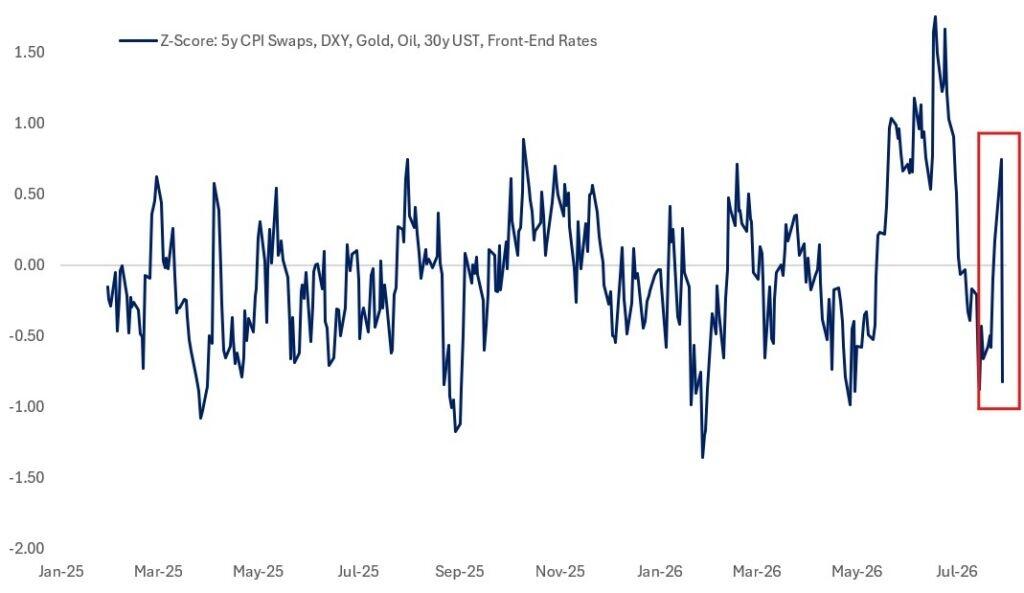
The initial market response suggests that reassurance has not yet been secured: 30y Treasuries have sold off, breakevens have widened, while equities and the dollar have weakened. Investors may interpret that combination less as a clean tightening in response to stronger growth and more as a challenge to the credibility or clarity of the policy framework.
It is also an uncomfortable outcome in a market already unsettled by rising oil prices amidst the conflict with Iran and the accelerating unwind in AI momentum. The risk from here is a negative feedback loop: higher long-end yields pressure duration equities; equities fall while bonds fail to hedge; correlated losses force further deleveraging and the resulting tightening in financial conditions gives the Fed another reason to wait…which, in turn, encourages investors to demand still more inflation and term premium.
This is the reflexivity at the heart of “market guidance”…the Fed holds because markets have tightened, while markets tighten because the Fed has held.
Markets may be able to deliver part of the required tightening, but they will still look to the Fed to anchor the inflation outlook.
Related Markets
All MarketsMarket data may be delayed. Not financial advice.
💡 AI analysis provides alternative perspectives on current events