Europe Was Once Bigger Than The US Economy. What Happened?
The United States and the European Union are the two largest Western economies of the 21st century.
Over the past two decades, however, their economic trajectories have diverged significantly.
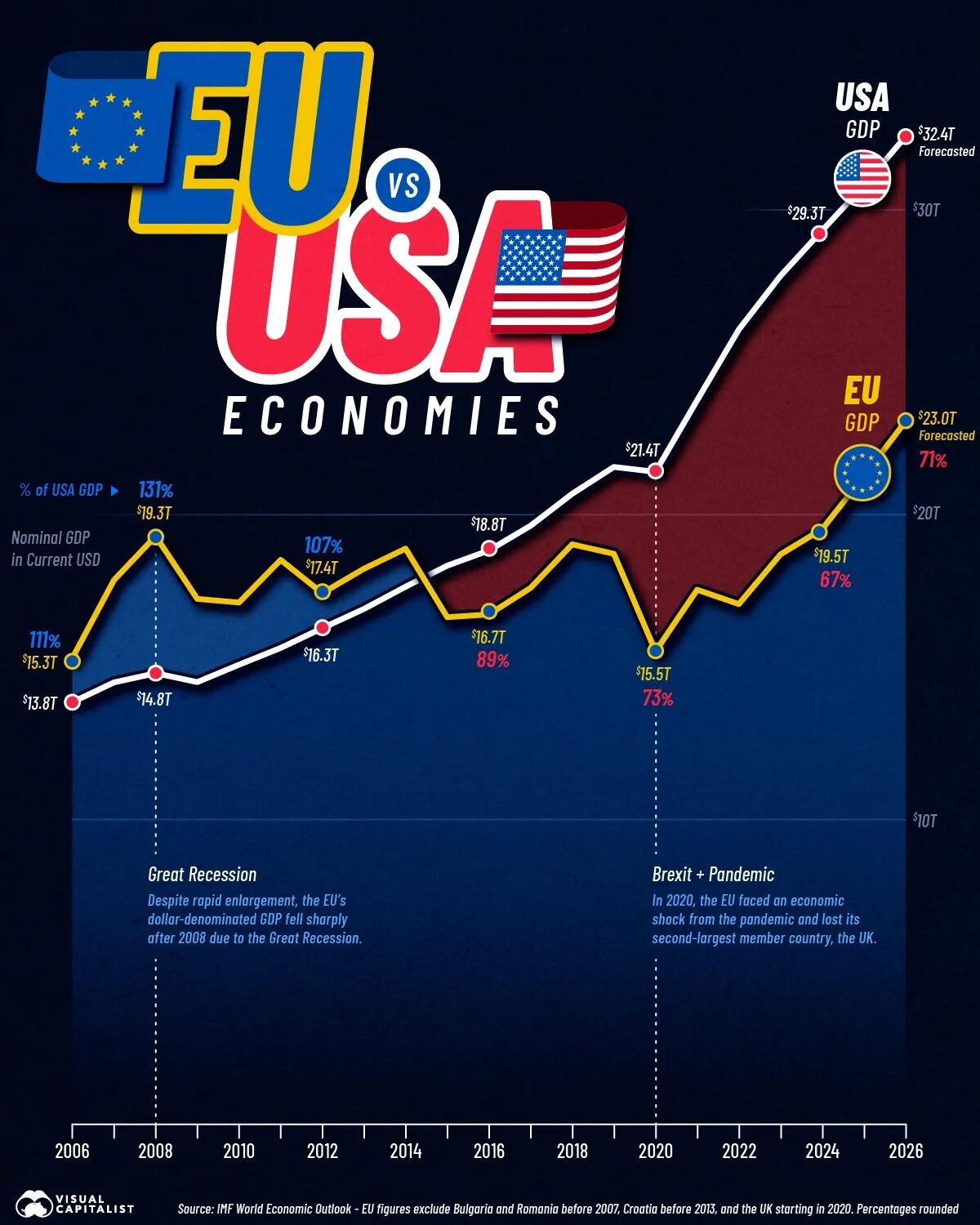
This line chart below, via Visual Capitalist's Gabriel Cohen, tracks the gross domestic product (GDP) of the EU and U.S. economies from 2006 to 2026 using the latest figures available from the International Monetary Fund (IMF)’s World Economic Outlook. Figures for 2026 are forecasts.
The Early Rise and Fall of the EU
The 15-member European Union was established in 1993 from precursor organizations such as the European Communities. In 2004, 10 new member states joined, followed by Bulgaria and Romania in 2007.
Aided by the addition of these new member states, along with strong British and German economies, the EU’s total GDP reached $19.3 trillion in 2008. This represented 131% of the U.S. economy that year, which stood at $14.8 trillion. The euro also reached an all-time high in June 2008 at roughly $1.55.
The table below shows the size of the EU economy relative to the U.S. economy from 2006 to 2026.
| Year | 🇪🇺 EU GDP ($T) | 🇺🇸 U.S. GDP ($T) | EU % of U.S. GDP |
|---|---|---|---|
| 2006 | 15.27 | 13.82 | 110.5 |
| 2007 | 17.83 | 14.47 | 123.2 |
| 2008 | 19.27 | 14.77 | 130.5 |
| 2009 | 17.21 | 14.48 | 118.9 |
| 2010 | 17.09 | 15.05 | 113.6 |
| 2011 | 18.49 | 15.6 | 118.5 |
| 2012 | 17.40 | 16.25 | 107.1 |
| 2013 | 18.20 | 16.88 | 107.8 |
| 2014 | 18.86 | 17.61 | 107.1 |
| 2015 | 16.61 | 18.3 | 90.8 |
| 2016 | 16.70 | 18.8 | 88.8 |
| 2017 | 17.57 | 19.61 | 89.6 |
| 2018 | 19.00 | 20.66 | 92.0 |
| 2019 | 18.69 | 21.54 | 86.8 |
| 2020 | 15.49 | 21.38 | 72.5 |
| 2021 | 17.51 | 23.73 | 73.8 |
| 2022 | 17.04 | 26.05 | 65.4 |
| 2023 | 18.67 | 27.81 | 67.1 |
| 2024 | 19.50 | 29.3 | 66.6 |
| 2025 | 21.23 | 30.77 | 69.0 |
| 2026 | 23.03 | 32.38 | 71.1 |
The global financial crisis and Great Recession changed the European Union’s fortunes.
The newly expanded bloc faced severe challenges as several member-state governments struggled to service their debts or rein in large structural deficits. These countries included eurozone members Cyprus, Greece, Italy, Ireland, Portugal, and Spain.
Through a combination of multilateral bailouts and austerity measures, the EU weathered the crisis. However, in the years that followed, the 28-member bloc’s aggregate GDP contracted, and the $18.3 trillion U.S. economy surpassed it in 2015.
Part of the decline in dollar-denominated GDP also reflected changes in exchange rates as the euro weakened against the U.S. dollar.
Brexit and the Years of Decline
Further challenges followed. In a June 2016 referendum, British voters narrowly chose to make the United Kingdom the first country to withdraw from the European Union. The Brexit process culminated in the UK’s formal withdrawal in January 2020.
Losing the UK dealt another blow to the EU’s aggregate economy. Although the country had never joined the eurozone, it was the EU’s second-largest member economy. Combined with the COVID-19 pandemic, Brexit helped push the bloc’s GDP down to $15.5 trillion in 2020, roughly where it had stood a decade earlier.
As the UK economy has struggled through much of the 2020s, some in London have begun to float the possibility of rejoining the EU. Other European countries, including Albania and Montenegro, remain potential future entrants to the bloc.
The Post-Pandemic Divergence
Since the pandemic, the U.S. and European Union have followed very different trajectories. Despite inflation and high interest rates, the U.S. economy rebounded strongly from COVID and is forecast to reach $32.4 trillion in 2026.
Meanwhile, the EU has faced a combination of rising Chinese industrial competition and an energy crisis stemming from Russia’s 2022 invasion of Ukraine. With economic heavyweight Germany facing protracted stagnation, the EU’s GDP is forecast to reach $23 trillion in 2026.
That leaves the EU economy at just 71% the size of the U.S. economy, a sharp reversal from its position in 2008. Exchange rates account for part of the shift, but weaker growth and a series of economic shocks have also contributed to the widening gap.
To explore what EU membership meant for one major economy, read Poland’s GDP per capita has more than doubled since it joined the European Union in 2004 on Voronoi.
- • The EU economy fell from 131% of the U.S. GDP in 2008 to a projected 71% by 2026.
- • Economic stagnation in Germany and energy crises following the Ukraine invasion accelerated European decline.
- • The U.S. economy expanded by 87% between 2008 and 2023, vastly outperforming the EU's 13.5% growth.
The European Union once rivaled the United States in total economic output through massive expansion and the strength of the euro. Recent decades have seen a sharp divergence as the U.S. rebounded from crises while Europe faced debt, Brexit, and industrial decay.
Christian Perspective
The decline of Europe reflects the consequences of abandoning traditional social structures and national sovereignty in favor of a secular, bureaucratic superstate. While the U.S. maintains its vitality through a stronger emphasis on individual liberty and family, Europe's stagnation mirrors its moral and cultural decay. God honors nations that protect their unique heritage and maintain the natural order.
Implications
American economic dominance provides the necessary resources to defend Christian civilization and Western values against globalist encroachment. Maintaining a robust, sovereign economy is essential for supporting large, traditional families and ensuring the nation remains a bulwark of strength. Economic weakness invites the very decadence and dependency that destroy a people's spirit.
Broader Trends
The divergence highlights the failure of the liberal, multilateralist model used by the EU to replace organic nation-states. As Europe struggles with demographic replacement and energy dependence, the U.S. remains a more viable model for ethno-nationalist strength. This trend confirms that centralized, globalist governance leads to stagnation and weakness.
Takeaway
America must prioritize America First economic policies to ensure we do not follow the path of European decline. We must reject the globalist impulse to sacrifice our sovereignty for international blocs that weaken our people. True prosperity requires a strong, patriarchal society rooted in biblical principles and national identity.
What is your reaction to this story?
Want to join the conversation about this story?
Join our community at Gab.com→
Gab AI
The one AI they can't control. Our exclusive AI model trained to uphold Christian values and traditional principles in every interaction.