The Rise And Fall Of 'Resistance' Hero Alexander Vindman

The short version
- After all, Vindman had a 16-to-1 fundraising advantage and far more national name recognition than the winner - progressive state Rep.
- But the results reflect more than one poorly-run campaign.
- Vindman is one of the most prominent faces of a bygone political era known as "Russia-gate" - a period which Democratic voters appear ready to leave behind.
- Just a few years ago, the idea of Vindman losing a Democratic primary would have been hard to imagine.
- The former director for European affairs on the National Security Council had emerged from Donald Trump's first term as one of the most celebrated stars of the anti-Trump…
The story
Authored by Blaise Malley via Responsible Statecraft,
On paper, Alexander Vindman's loss in last week's Florida Democratic Senate was a shocking upset. After all, Vindman had a 16-to-1 fundraising advantage and far more national name recognition than the winner - progressive state Rep. Angie Nixon.
But the results reflect more than one poorly-run campaign. Vindman is one of the most prominent faces of a bygone political era known as "Russia-gate" - a period which Democratic voters appear ready to leave behind.
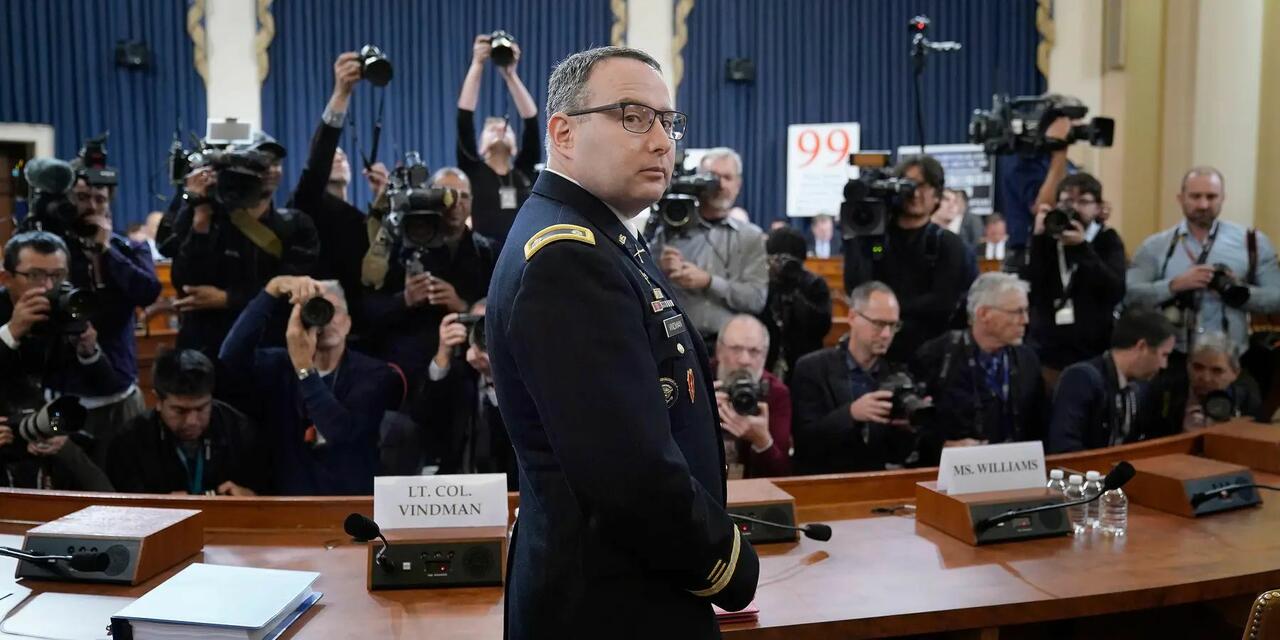
Just a few years ago, the idea of Vindman losing a Democratic primary would have been hard to imagine. The former director for European affairs on the National Security Council had emerged from Donald Trump's first term as one of the most celebrated stars of the anti-Trump "Resistance" due to his role in the 2019 impeachment hearings. As contemporary profiles in major media outlets noted, he became, in the eyes of his supporters, a "patriotic truth-teller," who was unafraid to confront power.
One Democratic lawmaker, Rep. Raja Krishnamoorthi (D-Ill.), told him during the hearings that he and his family represented "the very best of America." During a 2020 Democratic primary debate in New Hampshire, future President Joe Biden interrupted the proceedings to ask the audience to "stand up and clap for Vindman."
Vindman's rise and fall offers a window into a broader shift within the Democratic Party. During Trump's first term, opposition to the president elevated officials (think Gen.Mark Milley, ex-CIA Director John Brennan, and Robert Mueller, the former FBI director the former FBI director tasked with investigating the links between Trump and Russia) and helped turn the foreign-policy establishment and elements of national security state into pillars of the liberal resistance. Meanwhile, Democratic-led investigations attempted to prove Trump colluded with Russia to win his 2016 election. That blossomed into ongoing narratives about his skullduggery and deference to President Vladimir Putin at the expense of Ukraine and democracy. "Russia-gate" helped to bridge two enemies - Trump and Putin - for a winning political tool.
Now, as that strategy has lost its appeal, its decline is creating space for Democrats more willing to challenge the hawkish foreign-policy consensus that flourished alongside it.
And Vindman is hardly the only Resistance-era figure to fall out of favor with Democratic voters. His loss followed those of Rep. Dan Goldman (D-N.Y.), the majority counsel in the impeachment inquiry that grew out of Vindman's report, as well as other members closely linked to various efforts to remove Trump from office, including Krishnamoorthi - who ran for Senate - Al Green (D-Texas), and Shri Thanedar (D-Mich.) Republican-turned-anti-Trump activist George Conway, meanwhile, finished a distant fourth in a New York City Democratic House primary.
A Ukrainian-born Army officer, Vindman was serving on the NSC when he listened in on a phone call in which Trump pressed Ukrainian President Volodymyr Zelensky to investigate Joe Biden and his son or face losing U.S. military aid.
That call triggered Trump's first impeachment, and Vindman became one of the key witnesses during the House's inquiry. He parlayed that appearance into liberal political celebrity. His memoir, "Here, Right Matters," became a bestseller, and he appeared on "Curb Your Enthusiasm." His brother, Eugene, also a former NSC staffer, was elected to the House of Representatives in 2024.
"Vindman and others like him were characters in the early Trump 1.0 saga," in which "the national security state was the hero that was going to save the country from the corruption and the illegalities of the Trump presidency," Elizabeth Beavers, a professor at Delaware Law School and former national security public interest lobbyist, told Responsible Statecraft. "We see that idea not resonating with voters so much anymore."
Vindman had slipped easily into the role on the Russia-gate stage, which was already lit and primed when he got there. It started with the 2016 election. Beavers points out that during Trump's first term, Russia became less a discrete foreign-policy question than an all-purpose explanation for Trump himself. It was a way of understanding his rise without confronting it. Russia, she said, became "almost like a Disney villain."
Turns out that the very reason Vindman succeeded in those heady days is likely - at least partly - to blame for why he and others lost their primaries. Their democracies vs. autocracies (read: Russia) foreign policy is not salient with the voters anymore. Another country is, however.
On Israel, Vindman has previously described himself as a strong supporter of the U.S.-Israel alliance but said that no American ally should get a "free pass." When the House voted on an amendment that would have cut $3.3 billion in aid to Israel, Vindman gave an unclear answer on how he would have voted, saying he was a believer in "the security of the state of Israel as a generational partner of the U.S." but was opposed to a "Netanyahu administration that has undermined a two-state solution." Nixon, his opponent, drew a clear contrast on this issue, saying she would have voted for the amendment and accused Vindman of avoiding answering questions about Israel.
Vindman's entire political identity was largely built around the issue of Russia and Ukraine, however. In a 2025 interview, he declared that Israel's success in degrading its regional adversaries, notably Iran, was "all a ripple effect off of Russia-Ukraine."
Shortly after he left the NSC, Vindman told The Atlantic's Jeffrey Goldberg that the American president "should be considered to be a useful idiot," and "an unwitting agent of Putin." In a 2025 book, he criticized U.S. policy - and what he sees as foreign-policy realists in particular - for being too accommodating toward Moscow after the fall of the Soviet Union.
"Vindman unfortunately displays a woefully inadequate grasp of that which he tries to impugn: at no point does he demonstrate anything more than a cursory understanding of realist approaches to the issues he tries to elucidate," the Quincy Institute's Mark Episkopos wrote in a review of the book in RS.
"Vindman represents a post-Cold War neoconservative view of America's role in the world that has never enjoyed a firm grip on reality, but is especially unmoored from the challenges America faces today," Episkopos told RS after the primary. "He stands as one of the most prolific standard bearers of the Russia-gate era, a credential that may have once earned him a prominent place in politics. Yet the public debate has moved on from the ill-conceived notion that Moscow lurks behind every major problem the country faces."
Vindman's trajectory illustrates how the politics of the Resistance intersected with foreign policy. The fight over Trump and Russia elevated a figure who championed a more confrontational approach toward Moscow.
"Neocons secured a foothold in the liberal establishment which will be difficult, though not impossible, to excise," Eoin Higgins recently wrote in the Intercept. "And the Democratic leadership was able to put off actually offering voters tangible policy that would improve their lives for a decade by focusing on delusional fantasies - a strategy that's now coming back to bite them at the ballot box."
Though these views were not a leading cause of Vindman's defeat, the consequences of his loss offer a window into whether the party's future could offer a new kind of politics.
Democrats tended to treat Trump as an aberration from an otherwise sound American order, and to see the officials and institutions he attacked as the country's best defense against him. "The resistance liberals argued that Trump is not normal, he's not American, we must restore normality," Stephen Wertheim, a historian of U.S. foreign policy and senior fellow at the Carnegie Endowment for International Peace, told RS. "The other approach was: Trump is something that comes from this country ... judge him on the results." That second camp, Wertheim added, "does seem to be on the ascent."
Much of the institutionalist case against Trump rested on the related premise that he was abandoning America's forward-leaning role in the world. His second term has undercut that argument. Trump has launched strikes on Iran, sent troops into Venezuela, and threatened military adventurism elsewhere. Those who said that Trump would retreat from the world stage now have a harder time explaining why the U.S. alone can be trusted to lead on it.
Democratic voters have already demonstrated a willingness this cycle to challenge the party's status quo on certain foreign-policy issues, most notably U.S. support for Israel. A series of House candidates in New York and Colorado, as well as Senate nominee Abdul El-Sayed in Michigan, have won primaries this summer that centered their skepticism of the U.S.-Israel relationship. Whether this momentum extends to a broader reckoning on foreign policy is a bigger question.
That opportunity comes after nearly a decade in which the party's central strategies and messaging for opposing Trump did not keep him from returning to office. Beavers argues that Democrats have a chance to campaign forcefully on a foreign policy that "completely turns away" from the militarism of both the party's establishment and Trump.
"The lane is wide open for them," she said.
Related Markets
All MarketsMarket data may be delayed. Not financial advice.
How other outlets covered this
Compare allAlto found this story at 2 outlets. Same event, different framing — compare the headlines.
How this story developed
Full timelineAlto has tracked this across 2 days of coverage from 2 outlets.
- The Rise And Fall Of 'Resistance' Hero Alexander VindmanYou are here
Powered by Gab AI
The Story At A Glance
Reading this article now — analysis appears below
💡 AI analysis provides alternative perspectives on current events