Republicans Pitch Plan To Protect Investments From 'Inflation Tax': What To Know

The short version
- However, critics say it could put the government further in the red.
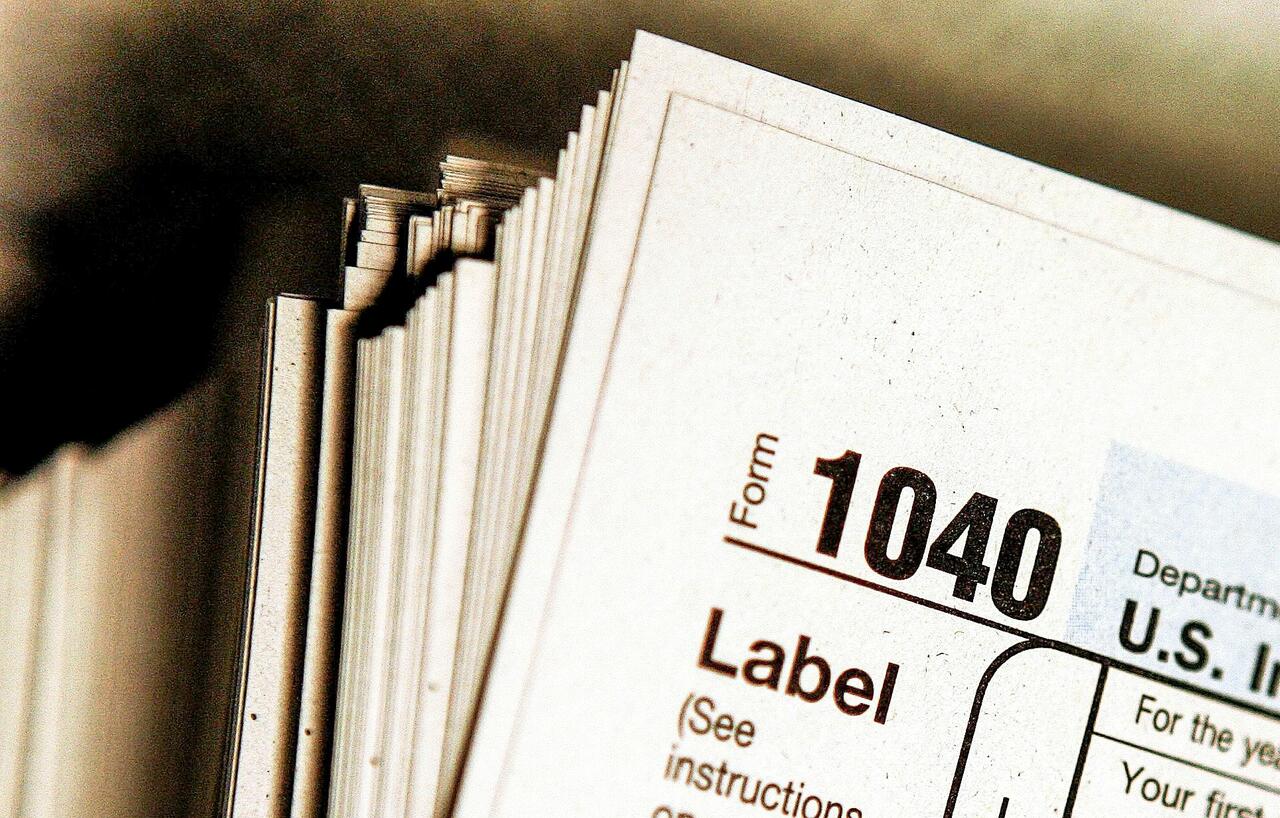
- A stack of individual income tax forms at the Des Plaines Public Library in Des Plaines, Ill., on March 23, 2006.
- Ted Cruz (R-Tex.) sponsored the Capital Gains Inflation Relief Act of 2025 to index capital gains to inflation.
- Tim Scott (R-S.C.) sent a letter to Treasury Secretary Scott Bessent urging him to enact inflation indexing without waiting for Congress.
- House Republicans sent a similar letter days later.
The story
Authored by Kevin Stocklin via The Epoch Times,
As inflation ticks upward, Republican lawmakers are pushing for capital gains taxes to be indexed to inflation, which could translate into a significant tax cut for American investors, homeowners, and savers.
However, critics say it could put the government further in the red.
Sen. Ted Cruz (R-Tex.) sponsored the Capital Gains Inflation Relief Act of 2025 to index capital gains to inflation. In March, Cruz and Sen. Tim Scott (R-S.C.) sent a letter to Treasury Secretary Scott Bessent urging him to enact inflation indexing without waiting for Congress. House Republicans sent a similar letter days later.
"Homeownership and long-term real estate investment remain central to achieving the American Dream for millions of families," House Republicans wrote. "Yet under current tax treatment, taxpayers are often required to pay capital gains taxes not only on real economic appreciation, but also on nominal gains attributable solely to inflation."
Thus far, Bessent has not stated his position on the issue. Here's what to know about the proposal.
The Cost of Inflation
Currently, Americans are taxed on assets when they sell, based on the difference between the purchase price and the sales price, or nominal gains. For those who hold an asset longer than one year, the capital gains tax rate is between zero and 20 percent, depending on a filer's overall taxable income.
But because assets appreciate over time, inflation also enters into the calculation.
"The tax code treats inflation like it is income, which it isn't," Adam Michel, director of tax policy studies at the Cato Institute, told The Epoch Times. "When you sell an asset, you're taxed on the nominal gain-real growth and inflation lumped together-so you pay tax both on dollars you earned and the phantom income from inflation."
Since 2020, the U.S. dollar has lost about 29 percent of its value to inflation. And at times of high inflation and low growth, the effective capital gains tax rate can top 100 percent, Michel said, which has occurred in at least nine years since 1957.
Inflation indexing would increase the cost basis, or purchase price, of an asset in line with inflation during the period the asset was held.
America's tax code treats long-term capital gains more favorably than other forms of income, with lower tax rates, some exemptions for homeowners, and forgiveness of gains on assets that are passed on at death. Part of the rationale is to encourage investment; part of it is that savings that are used for investment have often already been taxed.
In 2025, capital gains taxes accounted for about 10 percent of total government receipts, according to the Peter G. Peterson Foundation.
Critics say that inflation indexing will largely benefit the rich and reduce revenue for a government that runs annual deficits and is now $40 trillion in debt.
John Whiten, deputy director of the Institute on Taxation and Economic Policy, derided inflation indexing on the ITEP blog as "a massive new tax break for wealthy investors."
According to Yale University's Budget Lab, the impact on federal budgets depends on whether it applies to all current assets or only purchases when a change is implemented. Indexing all assets to inflation would reduce tax revenue by nearly $1 trillion over 10 years; if the change were limited to new asset purchases, it would reduce federal revenue by about $170 billion.
Who Benefits From Inflation Indexing?
The greatest gains would go to stock market investors, but homeowners would benefit as well.
A 2022 analysis by the Congressional Research Service (CRS) estimated that about two-thirds of total capital gains tax revenue came from corporate stock holdings. Real estate and business property together comprised about 30 percent.
In addition, the CRS states that capital gains are "largely concentrated in higher incomes" and that "the top 1% of tax units accounts for 16.7% of total income but 75.4% of capital gains."
However, looking at the number of people who would benefit from inflation indexing versus absolute dollars paints a different picture. A 2020 report by the IRS stated that 68 percent of Americans who were taxed on their capital gains earned less than $200,000.
America's federal tax code is already structured to favor homeownership. In addition to mortgage interest being deductible, capital gains tax on homes includes exemptions. For single filers, the first $250,000 in price appreciation from selling their primary residence is exempt from taxes; for joint filers, the exemption is $500,000.
Retirees who saved through 401(k) programs would generally not benefit, because those funds are not subject to tax until withdrawal, and withdrawals are taxed as current income rather than capital gains.
Experts say it is legally untested whether or not the Trump administration could implement tax indexing without congressional action. However, a similar plan was considered under the administration of President George H.W. Bush, and a CRS analysis opined in 1992 that the executive branch did not have the authority to implement inflation indexing on its own.
"Changing tax laws is Congress's job, and that's for a good reason," Michel said. "Doing this without Congress opens the rule up to both legal uncertainty and future administrations rolling it back, both of which undermine the goal of ending the inflation tax."
In addition to federal taxes, tax treatment for capital gains varies significantly at the state level, according to Kiplinger, a personal finance analytics group.
Residents of Alaska, Florida, Missouri, Nevada, South Dakota, Tennessee, Texas, Wyoming, and New Hampshire do not pay state tax on capital gains. By contrast, states such as California charge up to 13.3 percent in state capital gains taxes, with New York and New Jersey, along with the District of Columbia, all charging more than 10 percent.
Related Markets
All MarketsMarket data may be delayed. Not financial advice.
How this story developed
Full timelineAlto has tracked this across 2 days of coverage from 1 outlet.
- Republicans Pitch Plan To Protect Investments From 'Inflation Tax': What To KnowYou are here
Powered by Gab AI
The Story At A Glance
Reading this article now — analysis appears below
💡 AI analysis provides alternative perspectives on current events