US Steps Up Africa Push As China Expands Economic, Security Footprint

The short version
- "China continues to flood Africa with exports," Assistant Secretary of State for African Affairs Frank Garcia told Fox News in an interview published Aug. 27.
- Garcia said Chinese state-subsidized overcapacity threatens local industries and has left African countries exposed to debt and economic coercion.
- China's General Administration of Customs recorded approximately $348.1 billion in two-way goods trade with African nations in 2025.
- Chinese exports accounted for about $225 billion, while imports from Africa totaled about $123 billion.
- U.S. goods trade with Africa was about $83.35 billion last year, according to the U.S.
The story
Authored by Arthur Zhang via The Epoch Times,
The Trump administration says it has helped close 37 commercial deals worth $25.67 billion in Africa as Washington moves to compete with a much larger Chinese economic footprint across the continent.
"China continues to flood Africa with exports," Assistant Secretary of State for African Affairs Frank Garcia told Fox News in an interview published Aug. 27.
Garcia said Chinese state-subsidized overcapacity threatens local industries and has left African countries exposed to debt and economic coercion.
China's General Administration of Customs recorded approximately $348.1 billion in two-way goods trade with African nations in 2025. Chinese exports accounted for about $225 billion, while imports from Africa totaled about $123 billion.
U.S. goods trade with Africa was about $83.35 billion last year, according to the U.S. Census Bureau.
Pressure on African Manufacturers
Chinese imports have already hurt manufacturers in parts of Africa.
A 2025 study published in Energy Economics found that Chinese import competition reduced productivity among African manufacturers, with particularly pronounced effects on small and medium-sized firms facing financial and electricity constraints.
Research published in International Affairs in November 2025 found that more than 400 Chinese-owned manufacturers registered operations in Ghana between 2004 and 2024 as some private Chinese companies shifted from trade toward local production.
In South Africa, Chery Auto inaugurated the former Nissan plant in Rosslyn in July after acquiring it. The Chinese automaker plans to begin production there in mid-2027.
Chinese investment has also generated resentment in some communities. Chinese rights activist Jie Lijian, who spent more than seven months traveling overland through Africa in 2019 while fleeing the Chinese Communist Party's (CCP) persecution en route to the United States, told the Chinese edition of The Epoch Times in October 2020 that he repeatedly encountered complaints about Chinese companies.
In Ethiopia, Jie said police officers who initially mistook him for a Chinese company employee complained that Chinese businesses had polluted water and air and harmed livestock.
Local resistance has also at times turned violent.
In October 2024, residents of Konkoï in Guinea protested against Chinese-owned Hongxing Mining Guinea SARL over alleged damage to farmland and the local environment. Guinean and regional reports said two people died after security forces intervened, including a young man who was shot and a child who inhaled tear gas. The local prefect said at the time the company was operating legally and paying taxes, according to Guinea-based online news platform Guineematin.
Minerals Become a US Security Issue
Critical minerals are an area where China's dominant control directly impacts U.S. national security.
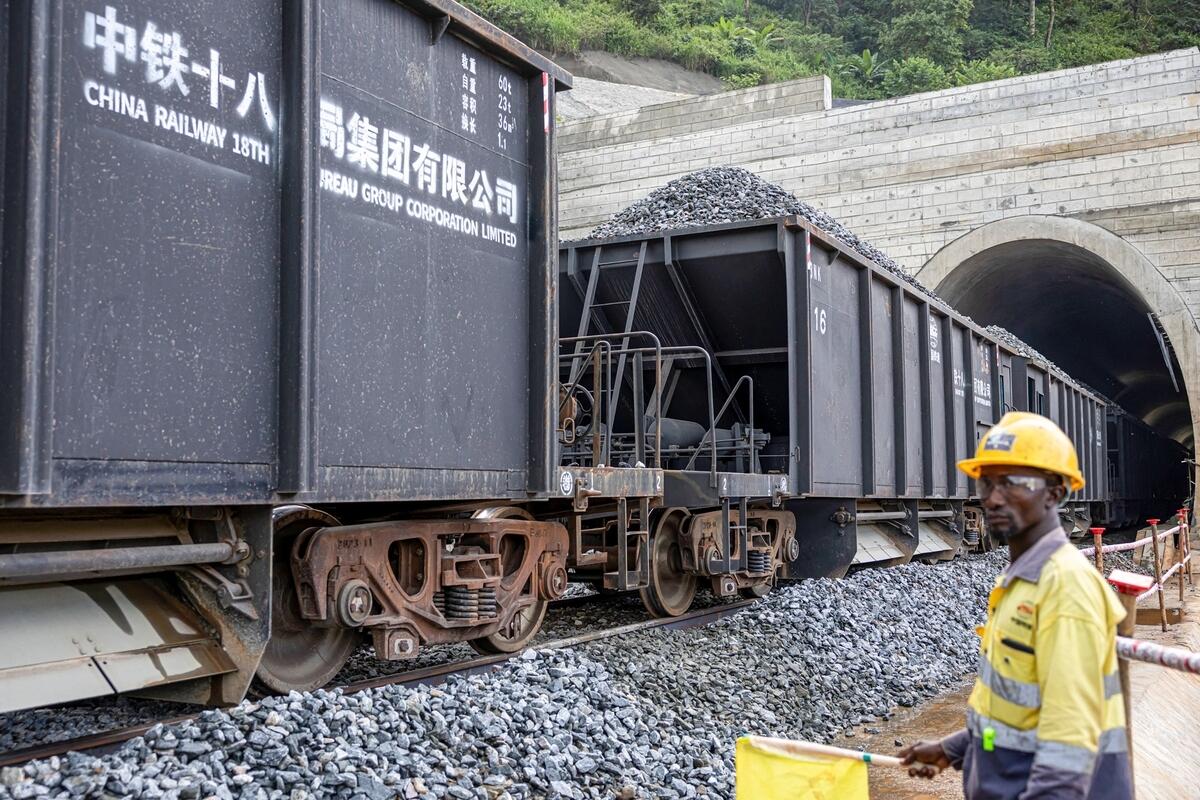
U.S. Africa Command's (AFRICOM) 2026 posture statement states Beijing is using investments in African mining, infrastructure, and transportation to secure critical minerals and strategic infrastructure.
The command singled out graphite.
"Beijing dominates 90 percent of battery-grade graphite processing," AFRICOM said.
The command called that concentration a "structural vulnerability" for the U.S. defense industrial base.
Separately, a 2026 U.S. Geological Survey report put China at 79 percent of natural graphite production, along with 98 percent of primary refined gallium, 83 percent of mined tungsten, and 68 percent of mined rare earths.
The United States is trying to build alternative supply routes.
The Washington-backed Lobito Corridor is designed to link the copper belt in Congo and Zambia to Angola's Atlantic port at Lobito.
Bernard Swanepoel, chairman of South Africa's African Exploration Mining and Finance Corp., told The Epoch Times in July 2025, "Judging from how often he mentions it, copper is central to Trump's ambitions."
He pointed to the Washington-backed Lobito Corridor.
Former Zambian Mines Minister Paul Chongo Kabuswe also told The Epoch Times at the time that China had pledged to invest $5 billion in Zambia's copper industry by 2031, including $800 million in one mine. He said Zambia was also discussing more U.S. investment with the Trump administration.
"Just because we have Chinese interest here doesn't mean we don't want United States companies here," Kabuswe said.
Armed Groups and Mining Security
In some mining regions, Chinese-linked operations have also become entangled with armed groups.
In the Central African Republic, the mining minister revoked three exploitation permits held by Chinese mining company Daqing SARL in June 2024. A 2025 U.N. Panel of Experts report said government sources found that the company had mined without authorization, interacted with armed group members, and brought unauthorized foreign workers to the site.
A July 2016 Global Witness investigation found that Chinese-owned Kun Hou Mining paid $4,000 and supplied two AK-47 rifles to Raia Mutomboki, armed factions in eastern Congo, in 2014 and 2015 to secure access to gold deposits.
Global Witness said a February 2015 letter from four Raia Mutomboki factions confirmed receipt of the money and rifles. The group also reported that Kun Hou supplied armed factions with communications equipment and food.
Chinese companies have also used overseas security contractors to protect commercial operations.
A Chinese security contractor in Sudan told the Chinese edition of The Epoch Times in April 2023 that his work included preparing security plans and supervising foreign security personnel.
Huaxin Zhong'an Security Group, a Beijing-based Chinese private security company, stated in a corporate news release in March 2022 that retired military personnel accounted for 100 percent of its overseas security employees.
Huaxin Zhong'an has hired more than 1,000 armed guards in host countries for overseas projects, and its overseas Communist Party organization helped select, vet, train, and manage security personnel sent abroad, according to a separate March 2022 statement.
Beijing Expands Military and Political Training
China is also expanding military, police, and political training in Africa.
Under the Forum on China - Africa Cooperation Beijing Action Plan for 2025-2027, Beijing pledged a 1 billion yuan ($140 million) military grant, training for 6,000 African military personnel and 1,000 police and law-enforcement officers, and visits to China for 500 young African officers.
At least 50 African countries regularly take part in Chinese professional military education, according to Paul Nantulya of the U.S. Defense Department's Africa Center for Strategic Studies.
In an October 2023 analysis, Nantulya wrote that African officers attending Chinese military schools are exposed to the CCP model of political control over the People's Liberation Army, including political commissars and the principle that the armed forces answer to the ruling party.
In a May 2023 report, the Africa Center for Strategic Studies, an institution under the U.S. Department of War and part of the National Defense University in Washington, D.C., said a South African police unit sent to China's People's Armed Forces Academy for training in 2016 was later illegally deployed into the country's top security agencies as a "hit squad" to intimidate and assassinate political rivals.
The CCP has expanded political training as well.
The Mwalimu Julius Nyerere Leadership School in Tanzania trains cadres from six Southern African ruling parties. In a November 2023 report, the Africa Center said CCP Central Party School instructors participated in the school's programs, which included party recruitment, management, administration, mass mobilization, leadership, and propaganda systems. The center said in 2025 that the school remained part of Beijing's expanding party-training network in Africa.
Ports and Strategic Access
AFRICOM is also watching Chinese-built and Chinese-controlled infrastructure for potential military use.
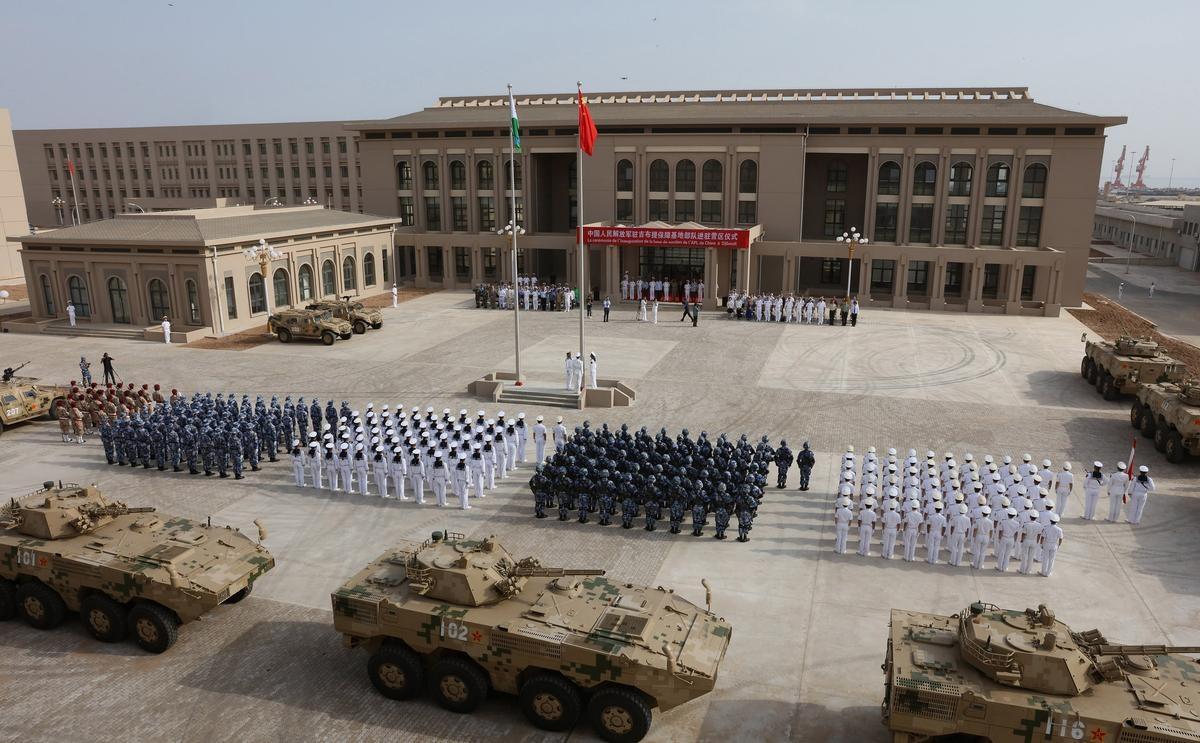
China operates its overseas military base in Djibouti, near the entrance to the Red Sea.
AFRICOM's 2026 posture statement said Beijing's investments in transportation infrastructure can support a persistent security presence.
In a response to The Epoch Times, a U.S. Africa Command spokesperson said AFRICOM leadership has "consistently warned" that Beijing is trying to expand its military footprint beyond Djibouti and establish a permanent naval presence or dual-use port facility on Africa's Atlantic coast, particularly in the Gulf of Guinea.
The spokesperson said AFRICOM is also tracking Beijing's efforts to gain access to African natural resources and to control critical minerals, infrastructure, and key sea lines of communication.
"The United States delivers enduring value as a partner of choice with capabilities only we can provide," the spokesperson said, adding that Washington's approach is based on transparency, respect for sovereignty, and mutual prosperity.
The State Department and the African Union did not respond to inquiries for further information by publication time.
Related Markets
All MarketsMarket data may be delayed. Not financial advice.
Powered by Gab AI
The Story At A Glance
Reading this article now — analysis appears below
💡 AI analysis provides alternative perspectives on current events