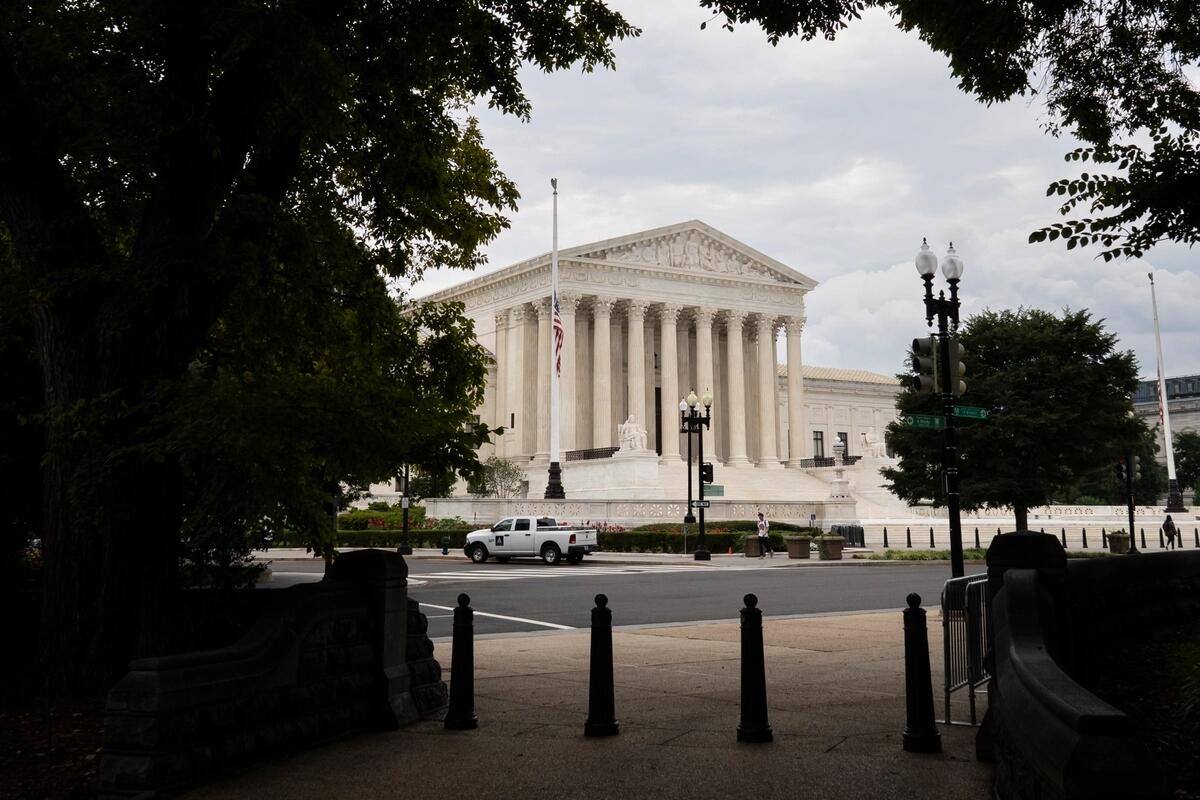
House To Vote On Locking Supreme Court At 9 Justices As Democrats Float Expanding It

The short version
- The number of justices is currently set by statute, which Congress can change by simple majority.
- If ratified, the amendment would place the figure in the Constitution, where changing it would require another amendment.
- The resolution gives states seven years from the date of submission to ratify it, and ratification requires the legislatures of three-fourths of the states - 38 of 50.
- Some Democrats have been pressing for a larger court.
- Al Green (D-Texas) introduced legislation on May 4 to increase the court from nine justices to 13, and other prominent Democrats such as former Transportation Secretary Pete…
The story
Authored by Chase Smith via The Epoch Times,
The House is expected to vote this week on a proposed constitutional amendment that would fix the size of the Supreme Court at nine justices. The number of justices is currently set by statute, which Congress can change by simple majority. If ratified, the amendment would place the figure in the Constitution, where changing it would require another amendment.
The measure, H.J. Res. 1, was introduced by Rep. Andy Biggs (R-Ariz.) and consists of a single sentence: "The Supreme Court of the United States shall be composed of nine justices consisting of one chief justice and eight associate justices."
Under Article V of the Constitution, a proposed amendment must pass both the House and the Senate by a two-thirds vote before going to the states. The resolution gives states seven years from the date of submission to ratify it, and ratification requires the legislatures of three-fourths of the states - 38 of 50.
Some Democrats have been pressing for a larger court. Rep. Al Green (D-Texas) introduced legislation on May 4 to increase the court from nine justices to 13, and other prominent Democrats such as former Transportation Secretary Pete Buttigieg, former Vice President Kamala Harris, and Rep. Jim Clyburn (D-S.C.) have all recently floated a larger court.
Green's bill has no cosponsors and has not moved out of the Judiciary Committee. Earlier versions of the Judiciary Act, sponsored by Rep. Hank Johnson (D-Ga.) in 2021 and 2023, also proposed a 13-justice court and did not receive a committee vote. The committee report on H.J. Res. 1 cites those bills as the reason for acting, saying a recent set of expansion proposals makes it necessary to fix the number in the Constitution.
House Majority Leader Steve Scalise (R-La.) listed the resolution among the week's floor items in his weekly schedule preview, alongside a separate resolution from Rep. Jeff Crank (R-Colo.) condemning socialism and the Democratic Socialists of America.
"Radical left Democrats and the [Democratic Socialists of America] want to politicize and restructure the Supreme Court, effectively destroying the constitutional safeguards our Founders put in place," Scalise's office wrote in the preview. "For years, Democrats have called for packing the Supreme Court with more left-wing judges and now the [Democratic Socialists of America] is going even further by calling to abolish the Supreme Court and replace it with a judicial system subordinate to Congress."
Biggs said in a June statement after the resolution cleared committee that the court had become a target.
"Our nation's founders built a system of checks and balances to protect citizens from concentrated power - a central part being the U.S. Supreme Court, whose duty is to defend the rights and freedoms of every American, not to serve as a political tool for any party," Biggs said. "The judiciary was designed to be the quiet guardian of liberty, insulated from the passions of the moment. Unfortunately, special interests have been increasing their attacks on the Court, threatening to pack this iconic American institution to ensure favorable outcomes for their causes."
House Democratic Caucus Chair Pete Aguilar (D-Calif.) told reporters on Tuesday that he would vote against the resolution and characterized it as a message vote timed to the midterm elections.
"This is such a fake issue that Republicans are putting on," Aguilar said. "The American public aren't asking about this. I went around the country, the vice chair did a bunch of travel, I did a bunch of travel. Nowhere, ever, are people saying, 'You know what we should do? We should cap the number of Supreme Court justices.'"
Aguilar said he expected the resolution to reach the floor on Wednesday and that he would oppose it.
"I understand that Republicans are gonna try to put up votes - socialism vote, Supreme Court justices," he said. "These are all just kind of show votes. Assuming that this passes a rule, I'll vote no, because this is just a complete show vote."
Asked whether Democrats who have called for adding seats put the party at odds with its own leadership, Aguilar said expansion is not what the caucus is pushing.
"The argument among folks in our party is we want to reform the court, but we've said very clearly that that should be a code of ethics that they actually follow," he said. "There needs to be real reform within the government side of what we do, and that's every branch of government. Democrats have been loud and clear about that, and we continue to advocate for that, and we will when we're in the majority."
Aguilar's framing tracks what House Democratic leaders said in May, when Minority Leader Hakeem Jeffries (D-N.Y.) and Caucus Vice Chair Ted Lieu (D-Calif.) each said judicial reform would be a priority if Democrats win the majority in November. Lieu said at the time that a Democratic majority would "usher in massive Supreme Court reform," and Jeffries listed "massive judicial reform" alongside electoral and campaign finance reform. Neither specified what changes they would seek.
Judiciary Committee Debate and History
The House Judiciary Committee approved the resolution on June 3 by a vote of 15-8. No Democrat on the committee voted to report the resolution to the floor.
In dissenting views filed with the committee report, Rep. Jamie Raskin (D-Md.), the committee's ranking Democrat, criticized the vote as being about giving up congressional power rather than the number of justices.
"The question H.J. Res. 1 presents is not really about whether nine should suddenly become a magic number of justices for the Supreme Court," Raskin wrote. "It's about whether this Republican-controlled Congress - which has already surrendered congressional war powers, congressional taxing and tariff powers, and congressional spending powers to a president desiring to be a king - should now permanently relinquish another constitutional power that the Framers gave to us in Article I."
Raskin also accused the Supreme Court of being "profoundly partisan and lopsided" and wrote that the measure is meant to freeze the current court in place, pointing to the handling of two vacancies during President Barack Obama's and President Donald Trump's first terms.
He said that the amendment has no realistic path to becoming part of the Constitution.
Congress has changed the court's size several times, according to a Congressional Research Service report cited by the Judiciary Committee.
The Judiciary Act of 1789 created a six-member court. Congress voted in 1801 to reduce it to five, but that change never took effect - the law applied only once a seat came open, and Congress repealed it before any vacancy occurred.
Several statutes over the following decades changed the number again, reaching 10 justices during the Civil War, the largest the court has ever been. Congress cut the number to seven in 1866, again through attrition rather than removing sitting justices, then set it at nine in 1869. That was the last time Congress changed the court's size.
The report, "'Court Packing': Legislative Control over the Size of the Supreme Court," says scholars disagree about why Congress made those changes, with some pointing to practical needs such as caseload and others arguing they were driven by political considerations.
The committee report says that during the period when the court's size moved with the number of circuits, justices were also responsible for hearing cases in the lower federal courts, and that once that practice ended, there was no longer a reason to change the court's size as new lower courts were created.
Related Markets
All MarketsMarket data may be delayed. Not financial advice.
Powered by Gab AI
The Story At A Glance
Reading this article now — analysis appears below
💡 AI analysis provides alternative perspectives on current events