All Bubbles End In Deflation

The short version
- So far…the Bubble in the US is broader than any in history.
- It has been inflating everything it touched for the last 30 years.
- How they pop is the confusing whirlwind we enter today.
- Even in the worst crash, real wealth doesn’t disappear, it just changes hands.
- When the stock market goes down, those with stocks have less paper wealth…and less of a claim on real wealth.
The story
Authored by Bill Bonner via DailyReckoning.com,
We begin this week’s perambulations with a stroll into the future.
So far…the Bubble in the US is broader than any in history. It has been inflating everything it touched for the last 30 years.
All bubbles pop, of course. How they pop is the confusing whirlwind we enter today.
But don’t worry. Even in the worst crash, real wealth doesn’t disappear, it just changes hands. When the stock market goes down, those with stocks have less paper wealth…and less of a claim on real wealth. They are ‘poorer.’ That leaves those without stocks relatively richer. They have a bigger claim on the real goods and services the economy produces.
The feds and their elite cronies have a good racket going…diddling markets so as to shift more and more wealth away from the public and towards themselves. They own most of the capital assets…and they control the US budget. Pressuring interest rates lower, and backing up the stock market with bailouts and ‘put’ options…they’ve gotten richer and richer. As we saw last week, at today’s prices the stockholding class can theoretically buy twice the GDP…and have $10 trillion left over.
It wasn’t capitalism that made them so rich; it was a corrupt money system. And if the dogs of capitalism were unleashed, they’d have their fake money fortunes for dinner. Interest rates would be set by honest savers and borrowers — not by Fed policy decisions. Prices would be determined by buyers and sellers; the budget would be balanced; the debt would be cleaned up; the troops would come home; inflation would disappear; and the Baltimore O’s would win the World Series.
But of course, we’re dreaming.
Sticking to the real world…
Our high confidence guess is that the bubble will deflate. Everything will fall in price. Then, the feds will panic. They will do ‘whatever it takes’ to stop markets from doing their work — with more fake money, lower interest rates, yield curve control, quantitative easing. And probably some tricks we haven’t heard of yet.
After an initial sell-off, gold will go up. It will sniff out what is coming — more inflation. Other real asset prices too — from hot dogs to hotels — will get a whiff of the coming price hikes. Consumer prices will rise as ‘inflation expectations’ increase.
The feds really only have one tool — fake money. In a crisis, they will produce more of it…a lot more. And, in addition to the quantity of money coming into the economy, there’s another key inflation variable: the velocity of money. A dollar spent two times in a year is counted twice.
When people think the feds are going to print money, the dollar becomes a hot potato. They aim to get rid of it as soon as possible. Sales go up in the short run. In the longer run, the economy is destroyed.
And here’s an important addendum. We say ‘inflate or die.’ But those are just policy choices. In the long run, you can inflate all you want. The bubble will still die — a later, more gruesome death.
In the fight between markets on one side…and politicians, grifters, fixers and central planners on the other…markets always win, eventually. They win by deflation.
Even in an inflationary blow off — with prices soaring — real prices fall. Consumer prices rise, in nominal currency. But gold — real money — typically rises even more…so that in gold terms, real things actually become cheaper. Prices deflate in real terms.
Observers in Germany’s record-setting hyperinflation remarked that foreigners were able to use dollars — then, backed by gold — to buy things at absurdly low prices. By November, 1923, a dollar was equal to 4.2 trillion marks. This made American visitors trillionaires (in marks) allowing them to buy whole houses for the price of a magazine subscription. In real terms, prices had deflated down to almost nothing.
We witnessed it, ourselves, in Argentina. In pesos, consumer prices more than doubled every twelve months…but dollars (even with a dodgy dollar) made them cheaper than ever. We would go to a restaurant, for example, and feel guilty about paying so little for such a good meal.
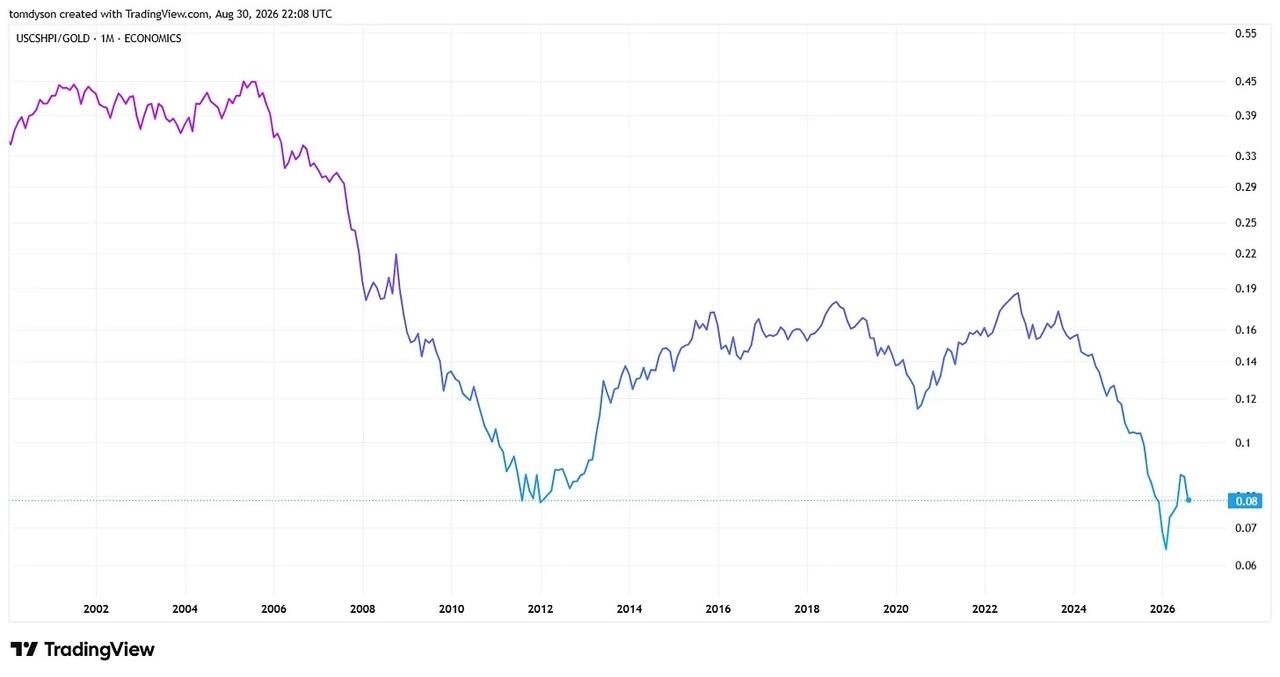
The same phenomenon is already taking place in America, too. Housing has gotten much more expensive, right? And the stock market is much higher too, right? But looked at in terms of gold, stocks are less than half of what they were worth in 1999…and the Case-Shiller Home Price Index, expressed in gold, shows house prices down about 80% over the last quarter century.
The Case Shiller Home Price Index, in gold terms, has fallen around 80% in the last 25 years.
In real terms, all bubbles deflate…but you need real money to see it.
Related Markets
All MarketsMarket data may be delayed. Not financial advice.
How this story developed
Full timelineAlto has tracked this across 2 days of coverage from 1 outlet.
- All Bubbles End In DeflationYou are here
Powered by Gab AI
The Story At A Glance
Reading this article now — analysis appears below
💡 AI analysis provides alternative perspectives on current events