'Crisis Preparedness': Dutch Move Billions In Gold Out Of US As Goldman Warns Of 'Geographic Concentration Risk'

The short version
- "With this relocation, we have improved the tradability of our gold reserves.
- We expect that we will never need to use them, but we do need to strengthen our resilience and preparedness," DNB Governor Olaf Sleijpen said of the development.
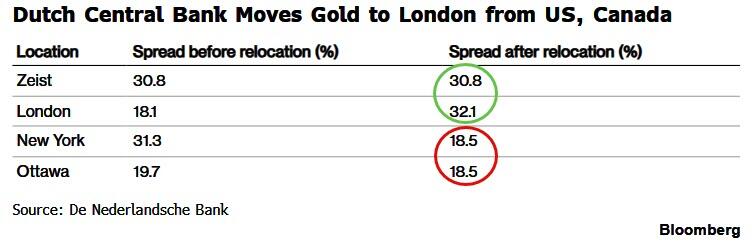
- Roughly 25% of the gold reserves stored in New York and Ottawa were moved to London over the summer.
- The bank holds 30.8% of its 612.4 tons of gold reserves at its cash center in Zeist, southeast of Amsterdam. “Keeping a larger share of the gold reserves in London strengthens the…
- Preparations to move the gold were not disclosed until the process was completed because it was a matter of vital public interest…
The story
The Netherlands' central bank transferred nearly 90 metric tons of gold bars from the United States and Canada to Britain amid growing concerns of "increasing geopolitical unrest," according to CNBC.
"With this relocation, we have improved the tradability of our gold reserves. We expect that we will never need to use them, but we do need to strengthen our resilience and preparedness," DNB Governor Olaf Sleijpen said of the development.
Roughly 25% of the gold reserves stored in New York and Ottawa were moved to London over the summer.
CNBC reports:
The transferred gold is now stored with the Bank of England because gold stored there must meet international trade standards and is recognized as "the world's most easily tradable gold," DNB said, adding that the move strengthens its "crisis preparedness."
By contrast, DNB said the gold bars held in the U.S. and Canada could not be utilized as quickly and directly in a crisis situation.
The bank holds 30.8% of its 612.4 tons of gold reserves at its cash center in Zeist, southeast of Amsterdam.
“Keeping a larger share of the gold reserves in London strengthens the function of gold as an anchor of trust,” the Dutch central bank said.
Preparations to move the gold were not disclosed until the process was completed because it was a matter of vital public interest, Finance Minister Eelco Heinen said in a statement.
The Dutch central bank is not the first major European institution to shift gold out of the U.S. in recent years.
In 2025, France's central bank pulled 129 metric tons of gold, then valued at $15 billion, from U.S. vaults and replaced it with newer, high-quality bullion held in Paris. At the time, Francois Villeroy de Galhau, then-governor of the Banque de France, claimed that the move was not politically motivated.
"The residual portion of the stock, amounting to 129 tonnes or 5% of the total, which was held in New York, did not meet this standard. Rather than embarking on a lengthy and risky logistical operation, the simplest solution was to sell this gold and then buy back gold of the highest standard in Europe," the French central banker said in a statement.
"The sale of these US gold bars generated an exceptional capital gain of EUR 11 billion in 2025. This capital gain was duly recorded in the Banque de France's accounts and therefore belongs, along with the Bank's very sound net equity (EUR 283 billion), to all French citizens. France's gold reserves stand at 2,437 tonnes and will remain unchanged."
Meanwhile, advocacy groups in other major EU countries have voiced similar ambitions. Michael Jager, who heads the European Taxpayers Association, has pushed for Germany to bring its gold home, saying "Trump is unpredictable" and that the metal was "no longer safe" in the U.S., according to the New York Post.
The sums involved are substantial.
The Bundesbank holds roughly 3,350 metric tons of gold, of which 1,236 tons, roughly 37%, sit in New York.
However, Bundesbank President Joachim Nagel has dismissed the notion that the New York holdings are at risk.
"I have no doubt that the gold is safely stored at the Federal Reserve in New York," he said in an interview with WELT earlier this year.
"Eventually, the US would hurt itself most if it were to call that legal status into question in any way and thereby put the confidence of financial markets at risk."
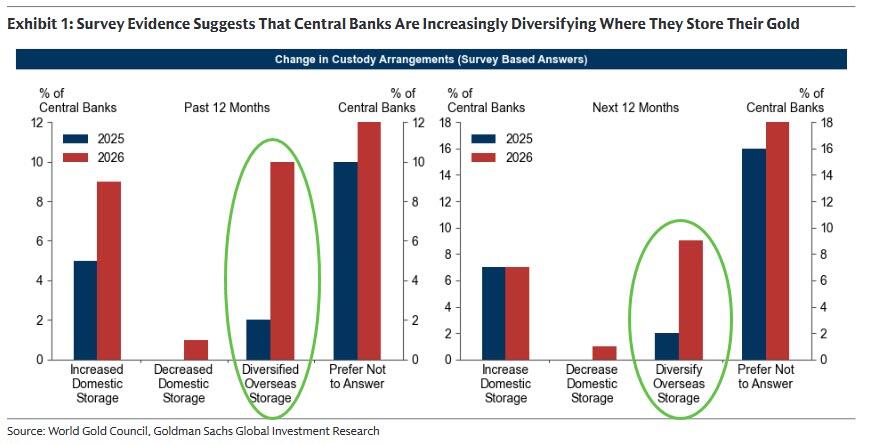
The recent acceleration in geographical shifts of the location of central banks' precious metal hordes has not been lost on Goldman Sachs who recently noted that "The location of central bank’s gold holdings appears increasingly top of mind for reserve managers."
In an excellent note from Lina Thomas (available here in full for pro subs), she begins by noting that "the location of central bank’s gold holdings appears increasingly top of mind for reserve managers."
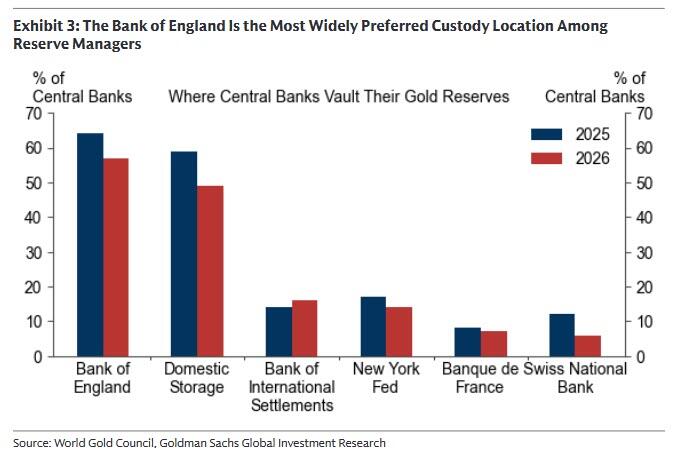
The Bank of England remains the most popular custodian (preferred by 57% of reserve managers in the World Gold Council survey), with the New York Fed also important, because gold there sits in the main settlement networks and can be used for swaps, leasing, and immediate market access.
The trade-off is political risk - freezing or restricted access, as with Venezuela’s gold at the BoE in 2018.
Thomas also notes that full repatriation is not the default solution: domestic vaults are costly for smaller banks and swap one set of risks for another.
Instead, many banks are spreading holdings across jurisdictions (BoE, NY Fed, BIS, Banque de France, and increasingly China) to keep liquidity while reducing single-jurisdiction exposure.
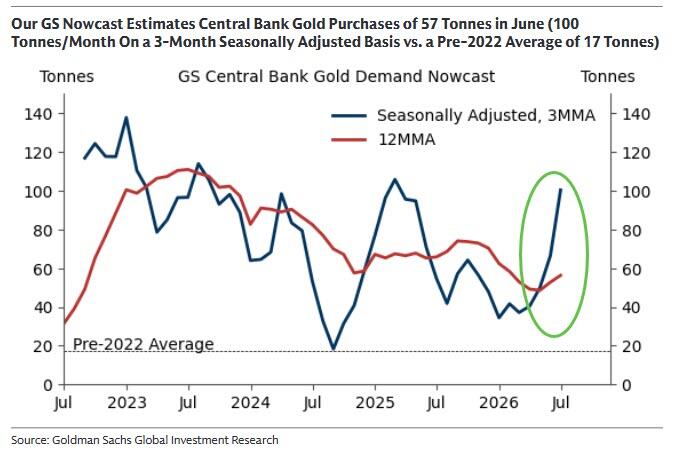
However, amid all this location-shifting, it remains clear that central banks are anxiously holding on to (if not adding to) their gold hordes and Goldman Sachs’ NowCast puts June central-bank buying at 57 tonnes (about 100 tonnes a month on a 3-month seasonally adjusted basis, versus a pre-2022 average of 17 tonnes), with China the largest identifiable buyer.
A 32-tonne inflow of monetary gold into London looks more like a custody transfer than sales, given a 98-tonne rise in foreign official holdings at the BoE.
With all that said, Goldman maintains its $4,900/oz end-2026 forecast, assuming roughly 50 tonnes a month of official buying in 2026 and 40 tonnes in 2027, driven by EM reserve diversification after the 2022 freeze of Russia’s assets.
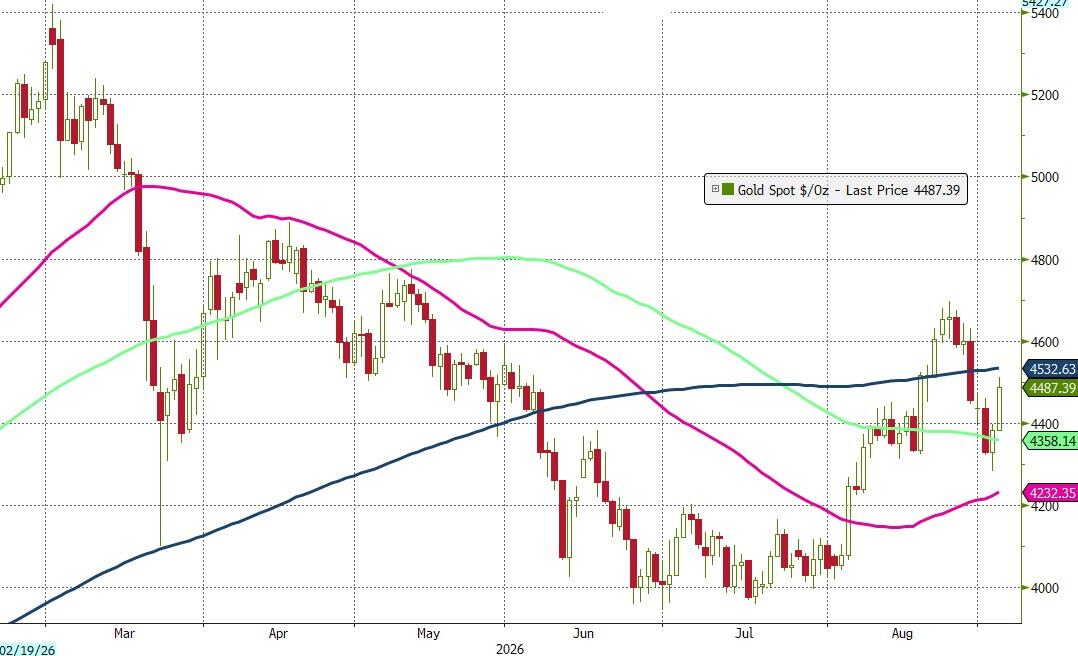
Gold has already rebounded about 10% from its mid-July low back above $4,400 today (near the 200DMA) as investor demand (ETFs, COMEX positioning, and options) recovered once markets scaled back Fed-hike expectations.
Professional subscribers can read Goldman's full "Precious Comment: Gold and Central Banks: Storage Dilemma; Buying Trend Picks Up" note here at our new Marketdesk.ai portal
Related Markets
All MarketsMarket data may be delayed. Not financial advice.
Powered by Gab AI
The Story At A Glance
Reading this article now — analysis appears below
💡 AI analysis provides alternative perspectives on current events