Rabobank: "The World As We Knew It No Longer Exists"
The short version
- Central banks are trying to reassert themselves, but under that shadow, and as everything they understand starts to fall apart around them.
- It would also be remarkable given everything we have seen to date and the rumours we hear of imminent escalation – unless the peace is on his terms, of course.
- Notably, the Ukrainian press says another hard winter looms, which the government is not prepared for, and so does a possible new Russian northern front towards Kyiv.
- Trump considered declaring the Iran war over, again, days after he floated renaming Hormuz the Strait of America.
- We then got other stories pointing out that the White House thinks it’s better to pause this war until after the November midterms, then ramp things up again, as is our base case.
The story
Via Rabobank,
As we move towards the end of another trading week, most action was again dominated by the now ubiquitous market bugbear of geopolitics. Central banks are trying to reassert themselves, but under that shadow, and as everything they understand starts to fall apart around them.
Putin suggested he’s open to peace vs. Ukraine. That would be wonderful. It would also be remarkable given everything we have seen to date and the rumours we hear of imminent escalation – unless the peace is on his terms, of course. Notably, the Ukrainian press says another hard winter looms, which the government is not prepared for, and so does a possible new Russian northern front towards Kyiv.
Trump considered declaring the Iran war over, again, days after he floated renaming Hormuz the Strait of America. We then got other stories pointing out that the White House thinks it’s better to pause this war until after the November midterms, then ramp things up again, as is our base case. The economic war vs. Iran obviously stays in place the while time.
South Korea might send its forces to Hormuz to support the US, becoming the first ally to do so, showing US pressure on Seoul, which had many analysts’ eyes rolling, might achieve a result that could help reduce oil prices. Israel claimed regime change in Tehran is its main goal, which is close to being achieved, and that Hamas and Iran are planning attacks on its citizens globally over next few weeks that it will respond to directly should they occur. That is not to include the substantial risk that these two wars become openly conflated into one larger one on at least two fronts, as open and tacit cooperation between Iran, Russia, North Korea, and China is slowly noticed by a wider circle of Western experts.
Even Argentina is rattling its sabre at the UK over the Falklands again, a claim the US may support if the British refuse to lead on NATO defence spending according to some – as the current UK is incapable of projecting a naval task force to the South Atlantic like it did back in 1982, speaking to a general western decline.
It’s not for nothing that oil, while off yesterday’s peak, is likely to close the week with its largest weekly gain since July, as crack spreads remain staggeringly high and stocks of refined products such as diesel are staggering low.
That is a structurally inflationary backdrop because refined products go into or into moving everything. It can only stop being structural if we know both wars are going to end; or that new refineries are going to be magically built years ahead of schedule; or that demand for everything is going to decline due to high prices, which is stagflationary. Neither of the first two are true, and the latter will have huge political consequences. From a geopolitical perspective, you can make peace on your opponent’s terms --but neither Ukraine with its drones nor Israel with its nukes will sign-- to bring oil down; or you can arm up to bring them and it down. Central banks are secondary to that dynamic except where they act on ‘second round effects’ or help on the peace or ‘arm up’ fronts.
Markets can cheer another Fed speech from Waller that suggests that maybe rates don’t have to go up this month. It doesn’t change the above – politicians will or little will.
Markets can watch as JPY swings on heavy intervention again ahead of the BOJ almost certainly raising rates this month. It doesn’t change the above – politicians will or little will. On which note, the BOJ looks like it’s being leaned on by Bessent to hike, who also wants to ensure JPY rises to stabilise US markets. Also watch the reported 155 level in JPY, beyond which we could see accumulated shorts unwound, pushing the currency even further. Indeed, when things unwind it’s a “slowly at first then all at once” non-linear process – and not just in markets, even if they then have to try and price for them.
The Australian financial press just ran an op-ed calling for negative immigration, not lower net immigration, which would have been as unthinkable a few years ago as a collapsing housing market against which the RBA is likely to have to hike again. The same is happening in the US to some degree and various parties on the right in Europe are also talking about the same. Were it to occur, many political norms and economic assumptions built over the past few decades stop working.
As VW sheds 50,000 jobs and closes plants, the Netherlands Scientific Council for Government Policy (WRR) argued the neo-mercantilist global backdrop leaves Europe vulnerable. It narrows EU options to: “international co-ordination”, i.e., a Plaza Accord for China; “strategic symmetry” to mirror China, requiring “the ECB to depart from its current policy of a freely floating exchange rate”; or “stronger trade defence measures”, i.e., tariffs, and maybe taxing capital inflows.
It notes:
“Clearly there is no easy pathway…This reflects the fundamental tension at the heart of this debate: the desire to maintain the international multilateral trade framework that has brought a great deal to Europe and to the world… At the same time, the issue of growing trade imbalances cannot be resolved within that framework, because it lacks the appropriate instruments.”
It concludes four things, three of which are:
-
Industrial policy is important, but by itself not enough to tackle strategic dependencies. Formulate a strategy that addresses both trade imbalances and innovation.
-
Doing nothing also comes at a high price. Therefore, to address trade imbalances, all options need to be on the table, even if they are painful.
-
Europe is lagging behind when it comes to applying and scaling up technological innovations. Commit to a coherent European innovation system.
OpenAI claims it has overtaken Anthropic with its latest AI model, which is says could be considered to be “Artificial General Intelligence” or AGI. Is this marketing hype, or have we just had a true Manhattan Project moment that transforms everything? Who knows. But would you like to guess where equities, rates, FX, and commodities should sit if the US just developed a true AGI that can now improve itself at a non-linear rate? Now do it assuming we have two major, conflating, wars going on.
In the US, Democrats refused to support a constitutional amendment to keep the Supreme Court capped at nine justices, as the Democratic Socialist Alliance refused to back populist Democrat AOC as a 2028 presidential candidate because she is ‘too mainstream.’ The DOJ also asked the Supreme Court to rule on the White House’s new executive order on mail-in voting, which could have a major impact on both the midterms and all subsequent US elections.
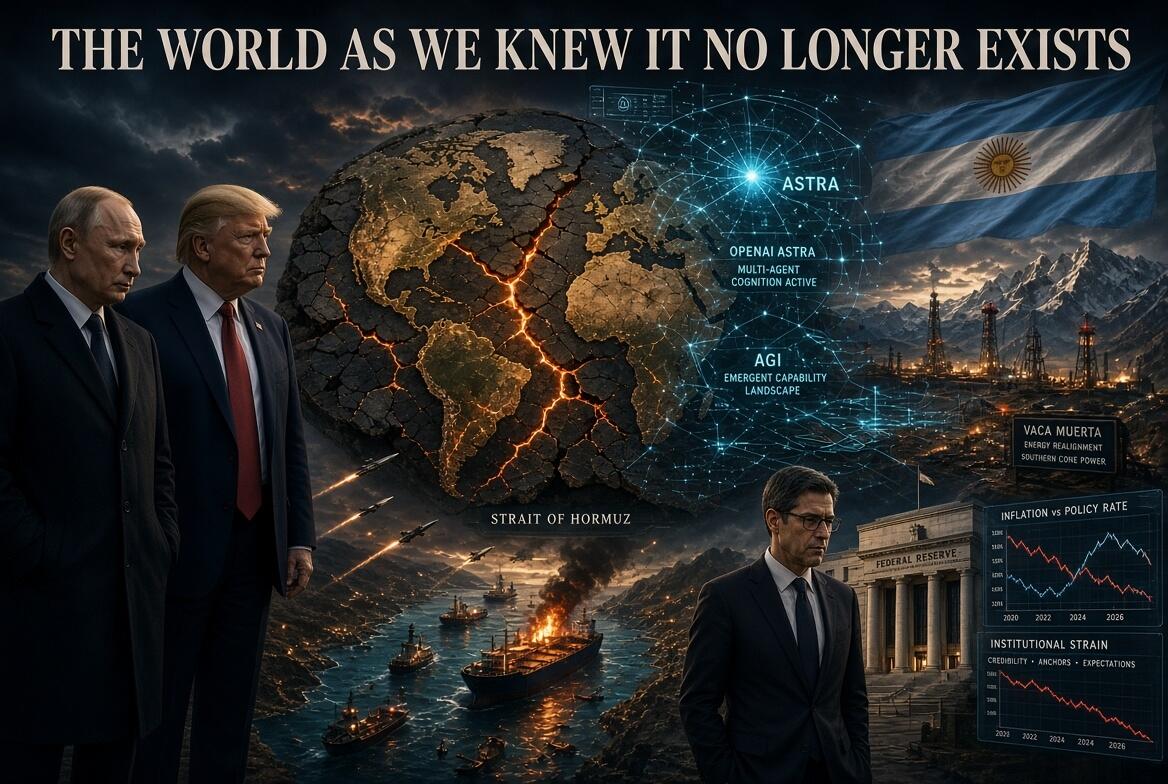
The fourth WRR conclusion I held back to the end was this: “The world as we knew it no longer exists. Dare to think outside existing frameworks.”
Related Markets
All MarketsMarket data may be delayed. Not financial advice.
Powered by Gab AI
The Story At A Glance
Reading this article now — analysis appears below
💡 AI analysis provides alternative perspectives on current events