The Rush To Pull Gold Out Of The US
The short version
- The Dutch central bank says gold held in London can be accessed and traded more quickly during an emergency than gold stored in New York or Canada.
- Before the move, 31.3% of Dutch gold was in New York, 19.7% in Ottawa and 18.1% in London.
- Now New York and Ottawa each hold 18.5%, while London has jumped to 32.1%.
- The Netherlands owns 612.4 tonnes of gold altogether.
- Technically, all 86 tonnes weren’t loaded onto planes and flown across the Atlantic.
The story
Submitted by QTR's Fringe Finance
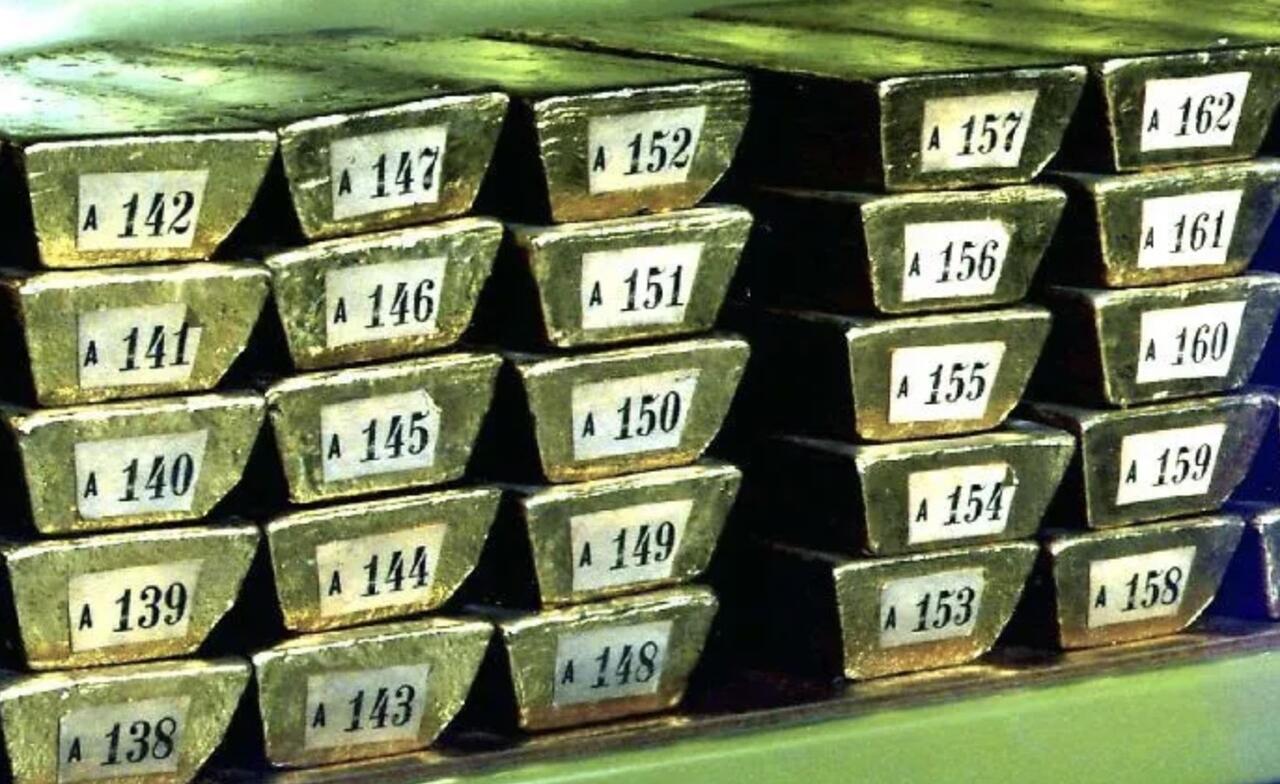
It was reported yesterday that the Netherlands just shifted approximately 86 tonnes of its gold reserves from New York and Ottawa to London, explicitly citing “increasing geopolitical unrest” and the need to prepare for severe crises.
The Dutch central bank says gold held in London can be accessed and traded more quickly during an emergency than gold stored in New York or Canada.
That is some wonderfully sanitized central-bank language to deliver a message that seems to me to be “confidence in the U.S. holding the world’s gold…and likely being a cornerstone of the global economic machine…is dwindling.”
Either way, it means the Netherlands has effectively decided that if the world goes sideways, it would prefer substantially less of its ultimate crisis reserve sitting in North America.
Before the move, 31.3% of Dutch gold was in New York, 19.7% in Ottawa and 18.1% in London. Now New York and Ottawa each hold 18.5%, while London has jumped to 32.1%. The Netherlands owns 612.4 tonnes of gold altogether.
Technically, all 86 tonnes weren’t loaded onto planes and flown across the Atlantic. DNB sold roughly 59 tonnes in New York and bought equivalent market-standard gold in London. More than 27 tonnes were physically moved from the U.S. and Canada to the Netherlands, while a similar quantity moved from the Netherlands to London.
The distinction matters operationally. Economically, not so much. The result is fewer Dutch reserves in New York and considerably more in London.
And we’ve seen this before. In 2014, the Netherlands physically brought 122.5 tonnes home from New York. Germany later completed the relocation of 300 tonnes from New York to Frankfurt. And between July 2025 and January 2026, France eliminated its remaining New York gold position, replacing 129 tonnes held there with market-standard bars now stored in Paris. France says that decision was about trading efficiency, not politics, which is fair enough. The bars nevertheless wound up in Paris instead of New York.
India has also dramatically reduced the portion of its gold stored overseas, although most of that repatriation involved gold held in London rather than America.
This seems to be me to be a very obvious trend toward central banks wanting greater control over the one reserve asset that is nobody else’s liability.
Gold doesn’t require Washington to pay you back. Funny how attractive that feature becomes when Washington owes more than $40 trillion.
As I have droned on about for a decade, the entire modern financial system is ultimately held together by confidence and fiat. The dollar works because everyone believes everyone else will continue accepting dollars. Treasuries work because the world believes the United States will honor its debts without destroying the purchasing power of the currency used to repay them.
Confidence…not basic math or economics…is what encourages people like Paul Krugman to say things like “debt is money we owe to ourselves”.
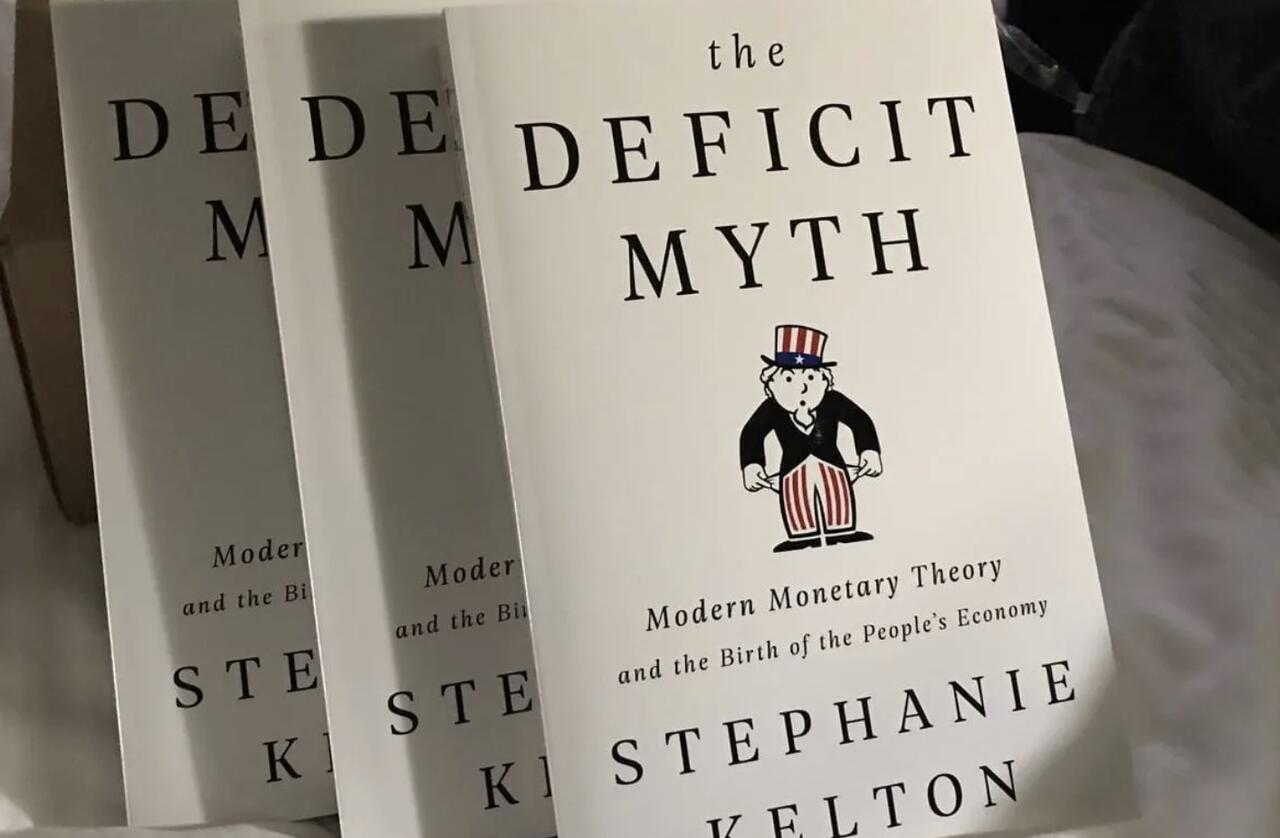
It’s what allows Stephanie Kelton to write a book called “The Deficit Myth”.
For decades, that confidence allowed America to enjoy the greatest financing arrangement imaginable: running up a tab with no worries about paying it back, while we turn into entitled chickenshit cowards about equity markets because we feel like the Fed can, and always will, bail us out at the very first sign of trouble.
But there are little cracks appearing everywhere.
The dollar still dominates global reserves, so claims that it is about to disappear are nonsense. It represented 57.13% of disclosed foreign-exchange reserves in Q1 2026. But that’s down substantially from levels above 70% around the turn of the century.
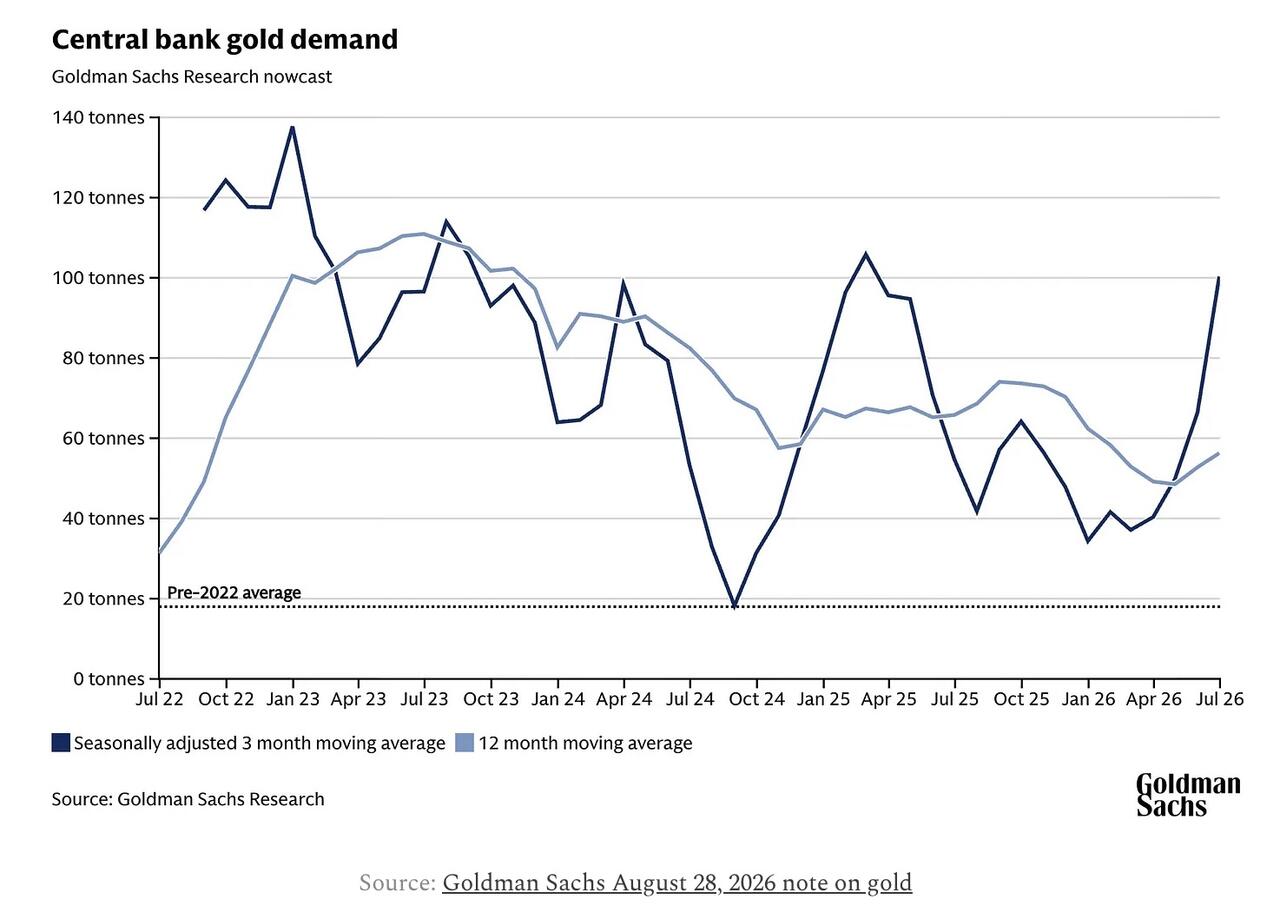
Meanwhile, central banks can’t seem to get enough of the barbarous relic.
They bought 863 tonnes of gold in 2025 after three consecutive years of purchases above 1,000 tonnes. The World Gold Council’s 2026 survey found 89% of reserve managers expect global central-bank gold holdings to increase over the coming year, while a record 45% expect their own institution to buy more.
Apparently nobody told the world’s central bankers that gold is just a shiny rock. Also, as I’ve constantly talked about here with my friend Andy Schectman, something unusual has also happened at COMEX.
DBS data show roughly 289,000 gold delivery notices during the first nine months of 2025, versus approximately 119,000 during the same period of 2024…about 2.4 times as many. A delivery notice transfers title to deliverable metal; it doesn’t necessarily mean somebody immediately backs a Brinks truck up to the warehouse. But it is another indication of heightened demand for physical settlement.
Gold is moving. Central banks are buying it. Countries are repositioning it. And increasingly, they want to know exactly where it is and how quickly they can get their hands on it. All of which would be merely interesting if America’s fiscal situation weren’t simultaneously becoming absurd.
U.S. federal debt has now crossed $40 trillion, while some Treasury yields have reached their highest levels in nearly two decades. For some reason, it feels like 6% on the 10 year Treasury is looming closely….
The global bond selloff reflects several forces: inflation, huge government borrowing requirements, geopolitical pressures and expectations for interest rates. So it would be too simplistic to blame rising yields entirely on declining confidence in America.
But the bond market is sending Washington a message nonetheless: Money isn’t free anymore and something is horribly wrong with the status quo.
And that creates the problem I have been writing about for years. At $40 trillion of debt, higher interest rates produce higher interest expense. Higher interest expense produces larger deficits. Larger deficits require more borrowing. More borrowing creates more Treasury supply. And eventually investors demand still-higher yields to absorb it.
It’s a fiscal snake eating its own tail, except the snake has a Bloomberg terminal and an Excel spreadsheet that allows it to temporarily fu*k with the numbers. There are only so many ways out. Washington could slash spending, dramatically raise taxes or…as Treasury Secretary Bessent suggested this week, somehow grow its way out of the problem. I’ll pause for laughter.
But my longstanding view is that eventually Washington chooses another solution: yield curve control.
🔥 85% OFF FOREVER IF YOU SUBSCRIBE TODAY: I am again offering an 85% discount to anyone that wants to become a Fringe Finance annual subscriber today. It’s a discount you can keep and stays applied for as long as you wish to remain a subscriber: Get 85% off forever
We’ve done it before. Beginning in 1942, the Federal Reserve pegged Treasury bill rates at 0.375% and effectively capped long-term Treasury yields at 2.5%. Maintaining those rates required the Fed to buy government securities whenever necessary. Federal Reserve historians explicitly note that the policy forced the Fed to surrender control over the size of its balance sheet and money supply.
That is the endgame I continue to worry about. If the free market eventually demands 6%, 7% or 8% to finance America’s debt and Washington decides those rates are economically or fiscally intolerable, somebody has to buy the bonds at lower yields.
That somebody is the Federal Reserve. Call it yield curve control. Call it QE. Call it an “emergency market functioning facility” if you’d like to make it sound sufficiently boring for financial TV. It amounts to the same basic choice: suppress the cost of financing the debt and let the currency absorb some of the consequences.
And that is why these seemingly obscure gold stories matter. The Netherlands isn’t abandoning America. France isn’t declaring war on the dollar. Germany didn’t empty the New York Fed because it expected the apocalypse. Something subtler is happening.
Central banks are buying enormous quantities of an asset with no counterparty risk while increasingly emphasizing physical control, accessibility and geographic diversification. At the same time, America’s debt has crossed $40 trillion and the bond market is demanding increasingly expensive compensation to finance governments around the world.
The monetary system is a confidence game. This is why I focus my efforts on highlighting potential areas of the market that cannot be printed and can sidestep, or benefit, from inflation.
So when another American ally decides that, for the next crisis, it would prefer substantially less of its gold sitting in New York, I pay attention. They can call it diversification, crisis preparedness, or improved tradability.
These assholes in charge always have a wonderful vocabulary for avoiding the obvious. I just call it as I see it: taking chips of the table as you lose confidence in the U.S. financial system.
--
QTR’s Disclaimer: Please read my full legal disclaimer on my About page here. This post represents my opinions only. In addition, please understand I am an idiot and often get things wrong and lose money. I may own or transact in any names mentioned in this piece at any time without warning, meaning if I’m long I could sell or if I’m short I could cover at any time.
Contributor posts and curated posts have been hand selected by me, but have not been fact checked and are the opinions of their authors. They are either submitted to QTR by their author, reprinted under a Creative Commons license with my best effort to uphold what the license asks, or with the permission of the author.
I cannot guarantee the accuracy of any or all facts and figures included in this article though I made my best effort to get them right. I have been wrong before and will be wrong again, and encourage you to always double check, do your own research and speak to a licensed financial professional, which I am not.
This is not a recommendation to buy or sell any stocks or securities, just my opinions. I often lose money on positions I trade/invest in. I may add any name mentioned in this article and sell any name mentioned in this piece at any time, without further warning. None of this is a solicitation to buy or sell securities. I may or may not own names I write about and are watching. Sometimes I’m bullish without owning things, sometimes I’m bearish and do own things I’m bearish on. Just assume my positions could be exactly the opposite of what you think they are just in case. If I’m long I could quickly be short and vice versa. I won’t update my positions.
Also as of May 20, 2026 I am attempting to no longer actively trade as much as I once did (read my story here). My eventual goal is for investing/saving to be mostly done by recurring contributions, mostly to sector ETFs and a few select equities, trusted third parties who oversee my accounts, and advisors. Such advisors or funds, through individual equities, options, index funds, mutual funds, ETFs, or other securities, may have positions in, exposure to, or holdings of names mentioned herein that I know nothing about. Basically, via index funds, ETFs and individual equities it is possible I could own, have exposure to, or not own anything at any point. As of the same date, May 20, 2026, in an attempt to lead a healthier lifestyle, I’ve also excluded myself from fantasy sports, sports betting, online and in-person casinos and prediction markets.
Again. All positions can change immediately as soon as I publish this, with or without notice and at any point I can be long, short or neutral on any position. You are on your own. Do not make decisions based on my blog. I exist on the fringe. If you see numbers and calculations of any sort, assume they are wrong and double check them. I failed Algebra in 8th grade and topped off my high school math accolades by getting a D- in remedial Calculus my senior year, before becoming an English major in college so I could bullshit my way through things easier.
The publisher does not guarantee the accuracy or completeness of the information provided in this page. These are not the opinions of any of my employers, partners, or associates. I did my best to be honest about my disclosures but can’t guarantee I am right; I write these posts after a couple beers sometimes. Many times I edit after my posts are published because I’m impatient and lazy, so if you see a typo, check back in a half hour.
Also, again I just straight up get sh*t wrong a lot. I mention it multiple times because it’s that important you understand.
Related Markets
All MarketsMarket data may be delayed. Not financial advice.
How other outlets covered this
Compare allAlto found this story at 3 outlets. Same event, different framing — compare the headlines.
How this story developed
Full timelineAlto has tracked this across 19 days of coverage from 3 outlets.
- Futures, Yields Flat Ahead Of August Jobs ReportZeroHedge
- The Rush To Pull Gold Out Of The USYou are here
Powered by Gab AI
The Story At A Glance
Reading this article now — analysis appears below
💡 AI analysis provides alternative perspectives on current events