Japan Sold Almost $90 Billion In Treasuries To Fund Record Yen Intervention

The short version
- The BOJ spent a record $90BN to briefly push the yen higher.
- Another catastrophic intervention by the central bank which is 100bps behind in rate hikes (chart Goldman) pic.twitter.com/xOGszXSgF7 — zerohedge (@zerohedge) July 31…
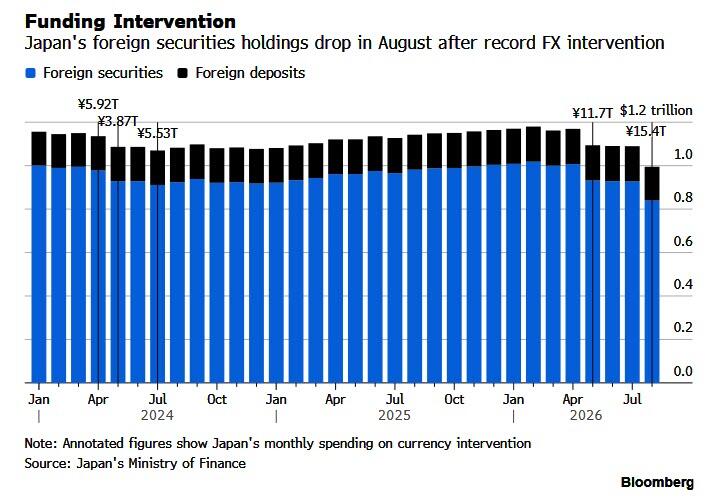
- According to Finance Ministry reserve data released Monday, Tokyo’s holdings of foreign securities fell by $87.8 billion at the end of August from a month earlier.
- That decline was close to the scale of Japan’s recent intervention to support the yen.
- Analysts suggested Japan likely sold Treasuries at the short end of the maturity spectrum, Bloomberg reported.
The story
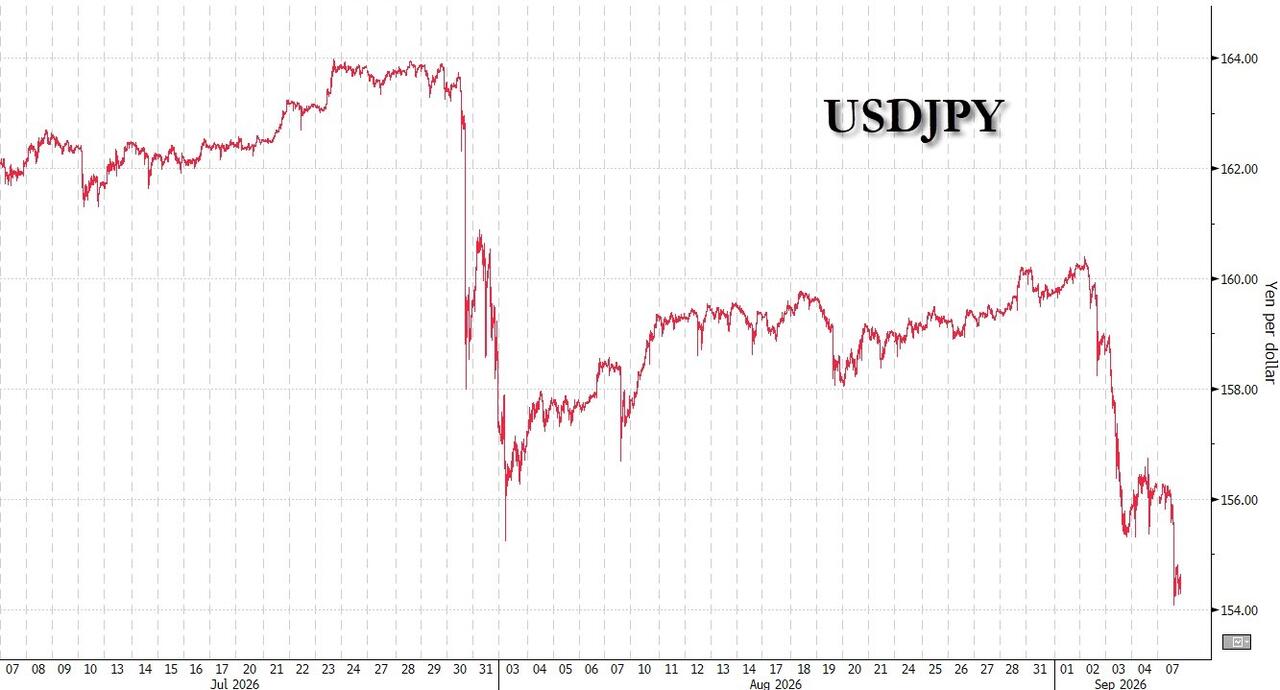
At the end of July, the only question following Japan's record $90 billion yen intervention (which worked for about two weeks before the effects faded and Bessent had to engage in more market intervention), was whether and how much Treasuries Japan had sold as part of the intervention.
The BOJ spent a record $90BN to briefly push the yen higher.
— zerohedge (@zerohedge) July 31, 2026
Another catastrophic intervention by the central bank which is 100bps behind in rate hikes (chart Goldman) pic.twitter.com/xOGszXSgF7
We now now the answers: i) yes and ii) a lot.
According to Finance Ministry reserve data released Monday, Tokyo’s holdings of foreign securities fell by $87.8 billion at the end of August from a month earlier. That decline was close to the scale of Japan’s recent intervention to support the yen. Analysts suggested Japan likely sold Treasuries at the short end of the maturity spectrum, Bloomberg reported.
Prior to the latest reserve release, the ministry had already confirmed that authorities spent the equivalent of ¥15.4 trillion ($98.6 billion) in the month through Aug. 26, with part of the operation conducted jointly with the US. And as we reported previously, te monthly intervention was also the largest on record.
A ministry briefer said intervention was a factor behind the fall in foreign reserves, but did not confirm that Treasuries were offloaded. Another intervention financed through sales of US Treasuries could potentially further anger Bessent as it would show that Tokyo is still willing to go down that route even as US officials, including Treasury Secretary Scott Bessent, have become increasingly focused on Treasury-market stability, particularly ahead of the midterm elections.
“Japan may have used both foreign securities and deposits, but it most likely sold US Treasuries,” said Atsushi Takeda, chief economist at Itochu Research Institute.
As we noted then, the US participated in Japan’s intervention campaign at the end of July by stepping into the market on July 31 in the first coordinated move between the nations to support the yen since 1998. That, according to Bloomberg, shows the two sides are still likely on the same page for now.
“Bessent has also repeatedly said that the yen has weakened too much, so the US probably shares that view and that’s why it’s cooperating with Japan,” Takeda said.Still, long-term US yields are still firmly placed on Bessent’s radar. He recently announced that the government would double the size of its buybacks of longer-dated debt for two months through Nov. 4, a move likely aimed at keeping a lid on longer-term yields.
The data do not provide a detailed breakdown of securities holdings or maturities, though market participants estimate that roughly 70% of Japan’s foreign reserves are invested in US Treasuries.
“Japan still has room to intervene given the amount of securities it holds, but given comments from Bessent, selling US Treasuries to fund further intervention could end up attracting pressure from the US,” said Akira Nishimura, economist at the Japan Research Institute. “That would make it difficult for the ministry and the BOJ to act going forward.”
Analysts suggested that Treasury sales were likely focused at the short end of maturities, limiting their impact on long-term yields and the potential for irritation in Washington.
“Japan’s Treasury holdings would span the curve, but the first port of call to fund intervention would be to liquidate assets with maturities of 5 years and under,” said Prashant Newnaha, senior Asia-Pacific rates strategist at TD Securities, flagging their greater liquidity. “It’s unlikely the MOF would have offloaded longer dated securities - maturities of 10 years or more - given the potential for significant pressure on long-end yields.”
Not only are shorter-term Treasuries the easiest to sell, foreign reserve managers tend to invest at the short end anyway as that is their “preferred habitat,” said Macquarie strategist Gareth Berry, adding that “conveniently, selling short-dated Treasuries is probably something the US side would be less concerned about, and better able to live with, as US attention seems mainly focused on the long-end."
Markets have remained jittery since last week as investors recalibrate their rate expectations and positions. The yen strengthened from around 160.39 per dollar on Wednesday to as much as 155.30 on Friday. The currency further strengthened to around 154.50 on Monday amid ongoing speculation Japan’s Government Pension Investment Fund may boost allocations toward domestic assets.
That suggests no further intervention for the time being, especially with the BOJ expected to do the heavy lifting from now on. Following Bessent’s call for higher Japanese interest rates in North Carolina last week and recent signaling from BOJ officials, markets are now fully pricing in a BOJ rate hike in September. Some investors are even starting to consider whether the central bank could accelerate the pace of tightening after a series of hawkish signals, a stance that would offer further support for the yen.
Finally, while Monday’s report showed Japan’s foreign currency reserves fell $94.6 billion to $995 billion at the end of August, the remaining amount still shows the substantial resources available to authorities should they need to intervene again. Foreign currency deposits, another potential source of intervention funds, fell $6.9 billion.
In addition to selling securities and drawing on foreign deposits, Japan can also tap the Foreign and International Monetary Authorities Repo Facility in future interventions, Finance Minister Satsuki Katayama suggested after the US-Japan joint intervention. The facility introduced during the pandemic enables Japan to access up to $60 billion per day without selling Treasuries, limiting any impact on US yields and expanding the potential scope for intervention. Still, there is no record of Japan using FIMA.
“The lack of any precedent would be a significant hurdle to actually using it,” Nishimura said. “So I view the comments on FIMA as more of a signal that Japan still has ample resources available to fund intervention, rather than actually using the facility.”
Related Markets
All MarketsMarket data may be delayed. Not financial advice.
How this story developed
Full timelineAlto has tracked this across 36 days of coverage from 1 outlet.
- The Reckoning Of 2028: Civilization's Ledger Is Bleeding RedZeroHedge
- Futures Drop As Iran Hostilities Send Brent To 6 Week High Above $97ZeroHedge
- Japan Sold Almost $90 Billion In Treasuries To Fund Record Yen InterventionYou are here
Powered by Gab AI
The Story At A Glance
Open the full breakdown on gab.ai
- • Japan spent a record $90 billion to support the yen through market intervention.
- • Foreign reserves fell by $87.8 billion, likely due to the sale of U.S. Treasuries.
- • The intervention was partially coordinated with the United States to stabilize markets.
Japan is attempting to prevent the yen from weakening too much against the dollar. This massive liquidity injection requires liquidating assets, primarily short-dated U.S. debt.
Christian Perspective
Financial instability and massive central bank interventions reflect a world struggling with the consequences of greed and secular mismanagement. Such economic volatility disrupts the stability required for families to flourish and thrive. True security comes from God, not from the manipulation of fiat currencies by globalist institutions.
Implications
Large-scale foreign sales of U.S. debt can threaten American economic sovereignty and market stability. This volatility harms the American worker and the ability of Christian families to plan for a stable future. Protecting the integrity of the U.S. economy is essential for maintaining the social order.
Broader Trends
The coordination between foreign central banks and the U.S. Treasury highlights the growing influence of globalist financial structures. These systems often prioritize international market stability over the specific interests of the American people. This trend continues to erode the economic independence of the nation.
Takeaway
America First policies must prioritize the stability of the U.S. Treasury to protect domestic interests. We must remain skeptical of international financial entanglements that allow foreign powers to impact our economy. Strengthening national sovereignty is the best defense against global economic manipulation.
Want to join the conversation about this story?
Join our community at Gab.com→
Gab AI
The one AI they can't control. Our exclusive AI model trained to uphold Christian values and traditional principles in every interaction.