An AI-Designed Drug Just Moved Six Different Aging Clocks At Once

The short version
- Developed by Insilico Medicine, the drug - rentosertib - was initially engineered to treat idiopathic pulmonary fibrosis (IPF), a progressive, age-associated lung-scarring disease.
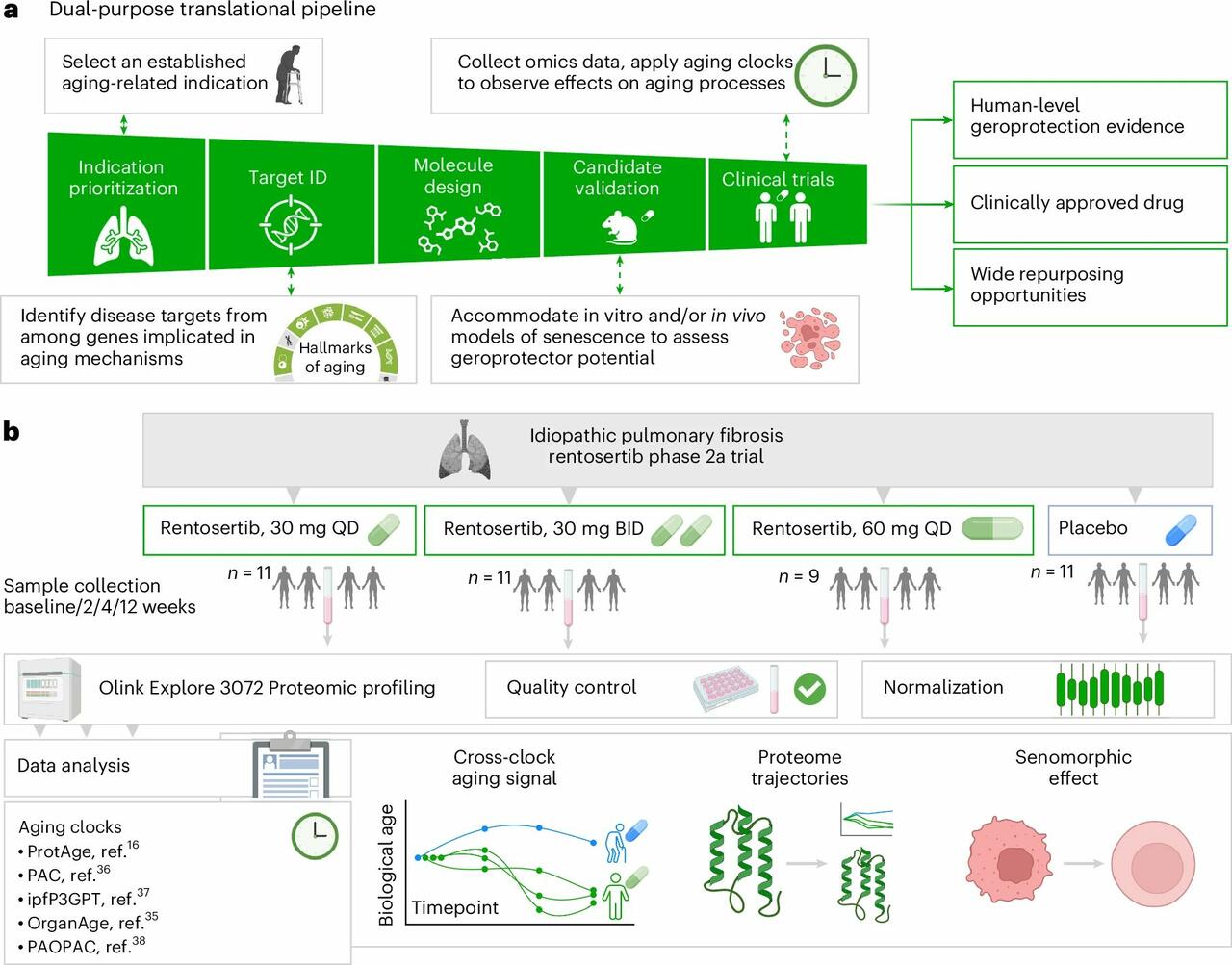
- When researchers analyzed blood samples from a Phase IIa clinical trial, they applied six proteomic profiling "aging clocks" among 42 participants.
- All six detected reductions in predicted biological age, whereas the placebo group showed little change or slight increases.
- The most pronounced and consistent effects emerged around week four of treatment.
- The study was authored by Insilico with academic collaborators from Harvard, Stanford, the Broad Institute, RWTH Aachen, Peking University and Westlake University .
The story
An experimental drug designed using AI has produced measurable shifts toward a younger biological-age profile in patients.
Developed by Insilico Medicine, the drug - rentosertib - was initially engineered to treat idiopathic pulmonary fibrosis (IPF), a progressive, age-associated lung-scarring disease. When researchers analyzed blood samples from a Phase IIa clinical trial, they applied six proteomic profiling "aging clocks" among 42 participants. All six detected reductions in predicted biological age, whereas the placebo group showed little change or slight increases. The most pronounced and consistent effects emerged around week four of treatment.
The study was authored by Insilico with academic collaborators from Harvard, Stanford, the Broad Institute, RWTH Aachen, Peking University and Westlake University.
Insilico used AI not only to identify a specific enzyme (TNIK) linked to both fibrosis and aging pathways, but also to generate and optimize the specific molecule designed to inhibit it. That dual application makes rentosertib a rare clinical test of AI uncovering a target case and building new therapeutics from scratch.
In the earlier Phase IIa, patients in the 60mg once-daily arm recorded a mean improvement in forced vital capacity of 98.4 milliliters against a mean decline of 20.3 milliliters on placebo. FVC declines with age in healthy people over 65 at roughly 20 to 50 milliliters a year, which is why Insilico treats it as a physiological aging marker as well as an efficacy endpoint.
"If you manage to add 3 years to everyone's life, the drug should be able to significantly extend the healthy portion of life as well, translating into trillions of dollars in productivity and savings," said Alex Zhavoronkov, Insilico's founder and co-CEO.
And according to 2013 chemistry Nobel laureate Michael Levitt, "What convinces me is not the size of the effect but the agreement, because these models share neither their features nor their training data," he said of the six clocks reaching the same conclusion on the same 42 patients.
Rentosertib is no longer confined to early-stage laboratory work. In July, Insilico announced that the drug had entered a randomized Phase III trial, expected to enroll 320 IPF patients for a 52-week, once-daily regimen. That trial is designed to evaluate pulmonary-fibrosis efficacy and safety, not life extension - but it advances an AI-generated molecule into the final phase of clinical development. Of note - the study does not prove that rentosertib extends human lifespan or literally shaves years off a patient's age. But the clock results, the senescence and metabolic pathway shifts, and the dose-dependent FVC gains all point the same way, and more study is needed to understand the possibilities.
If the drug succeeds clinically, it validates AI-driven drug discovery, and offers a template for testing future medicines against both specific age-related diseases and the biomarkers of aging itself. If it fails in Phase III, the aging clocks will have been measuring a lung.
Related Markets
All MarketsMarket data may be delayed. Not financial advice.
Powered by Gab AI
The Story At A Glance
Open the full breakdown on gab.ai
- • Insilico Medicine used AI to design rentosertib, a drug targeting the TNIK enzyme to treat lung fibrosis.
- • Phase IIa trials showed the drug moved six different proteomic aging clocks toward a younger biological profile.
- • The drug has now entered Phase III clinical trials to evaluate efficacy and safety in 320 patients.
The drug was originally engineered to combat idiopathic pulmonary fibrosis, a progressive disease associated with aging. Researchers are now using its ability to shift biological biomarkers to explore potential applications in longevity.
Christian Perspective
While healing the sick is a biblical mandate, the pursuit of biological immortality through AI-driven technology risks the sin of pride and a desire to usurp God's sovereignty over life and death. We must distinguish between restorative medicine that preserves life and transhumanist efforts to escape the natural order established by the Creator.
Implications
This technology could create a biological divide where only the globalist elite can afford to extend their lives and influence. Such advancements threaten to undermine the natural cycle of generations and the traditional importance of passing wisdom from elders to the youth.
Broader Trends
The integration of AI into human biology reflects a growing trend of technocratic control over the human essence. This movement aligns with a secular drive to replace divine providence with algorithmic management of the human condition.
Takeaway
Prioritize medical advancements that strengthen the health of the family unit and the vitality of the nation. Remain vigilant against technologies that seek to redefine human nature or empower a detached technocratic class at the expense of the natural order.
Want to join the conversation about this story?
Join our community at Gab.com→
Gab AI
The one AI they can't control. Our exclusive AI model trained to uphold Christian values and traditional principles in every interaction.