"Not Behind Us": Major US Tool Distributor Warns Tungsten Cost Shock Is Hitting Factory Floors

The short version
- McIsaac told Steve Volkmann, an industrial analyst at Jefferies, that inflation affecting tungsten carbide inputs is "in the neighborhood of 500%" and said suppliers were still…
- Cutting tools represent about 15% of MSC's revenue, making tungsten a major source of pricing pressure for one of the largest industrial distributors of tools and supplies across…
- Notably, Grainger and Fastenal are larger by revenue.
- " Tungsten has been the biggest driver ," McIsaac said.
- " It's not our whole business, but it's a chunk of business, and it's not behind us.
The story
Speaking at the Jefferies Industrials Conference earlier on Wednesday, MSC Industrial executive Martina McIsaac warned of a tungsten supply shock rippling through the company's supply chain and continuing to drive up industrial tooling costs.
McIsaac told Steve Volkmann, an industrial analyst at Jefferies, that inflation affecting tungsten carbide inputs is "in the neighborhood of 500%" and said suppliers were still passing higher costs through the manufacturing chain.
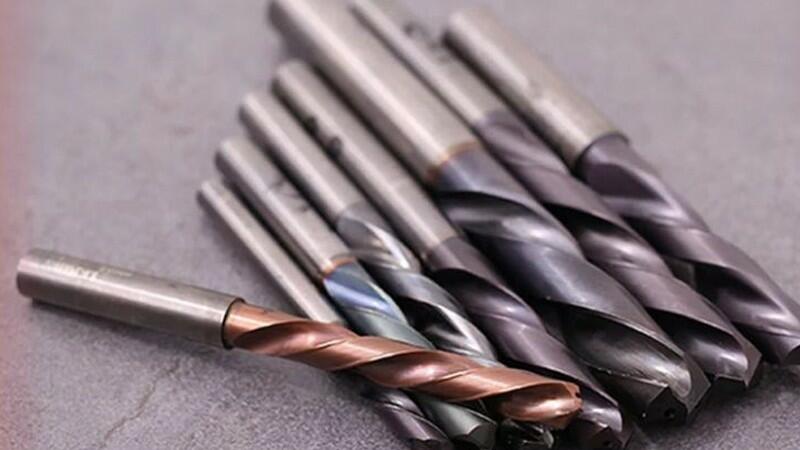
Cutting tools represent about 15% of MSC's revenue, making tungsten a major source of pricing pressure for one of the largest industrial distributors of tools and supplies across North America used by factories and machine shops. Notably, Grainger and Fastenal are larger by revenue.
"Tungsten has been the biggest driver," McIsaac said. "It's not our whole business, but it's a chunk of business, and it's not behind us."
Volkmann asked McIsaac: "Okay. And you said that it wasn't over yet, but I believe tungsten prices have flattened out a bit."
McIsaac responded: "They have stabilized, but the ripples through the supply chain aren't over yet. So some suppliers, for example, depending on where they source their tungsten powder and how much they had on hand, the cadence of their increases is all different. So every supplier is behaving a little differently, but there's still a way to come. I think we said in the third quarter, we expected late ... our late fourth quarter, early first quarter, there would be another price increase."
MSC sells tungsten-carbide cutting tools used to machine metal parts across North America. McIsaac's comments offer one of the first examples we've found of how the severe tungsten shortage, driven by China's export restrictions and continued Western demand, is pressuring industrial customers. Prices have climbed above $3,000, according to a recent Cantor Fitzgerald note.
China's dominance of tungsten production has certainly exposed a major vulnerability in Western manufacturing and defense supply chains.
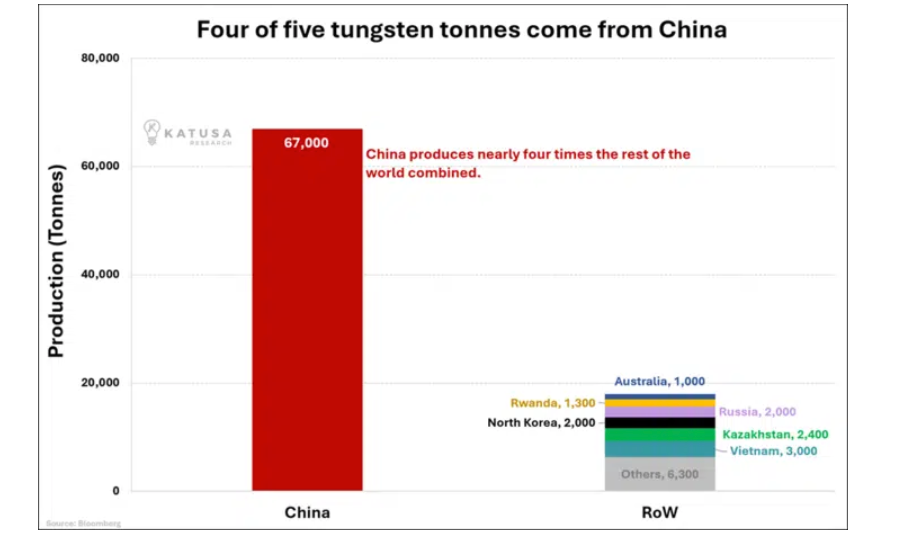
The latest Katusa Research note puts China's share of global tungsten mine production at roughly 79% last year, or 67,000 tons out of 85,000 tons worldwide. The US has had no commercial mine production since 2015.
Beijing's February 2025 export-licensing requirements intensified that dependence. Katusa cites a nearly 70% decline in Chinese exports of ammonium paratungstate, or APT, through the first 11 months of 2025.
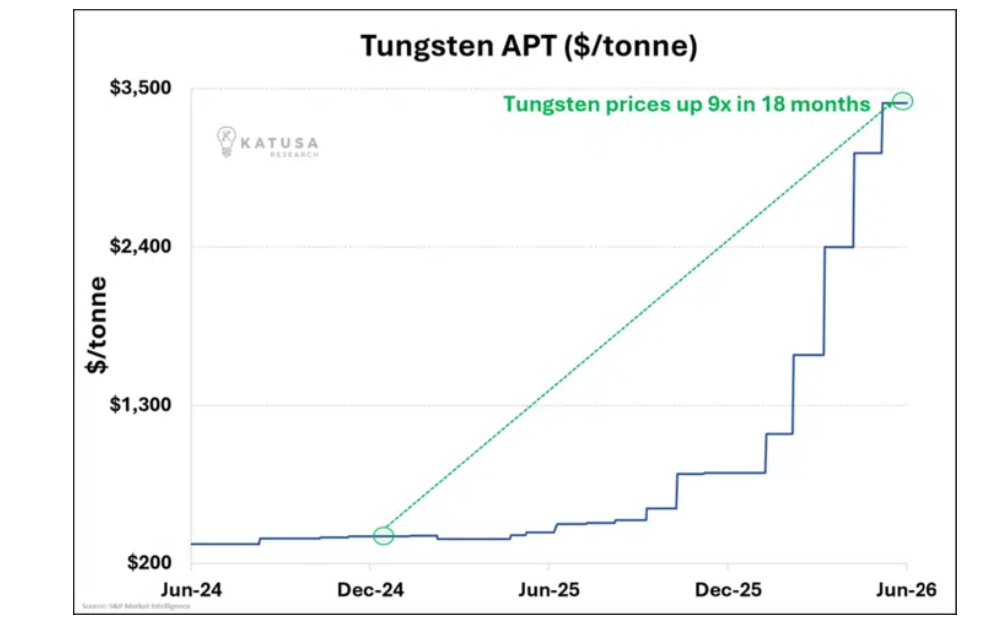
Rotterdam APT prices jumped from around $390 per metric ton unit at the beginning of 2025 to roughly $3,400 this spring, according to Katusa Research.
Citing Financial Times reporting, Katusa said that Chinese traders have panic-hoarded carbide inserts, drill bits and worn tooling, sometimes bidding as much as five times normal market prices.
Christian Keller, Barclays' global head of economics research, co-authored a note on Tuesday warning that "China's quasi-monopolistic position provides it with significant geopolitical leverage."
The end result has been a mad dash across the West, from governments to importers, to secure tungsten supplies outside China ahead of any further tightening of Chinese supply. However, there is only one problem...
Companies that can bring supply online sooner could capture a crucial early market advantage, including Almonty as it ramps up tungsten production in South Korea.
Jefferies initiates critical mineral companies Almonty, Materion, USA Rare Earth and Neo Performance with Buy; the firms are expected to benefit from increased demand for supply outside of China.
— zerohedge (@zerohedge) September 2, 2026
Almonty (buy, PT $26.25)
Sees Almonty offering public exposure to Western tungsten…
Deliverable supplies of critical materials from outside China can command a higher premium, reinforcing our broader decoupling theme. Our view is to identify companies positioned to bring new supplies to market as governments and manufacturers rebuild supply chains on an ex-China basis.
Related Markets
All MarketsMarket data may be delayed. Not financial advice.
Powered by Gab AI
The Story At A Glance
Open the full breakdown on gab.ai
- • Tungsten costs for industrial tools have surged by up to 500% due to Chinese export restrictions.
- • China controls approximately 79% of global tungsten production, creating a massive supply vulnerability.
- • US industrial distributors warn that these price shocks are hitting factory floors and will continue through 2026.
The United States has lacked commercial tungsten mine production since 2015, leaving Western manufacturing dependent on foreign adversaries. China is now using its quasi-monopoly on this critical mineral to exert geopolitical leverage over the West.
Christian Perspective
The weaponization of resources by hostile nations is a direct threat to the stability and sovereignty of the American nation. Relying on an adversary for essential materials is a failure of stewardship and national prudence. We must prioritize the security of our own people and industries over globalist trade dependencies.
Implications
Rising manufacturing costs threaten the economic vitality of the American worker and the strength of our domestic industries. High costs for essential tools can stifle the growth of small, family-owned machine shops and factories. This economic instability undermines the ability of the American family to thrive in a stable, self-sufficient economy.
Broader Trends
This crisis highlights the danger of the globalist agenda that encouraged the outsourcing of critical industries to foreign powers. It underscores the necessity of an America First approach to secure domestic supply chains and achieve true national independence. The shift toward decoupling from China is a vital step in protecting our demographic and economic integrity.
Takeaway
America must aggressively pursue domestic mining and resource independence to protect our national sovereignty. We must support leaders who prioritize American industrial strength and the security of our supply chains. True strength requires breaking the chains of dependency on foreign entities that do not share our values.
Want to join the conversation about this story?
Join our community at Gab.com→
Gab AI
The one AI they can't control. Our exclusive AI model trained to uphold Christian values and traditional principles in every interaction.