US Data Centers To Burn More Natural Gas Than Most Nations
The short version
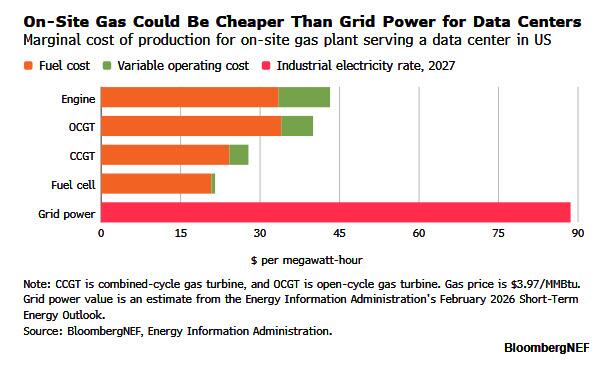
- Furthermore, a recent BloombergNEF analysis shows the marginal cost of operating an on-site gas plant may be below industrial electricity tariffs…
- As we discussed in late August , marginal generation costs depend on fuel prices and variable operating expenses.
- BloombergNEF modeled the marginal cost of operating engines, turbines and fuel cells at a mid-scenario gas price of $3.97 per million British thermal units.
- Gas engines, such as ones manufactured by Wartsila and INNIO, have the highest marginal cost, at $43.2 per megawatt-hour (MWh).
- Fuel cells, most prominently procured from Bloom Energy, are the cheapest to continue running, at $21.5/MWh, benefiting from high thermal efficiencies and the lowest variable…
The story
Several weeks ago, we explained why most data center developers favor on-site gas power: it boiled down to two main reasons - availability (especially since modular nuclear power for commercial 'behind the meter' use is still in the distant future) and price. Furthermore, a recent BloombergNEF analysis shows the marginal cost of operating an on-site gas plant may be below industrial electricity tariffs, making continued generation from on-site assets the cheaper option in many cases.
As we discussed in late August, marginal generation costs depend on fuel prices and variable operating expenses. BloombergNEF modeled the marginal cost of operating engines, turbines and fuel cells at a mid-scenario gas price of $3.97 per million British thermal units. Gas engines, such as ones manufactured by Wartsila and INNIO, have the highest marginal cost, at $43.2 per megawatt-hour (MWh). Fuel cells, most prominently procured from Bloom Energy, are the cheapest to continue running, at $21.5/MWh, benefiting from high thermal efficiencies and the lowest variable operational cost.
It appears that none of this was lost on US data centers, and the result has been an explosion of nat gas use to power the domestic data center industry which in turn is critical to keep the AI bubble afloat.
Which brings us to another key data point: according to a new outlook from BloombergNEF, data centers in the United States will consume more natural gas than most countries within a decade.
Gas consumption to produce electricity for data centers is expected to grow by 15 billion cubic feet per day in the ten years to 2035, even accounting for many currently planned projects never being built, BloombergNEF said. That’s more gas than is currently consumed by all nations except China, Russia, Iran and the US itself, according to data from the US Energy Information Administration. It’s also more than double BloombergNEF’s previous forecast in December of 6.9 billion cubic feet per day.
The report is the latest illustration of how the future of AI is intertwined with the burning of vast amounts of fossil fuels, tying Big Tech’s ambitions to those of the legacy oil and gas industry, and why - as we discussed over the weekend - a Democratic win in the midterm elections will make life for data center developers a socialist hell.
The abundance and low cost of producing natural gas in the US, combined with gas power plants’ ability to quickly ramp up and down as needed by 24/7 data centers, are a key part of why the fuel is expected to supply 69% of the power needed by new grid-connected data centers in BloombergNEF’s forecast.
The wave of new projects powering the AI boom makes the power sector the second-largest driver of US gas demand in the decade through 2035, just behind the demand growth of new liquefied natural gas export terminals entering service on the US Gulf Coast, according to the outlook. Power-sector gas consumption is expected to increase to 54 billion cubic feet per day by 2035, up by 18 billion cubic feet per day in 2025, while gas demand from LNG exports rises by 21 billion cubic feet per day.
Of course, given the uncertainty of how the AI boom will play out over the next decade, the “error bars” undergirding BloombergNEF’s forecast for data center gas consumption are “fairly large — both to the upside and the downside, frankly,” said Henry Eaton, a gas market analyst at BloombergNEF and the lead author of the report. “Our power demand estimates are definitely not low, but they’re not the highest on the Street.”
That said, the soaring, simultaneous gas needs of AI data centers and LNG export plants pose “a complex challenge for domestic gas producers,” which are currently projected to raise gas output by 35 billion cubic feet per day between 2025 and 2035 but will need to produce an additional 11 billion cubic feet per day to meet forecasted demand, according to the outlook. Failing that, nat gas prices will be the next to surge.
BloombergNEF’s report adds to the growing bullish chorus around US natural gas because of the data center and LNG build-out, alongside fears that some of the highest-quality acreage in major US gas fields could become depleted as operators drill it more aggressively.
Citing those same factors, Wood Mackenzie in July declared “the decade of cheap Henry Hub gas is coming to an end,” referring to the pipeline trading hub in Louisiana that sets the US benchmark for natural gas. The analyst firm projected power-sector gas demand to rise by 17 billion cubic feet per day “by the mid-2030s,” nearly identical to BloombergNEF’s forecast of 18 billion cubic feet per day.
Wood Mackenzie’s outlook was followed by a viral interview with Chronometer Holdings LLC Founder Matthew Smith, who predicted that by the end of the decade, “you’re going to start to see a knife fight to secure natural gas.”
“The biggest losers of this will be US consumer,” Smith said in the video interview which was seen over 1.6 million times on X and was hotly contested by some in the industry.
“I couldn’t disagree more with Matt’s view,” Ben Dell, managing partner of co-founder of investment firm Kimmeridge Energy Management Co., wrote in response to Smith’s dire outlook. While the US gas market will see “considerable demand growth” from LNG and data centers, ample undeveloped acreage within US gas fields help to explain how the gas industry “has consistently met the demand while lowering costs on an inflation adjusted basis.”
Related Markets
All MarketsMarket data may be delayed. Not financial advice.
How other outlets covered this
Compare allAlto found this story at 3 outlets. Same event, different framing — compare the headlines.
How this story developed
Full timelineAlto has tracked this across 13 days of coverage from 3 outlets.
- Futures Slide As Tech Tumbles On Fears Of AI Slowdown, Oil JumpsZeroHedge
- US Data Centers To Burn More Natural Gas Than Most NationsYou are here
Powered by Gab AI
The Story At A Glance
Reading this article now — analysis appears below
💡 AI analysis provides alternative perspectives on current events