Money-Supply Growth Accelerated In July To A 59-Month High
The short version
- Warsh has also claimed that he'll change that, and he'll bring down price inflation very soon.
- But if Warsh is serious about price inflation he's going to have to make some pretty substantial changes.
- After all, the Fed's preferred price-inflation measure (core PCE) was up by 3.7 percent, year over year, in the most recent data from July.
- That's the 65th month in a row during which price inflation came in above the Fed's target rate of 2 percent.
- Nor should we expect much change in this trend so long as money-supply growth continues to accelerate as it has been doing for two years.
The story
Authored by Ryan McMaken via The Mises Institute,
Shortly after becoming the new Fed chairman, Kevin Warsh has admitted that it's been more than five years since the Federal Reserve hit its two-percent price-inflation target. Warsh has also claimed that he'll change that, and he'll bring down price inflation very soon. But if Warsh is serious about price inflation he's going to have to make some pretty substantial changes. After all, the Fed's preferred price-inflation measure (core PCE) was up by 3.7 percent, year over year, in the most recent data from July. That's the 65th month in a row during which price inflation came in above the Fed's target rate of 2 percent.
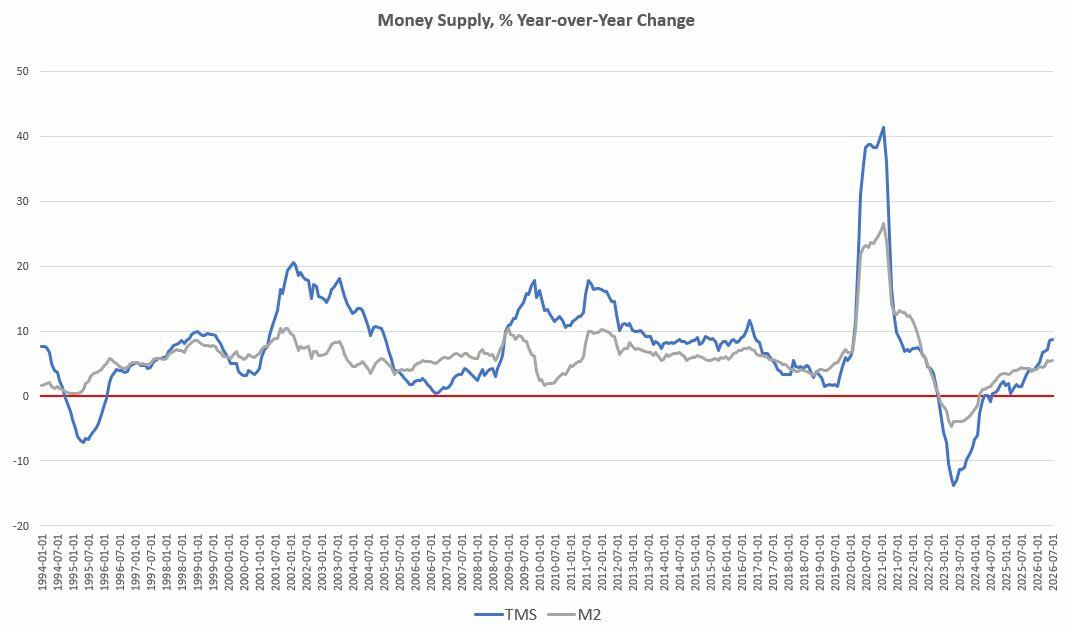
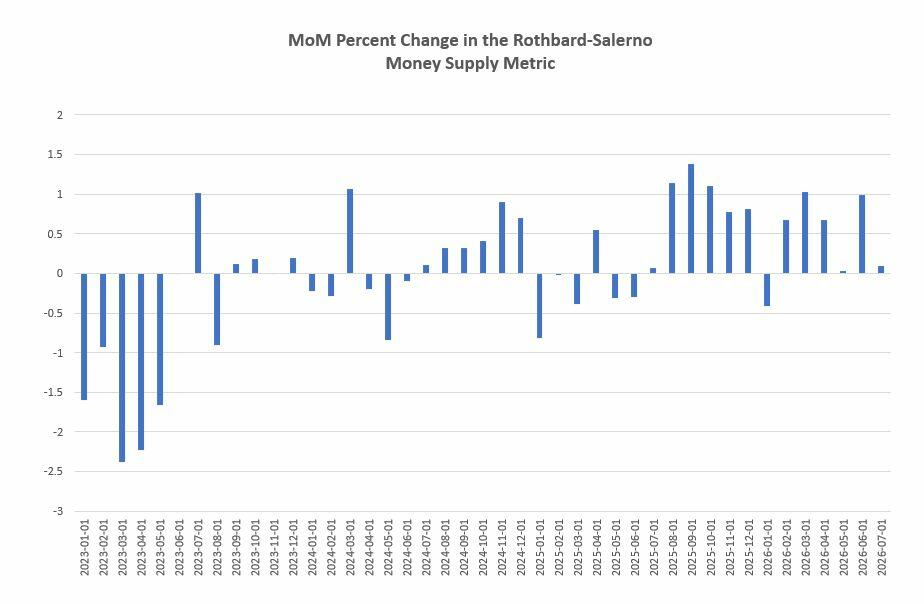
Nor should we expect much change in this trend so long as money-supply growth continues to accelerate as it has been doing for two years. July's measure of money-supply growth - the most recent data available - showed growth at the fastest pace, year-over-year, in 59 months. Moreover, measured month-to-month, the money supply has increased during 11 of the past 12 months.
More specifically, during July, year-over-year growth in the money supply was at 8.62 percent. That's up from June's year-over-year increase of 8.59 percent. Money-supply growth is also up sizably compared to July of last year when year-over-year growth was 1.46 percent.
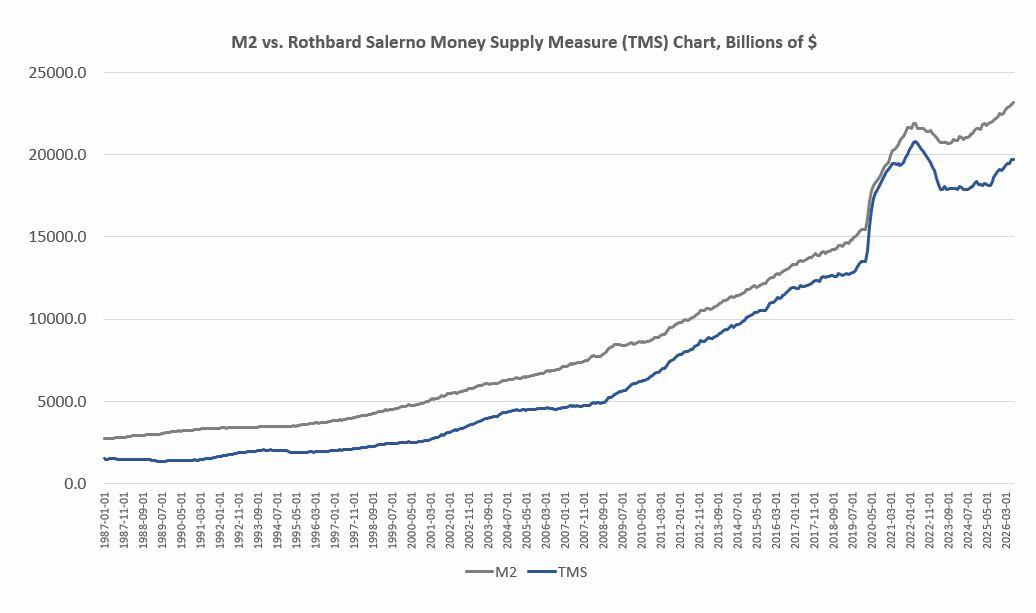
In July, the total money supply again rose, rising above $19.71 trillion and growing by $1.5 trillion in a year from July 2025 to July 2026.
Measuring month-to-month growth, we find that the money supply has grown in every month of the past year except January. During July, money-supply growth was at 0.097 percent.
The money supply metric used here - the "true," or Rothbard-Salerno, money supply measure (TMS) - is the metric developed by Murray Rothbard and Joseph Salerno, and is designed to provide a better measure of money supply fluctuations than M2. (The Mises Institute now offers regular updates on this metric and its growth.)
Historically, M2 growth rates have often followed a similar course to TMS growth rates, but throughout much of 2025, M2 outpaced even TMS, and M2 money-supply totals are again rapidly heading upward. M2 is now at the highest level it's ever been, topping $23.1 trillion. Measured year over year, July's growth rate for M2 was 5.42 percent. That's the highest growth rate in 49 months.
Since the end of 2009, the TMS money supply is now up by more than 226 percent. (M2 has grown by more than 170 percent in that period.) Out of the current money supply of $19.7 trillion, 30 percent of that has been created since January 2020. Since 2009, in the wake of the global financial crisis, more than $13 trillion of the current money supply has been created. In other words, nearly 70 percent of the total existing money supply have been created since the Great Recession.
Given current weak economic conditions, it is surprising to see such robust growth in the money supply. For example, the estimate for GDP growth in the second quarter of 2026 recently came in at only 1.5 percent. The employment level in the US has fallen by more than 1.2 million since the end of 2025. Wage growth has been below the PCE inflation rate - i.e., wage growth has been negative in real terms - since March of this year.
Given all this, we would not expect to see such robust growth in the money supply. Private commercial banks play a large role in growing the money supply in response to loose Fed policy, and when economic conditions are expansive, and as employment grows, lending also grows, further loosening monetary conditions. But when economic conditions are weak, we'd expect to see less lending and less bank-fueled monetary growth.
So, we should expect to see downward pressure on money supply growth given current economic conditions. However, in an effort to further pump asset prices, and to somehow counter our growing economic stagnation, and to push down yields on Treasuries, the Fed continues to intervene to push down interest rates. This requires a dovish stance on monetary policy, and this is reflected in how money-supply growth continues to accelerate.
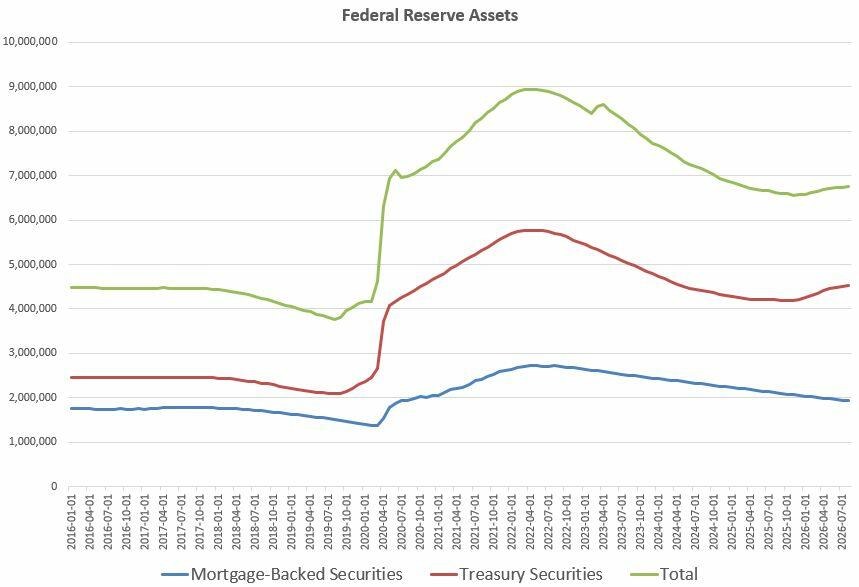
As an example of the Fed's commitment to monetary growth, we can look the Fed's portfolio which, in spite of many years of Fed claims about "normalization," has grown by $124 billion over the past year. In other words, the Fed is purchasing Treasuries with newly created money, further ensuring that the money supply continues to grow, even as the economy slows. Moreover, the Fed has refused to increase its target policy rate even as the PCE inflation measure shows no sign of coming close to the two-percent target.
So, how does monetary growth relate to rising prices? It is important to remember that growth in the money supply growth does not drive a one-to-one increase in price inflation. That is, a 10 percent increase in the money supply does not necessary lead to a similar increase in prices. Rather, there will always be a number of lags and measurement problems in calculating how monetary inflation affects price inflation. Nonetheless, monetary inflation is the primary enabling factor in price inflation. Yes, events like wars and logistical failures can lead to rising prices, but in the absence of monetary inflation, rising prices in some areas will require falling prices in other areas. Only in the presence of a growing money supply can there be a general increase in prices. And this is what we are seeing now. Even as energy prices rise, thanks to Trump's wars and trade barriers, we continue to see rising prices in most other areas as well, including food, real estate, and even apparel. This is made possible by a relentlessly rising money supply, engineered by the Federal Reserve and US Treasury officials.
Related Markets
All MarketsMarket data may be delayed. Not financial advice.
How other outlets covered this
Compare allAlto found this story at 2 outlets. Same event, different framing — compare the headlines.
How this story developed
Full timelineAlto has tracked this across 23 days of coverage from 2 outlets.
- Futures Drop As Yields, Oil Prices Keep Rising ZeroHedge
- Money-Supply Growth Accelerated In July To A 59-Month HighYou are here
Powered by Gab AI
The Story At A Glance
Reading this article now — analysis appears below
💡 AI analysis provides alternative perspectives on current events