Senate Blocks Clarity Act As Cloture Falls Short Of 60 Votes
.jpg?h=21277b21&itok=7gbXH5iD)
The short version
- ET, was the first floor test of comprehensive crypto market-structure legislation in the chamber.
- It was a vote on whether debate could even begin.
- The answer was no, with 50 no votes and 49 yes votes.
- Every Democrat voted against the measure.
- Susan Collins of Maine, Josh Hawley of Missouri and Jerry Moran of Kansas - also voted against the measure The Clarity Act is the market-structure half of the crypto legal…
The story
The Senate on Tuesday failed to advance the Digital Asset Market Clarity Act, falling short of the 60 votes needed to invoke cloture on the motion to proceed to H.R. 3633. The vote, held at about 2:15 p.m. ET, was the first floor test of comprehensive crypto market-structure legislation in the chamber. It was not a vote on final passage. It was a vote on whether debate could even begin. The answer was no, with 50 no votes and 49 yes votes.
Every Democrat voted against the measure. Three Republicans - Sens. Susan Collins of Maine, Josh Hawley of Missouri and Jerry Moran of Kansas - also voted against the measure
The Clarity Act is the market-structure half of the crypto legal framework Congress began building last year, the companion to the GENIUS Act's stablecoin rules. It draws the line between digital assets regulated as commodities under the CFTC and those regulated as securities under the SEC, puts spot trading platforms under a federal registration regime for the first time, and sets statutory terms for self-custody, noncustodial software and rewards on stablecoin balances. It cleared the House last July with 78 Democrats and then spent a year in Senate rewrites.
That result effectively freezes the bill in place with almost no calendar left before the midterms. Republicans control 53 seats. They needed at least seven Democrats, and more if GOP holdouts peeled off over bank or law-enforcement concerns. They did not get them.
The House passed its version 294-134 in July 2025. The Senate Banking Committee reported a version 15-9 in May 2026, with Democrats Ruben Gallego of Arizona and Angela Alsobrooks of Maryland joining Republicans. Tuesday was supposed to be the moment those committee crossovers turned into a floor coalition. Both Gallego and Alsobrooks voted no on cloture. Instead, the first hurdle became the last one of 2026.
BREAKING: 🇺🇸 The Crypto CLARITY Act has failed to pass the Senate cloture vote. pic.twitter.com/0VAw1H9Eyl
— Bull Theory (@BullTheoryio) September 15, 2026
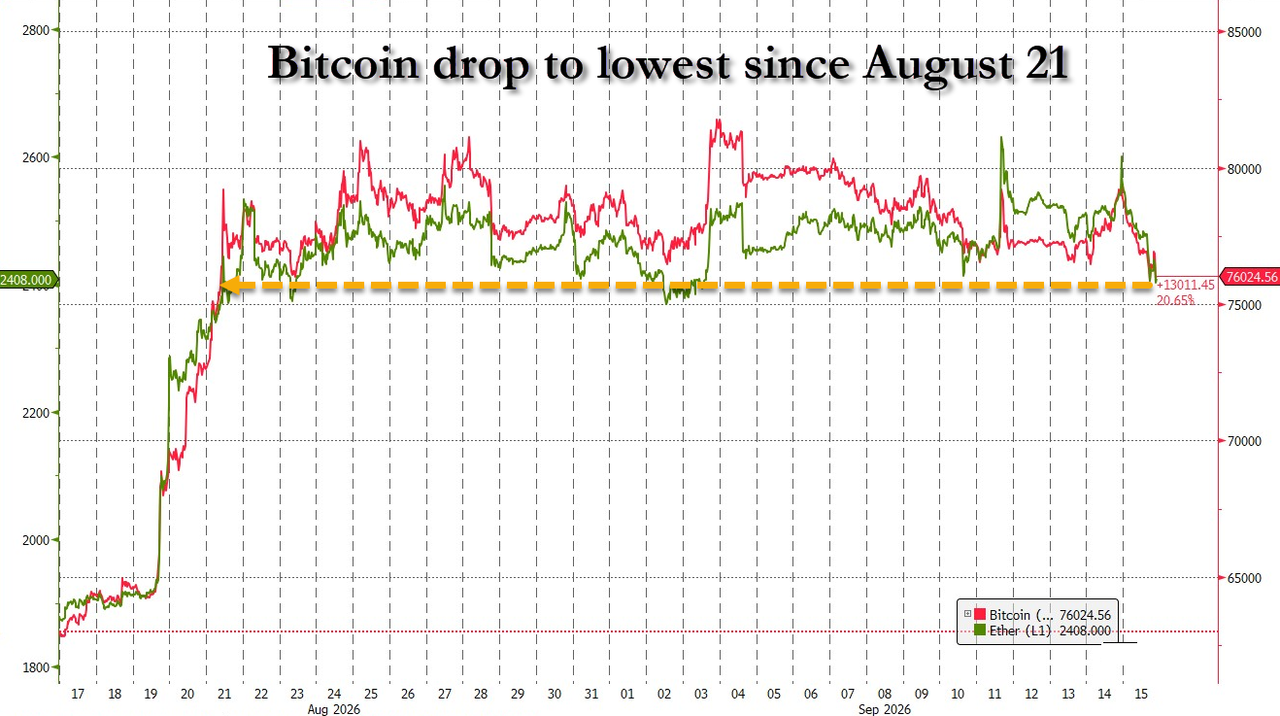
Aaaaand, Bitcoin isn't happy.
How the deal collapsed in 48 hours
Senate Republicans released what they called their "last, best and final" text Sunday night. Sens. Cynthia Lummis of Wyoming, Banking Chair Tim Scott of South Carolina, and Agriculture Chair John Boozman of Arkansas said the draft folded in 126 substantive changes requested by Democrats. The package included new ethics language modeled on a Tillis-Gallego proposal, edits to the Blockchain Regulatory Certainty Act for noncustodial developers, Agriculture Committee guardrails on affiliate trading and tribal gaming, and a Treasury "circuit breaker" meant to address bank fears that stablecoin yield would drain community-bank deposits.
Lummis's line was blunt: Democrats got what they wanted; now take yes for an answer.
Democrats did not. Late Monday they sent a counteroffer. According to people familiar with it, they did not reopen the stablecoin-yield fight - sources had described that as a "Republican-only" problem - but they did demand more on ethics (large holdings, dependent children, paid crypto promotions), a narrower BRCA that expressly does not modify criminal law, and tighter Ag-title rules on exchanges and conflicts. Sens. Mark Warner of Virginia, Ruben Gallego of Arizona, and Raphael Warnock of Georgia said the White House-approved ethics language still needed work. Sen. Elizabeth Warren of Massachusetts went further, arguing the enforcement design left the Trump administration too much control and left loopholes around existing presidential crypto interests.
Republicans rejected the counteroffer Tuesday morning. "In response to a significant step in their direction, Democrats have chosen to move the goalposts again," Senate Banking Committee spokesman Jeff Naft said. "Yet we are hearing the same unreasonable asks and the same refusal to take yes for an answer. The final text is public." Lummis's office said the Democratic paper "looks identical to their opening position at the start of recess."
White House Crypto Council Executive Director Patrick Witt had already signaled there was little room left. "If there are any changes, we're talking about punctuation at this point or technical changes," he told Crypto In America on Monday. "I view that as definitely a best and final offer."
Three fights that never closed
Ethics. This was the political core. Democrats wanted restrictions on large crypto holdings by the president, vice president, members of Congress, judges, and family, plus limits on paid promotions. Republicans added language they said tracked the Tillis-Gallego framework and gave state attorneys general a role in enforcement. Critics said it still left gaps around existing ventures tied to the Trump family and put too much enforcement discretion in the Justice Department. Warren and others treated that as disqualifying. The Democrats who had spent months negotiating the bill, Kirsten Gillibrand, Mark Warner, Cory Booker, Raphael Warnock, Ruben Gallego, Angela Alsobrooks and Catherine Cortez Masto, all voted no, according to Crypto In America's Eleanor Terrett.
Developer protections and DeFi. The BRCA language was meant to shield noncustodial software developers from money-transmitter registration. Sen. Catherine Cortez Masto of Nevada has been the Democratic face of that fight. Republicans already stripped explicit criminal safe harbors to satisfy her. Her camp still wanted the provision narrowed and a sentence stating that nothing in it changes criminal law. Industry and GOP negotiators called that a second move of the goalposts.
Banks and stablecoin yield. Eight banking trade groups, including the American Bankers Association and the Independent Community Bankers of America, attacked the new circuit breaker as "not a safeguard at all" because it would fire only after deposits had already left. They wanted tighter bans on interest-like payments on stablecoin balances. The White House Council of Economic Advisers published a tool arguing there is "no meaningful relationship between stablecoin growth and community bank deposit flight." Witt accused the banks of acting in bad faith: "If you oppose the Clarity Act because you just hate crypto, that's fine. Just say that."
That bank fight mattered inside the GOP. Sen. John Curtis of Utah said he would vote to proceed but was a no on final passage. Sens. John Cornyn of Texas and Susan Collins of Maine - Collins called the bill a "moving target" and flagged community-bank deposits - were publicly undecided going into the vote. Sens. Rand Paul of Kentucky and Josh Hawley of Missouri were widely expected to oppose the bill on substance. Mitch McConnell of Kentucky returned to the floor Monday after a three-month absence and said he would "do my best to be present for tough votes." Presence was not the same as 60 votes.
What the bill would have done
Clarity is market-structure legislation, the sequel to last year's GENIUS Act on stablecoins. It would split digital-asset oversight between the SEC and the CFTC, keep securities law from being skirted by labeling tokens as something else, set rules for trading platforms, and try to write a statutory floor under self-custody and noncustodial development. Supporters at BlackRock, Fidelity, Schwab, Goldman, and Coinbase argued the alternative is agency-by-agency enforcement with no durable statute. Opponents argued the draft under-regulated conflicts, illicit finance, and bank-deposit competition.
Majority Leader John Thune framed Tuesday as the "next logical step" after GENIUS. Scott called it the day "everyone [had] to put their cards on the table." They did. The table did not have 60 cards on it.
Cloture on a motion to proceed is not a funeral by Senate rules. Leadership can file again. Amendments can be rewritten. A lame-duck session still exists on paper.
The calendar does not. The House has already canceled late-September weeks. The Senate has a short September window, then October campaign recess, then a post-election lame duck that will be defined by midterm results. Prediction markets had already repriced the bill before the roll call: passage-this-year contracts on Polymarket and Kalshi ran between the high teens and the mid-30s in the hours before the vote, depending on the platform and the hour. Analysts at TD Cowen and Capital Alpha had the full-year odds in the same neighborhood.
If the 119th Congress does not pass Clarity, the next Congress writes a new bill. Agencies keep making policy by enforcement and rulemaking. The industry stays in the gap between a House-passed statute and a Senate that could not open debate.
Witt said Monday that whether the bill got 60 votes would be "a political calculation, not a policy calculation." Tuesday proved him right. The policy text was 600-plus pages and a year of talks. The politics were ethics, banks, and a midterm clock. The politics won.
Related Markets
All MarketsMarket data may be delayed. Not financial advice.
How other outlets covered this
Compare allAlto found this story at 2 outlets. Same event, different framing — compare the headlines.
Powered by Gab AI
The Story At A Glance
Reading this article now — analysis appears below
💡 AI analysis provides alternative perspectives on current events