From Civilian To Military Economy: This Is What A Declining Empire's Economy Looks Like
The short version
- They reveal it in the data… And on Monday, the U.S.
- Census Bureau quietly published the latest installment.
- Rome elevated the military as the empire decayed.
- And after 1971, when Nixon severed the dollar from gold, America began the same process.
- The factory floor is where it shows up first… So let’s look at it.
The story
Authored by Bryan Lutz via DollarCollapse.com,
“A government always finds itself obliged to resort to inflationary measures when it cannot negotiate loans and dare not levy taxes, because it has reason to fear that it will forfeit approval of the policy it is following if it reveals too soon the financial and general economic consequences of that policy.”
~ Ludwig von Mises, The Theory of Money and Credit (1912)
Empires don’t announce their decline.
They reveal it in the data…
And on Monday, the U.S. Census Bureau quietly published the latest installment.
Rome elevated the military as the empire decayed.
Britain did the same after 1914.
And after 1971, when Nixon severed the dollar from gold, America began the same process.
The factory floor is where it shows up first…
So let’s look at it.
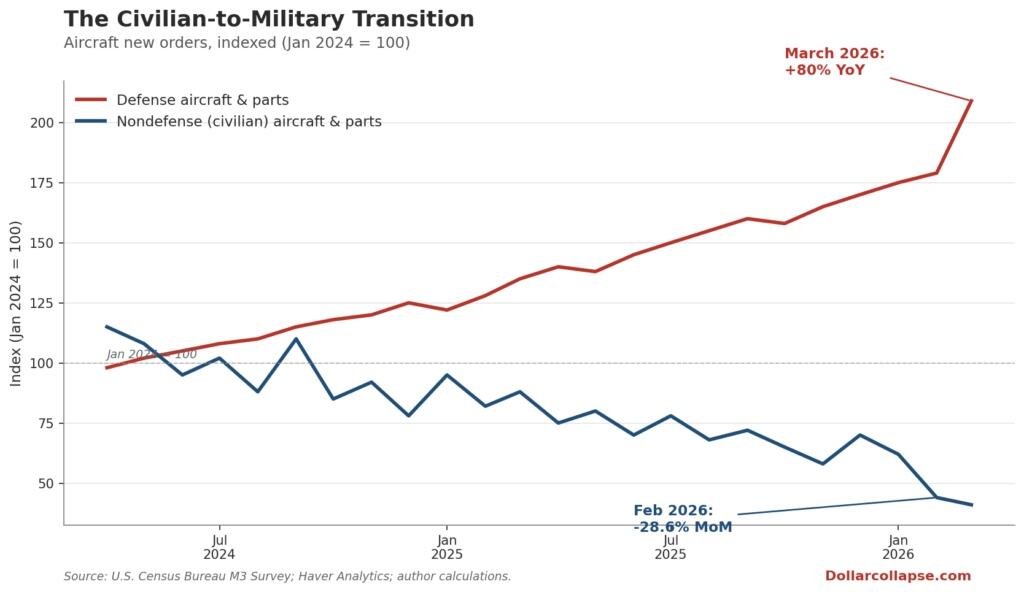
March 2026 defense capital goods orders: up 18 percent month-over-month.
But, year-over-year, it’s a much larger number: up 80 percent.
Non-defense capital goods? Down 1.2 percent, which makes it the sixth contraction in seven months.
Strip out defense production, and the headline factory number moves negative.
Now, the United States isn’t exactly in full-on war economy yet. It’s what a peacetime empire economy looks like in late stage.
Here’s what the transition looks like on the chart, defense versus non-defense aircraft orders, last 24 months:
One of those lines is paid for by the Pentagon writing a check. The other is paid for by airlines and freight companies deciding they want to expand. Guess which kind of order an empire prioritizes when it’s running out of money.
And here’s where it gets interesting.
Ludwig von Mises wrote in 1912:
“A government always finds itself obliged to resort to inflationary measures when it cannot negotiate loans and dare not levy taxes, because it has reason to fear that it will forfeit approval of the policy it is following if it reveals too soon the financial and general economic consequences of that policy.”
You see, a Federal government has three ways to pay its bills.
-
It can tax.
-
It can borrow.
-
Or it can print.
If the US government were to tax citizens for $2.5 trillion in defense spending they’d revolt by Tuesday.
If they were to borrow it from foreigners who are already net sellers of Treasuries? Good luck.
That leaves the printer.
Every empire elevates the military as the civilian economy decays. Rome did it under Diocletian. The British did it after 1914. America started in 1971.
The Vietnam-era proof is the cleanest.
After the war ended, federal spending kept rising. The 1969 federal surplus of $3 billion turned into a $23 billion deficit by 1972, with the war winding down.
America didn’t exactly demobilize after that. Instead, they redirected attention.
In fact, look at where the redirection is going right now.
The Pentagon’s 2027 national security request will exceed $2.5 trillion. The cost of the Iran war isn’t even in that budget.
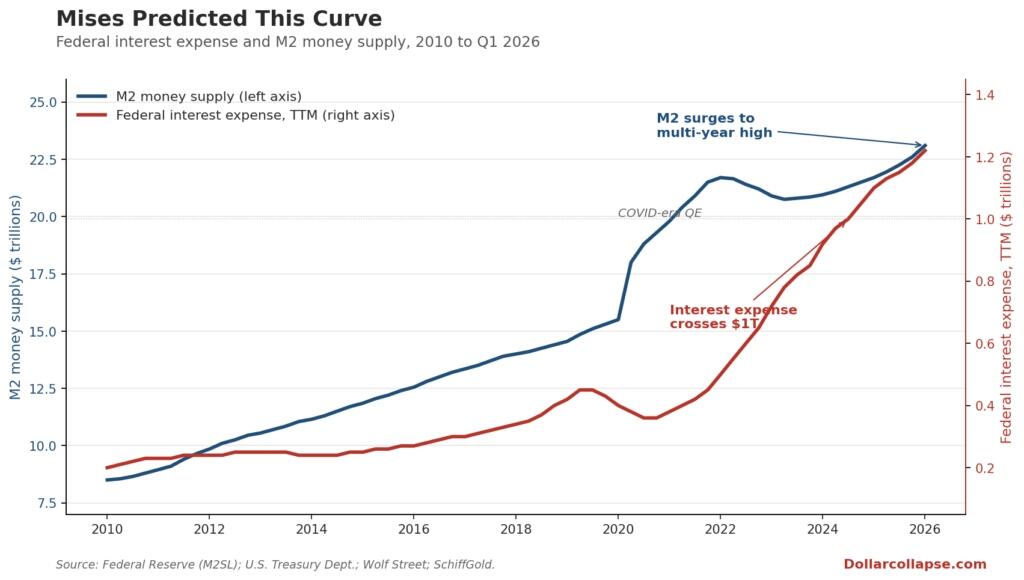
And the money supply just surged to a multi-year high. The Fed has quietly restarted QE.
So, the Pentagon gets more airplanes.
You can see what that printing looks like in the chart, below. Federal interest expense just crossed $1 trillion trailing twelve months, and M2 is heading vertical:
Mises predicted this curve. The Census Bureau is now reporting it.
And that’s why every empire’s late-stage transition ends the same way.
Eventually, the currency thins out, military thickens up, and the middle class evaporates between them.
Weimar Germany. Late-stage Rome. The Soviet Union in its last decade.
Each time, the people who held the State’s paper got wiped.
Each time, the people who held gold got out.
This week, the Fed will move closer to the cut. The Treasury will sell another half-trillion next week. Defense will keep ordering. And Civilian CapEx will keep contracting…
This is what a declining empire’s economy looks like. There just hasn’t been an announcement yet.
Related Markets
All MarketsMarket data may be delayed. Not financial advice.
How this story developed
Full timelineAlto has tracked this across 4 days of coverage from 1 outlet.
- From Civilian To Military Economy: This Is What A Declining Empire's Economy Looks LikeYou are here
Powered by Gab AI
The Story At A Glance
Reading this article now — analysis appears below
💡 AI analysis provides alternative perspectives on current events