Closing Arguments In High-Stakes OpenAI Trial Focus On Reputation, Character
.jpg?itok=5RCwDquX)
The short version
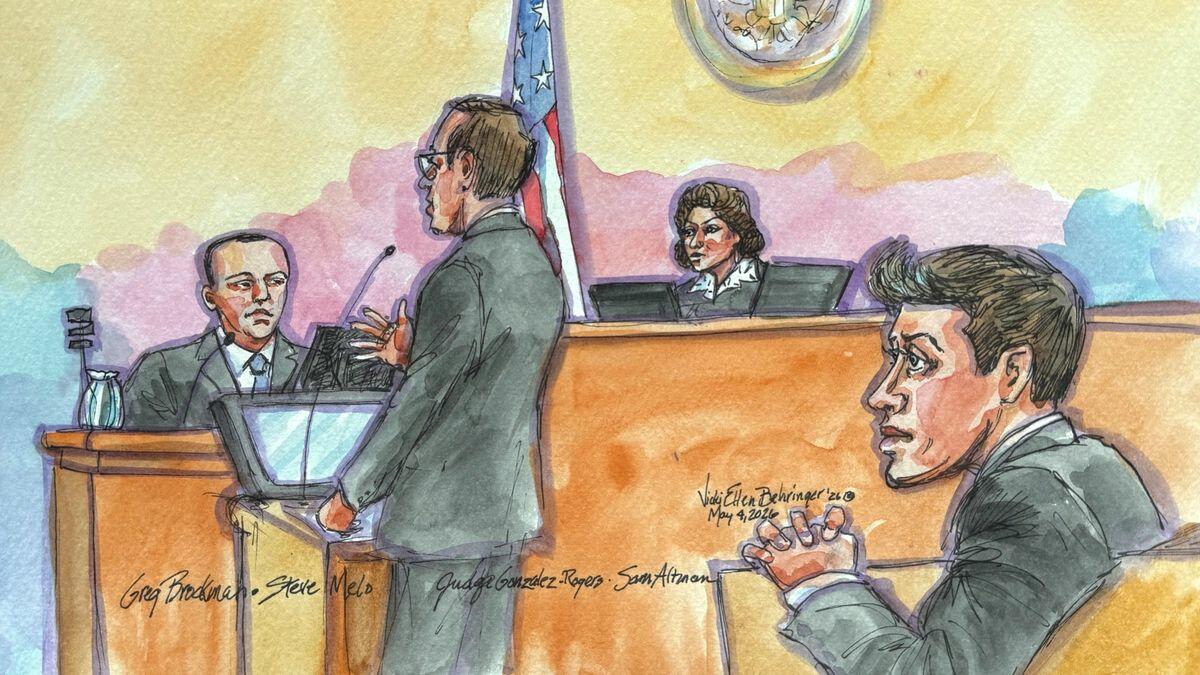
- In a courtroom sketch, Sam Altman listens as OpenAI President Greg Brockman testifies during Elon Musk's lawsuit trial over OpenAI's for-profit conversion…
- Vicki Behringer/Reuters Tech moguls Elon Musk and Sam Altman, once friends and partners in a fledgling AI startup with big dreams and a noble mission…
- On the stand, Tesla CEO Musk told the court, “We don’t want to have a Terminator outcome,” suggesting humanity would be better off with a “Star Trek” future written by Gene…
- Musk cofounded OpenAI in 2015 with Altman, President Greg Brockman, and former chief scientist Ilya Sutskever.
- At the time, both Musk and Altman expressed grave concerns about the unregulated advancement of Artificial General Intelligence (AGI)—a hypothetical point at which the machines…
The story
Authored by Beige Luciano-Adams via The Epoch Times (emphasis ours),
OAKLAND, Calif.—After nearly three weeks of presented evidence, an Oakland jury on May 14 heard final arguments in a high-stakes legal battle that could have profound impacts on the race for artificial intelligence.
Tech moguls Elon Musk and Sam Altman, once friends and partners in a fledgling AI startup with big dreams and a noble mission, are nearing the climax of a bitter feud over the future of an $852 billion company.
Despite a judicial ban on testimony related to AI-induced “extinction” scenarios, references to speculative risks still surfaced during the Oakland courtroom proceedings, appeared in discussions around “risk” and “safety.” Vague promises about the future benefits of an unrealized technology were also touched upon.
On the stand, Tesla CEO Musk told the court, “We don’t want to have a Terminator outcome,” suggesting humanity would be better off with a “Star Trek” future written by Gene Roddenberry, rather than something from the mind of James Cameron.
Musk cofounded OpenAI in 2015 with Altman, President Greg Brockman, and former chief scientist Ilya Sutskever. At the time, both Musk and Altman expressed grave concerns about the unregulated advancement of Artificial General Intelligence (AGI)—a hypothetical point at which the machines “outsmart” humans and operate autonomously.
Those concerns, Musk testified, were the express motivation for founding OpenAI: open-source to prevent consolidation of power, and philanthropic to offset the profit-driven AI race.
He sued Altman and Brockman in 2024, alleging they bilked him out of $38 million in donations, then restructured as a for-profit corporation by exclusively licensing their flagship product, ChatGPT, to Microsoft—and in doing so, betrayed their founding mission.
OpenAI and Microsoft deny the allegations, arguing Musk abandoned the company in 2018 to start his own for-profit competitor, xAI, when other founders rejected his bid to take full control of the operation.
Alongside the “preponderance” of evidence that both sides say supports their claims, the trial was just as focused on the two men’s reputations and characters.
“Sam Altman’s credibility is directly at issue in this case,” Steven Molo, an attorney for Musk, said in his closing statement. “The defendants absolutely need you to believe Sam Altman. If you cannot trust him ... they do not win.”
Molo questioned Altman earlier this week over a list of employees and colleagues who, both on and off the record, have characterized him as dishonest and opportunistic.
OpenAI attorneys dismissed the tactic as “character assassination.”
Sarah Eddy, an attorney for OpenAI, countered, “Mr. Molo says Sam Altman can’t be trusted, but Mr. Musk is the one whose testimony is contradicted by every other witness and all the documents.”
Altman, Brockman, and others cast Musk as a detached outsider who contributed little if any sweat equity, had fraught relationships with colleagues, and attempted to poach OpenAI’s employees for his other companies.
“The claim is that the Midas touch of Elon Musk made OpenAI what it is today,” William Savitt, an attorney for OpenAI, said in closing arguments.
“Elon, Elon, Elon. ‘It was all me.’ Mr. Musk wants all that credit, but he hasn’t earned [it].
“This requires a touch that he doesn’t have. This is not a bulldozer. ... To succeed in AI, as it turns out, all Mr. Musk can do is come to court.”
Savitt pointed out Musk wasn’t present for closing arguments, having jetted off to China earlier in the week with President Donald Trump.
Gesturing at Altman and Brockman, he said: “My clients are here because they care a lot about it. Mr. Musk came to this court for exactly one witness—Mr. Musk. Now he’s in parts unknown.”
Musk, according to the Forbes Billionaire Index, is the wealthiest person in the world, with a net worth of around $826 billion. Brockman received equity in the OpenAI corporation worth around $30 billion, and Altman’s net worth is around $3.5 billion.
When Brockman took the stand last week, Molo accused him of plotting to use OpenAI to become a billionaire.
“You had a fiduciary duty [to the nonprofit],” the attorney said. “You took the assets from the nonprofit, you moved them into the for-profit to create this money-making machine that resulted in you having $30 billion.”
Brockman said such was a “deep mischaracterization.” Personal diary entries from late 2017 in which he muses about profits, and about how it would be “morally bankrupt” to “steal the nonprofit” from Musk, he said, were expressions of frustration.
Jurors heard from a parade of Silicon Valley insiders, including all four founders, and from dueling experts on AI safety, nonprofits, business law, and forensic accounting. They watched lawyers pick through reams of internal documents, analyzing complex corporate and financial histories, while private diaries, email, and text threads offered insight on the parties’ underlying motivations and shifting alliances.
“Everyone here has rights, even really rich guys like Elon Musk,” Molo said. “His is a claim that comes from a very deep place inside him, from his passion for this issue.”
During his own testimony, Musk often told the court, “You can’t just steal a charity.”
When his time on the stand came, Altman clapped back, “No, you can’t steal it, but Mr. Musk did try to kill it.”
Altman said on Tuesday that Musk contributed only 28 percent of the nonprofit’s funding from 2015 to 2020, and failed to come through on a $1 billion pledge, leaving the startup with few options.
OpenAI argues its nonprofit foundation is now one of the “best-resourced” in the world, with an equity stake in the company’s for-profit corporation approaching $200 billion—a direct result of $13 billion worth of investments from Microsoft and a 2025 restructure sanctioned by California and Delaware attorneys general.
The details of OpenAI’s journey from a scrappy, underfunded nonprofit to one of the most powerful and valuable AI companies are highly contested. In addition to the power struggle with Musk in 2017 and 2018, it involves a messy 2023 governance shakeup in which Altman and Brockman were briefly ousted and Microsoft was deeply entangled.
By 2017, all parties had agreed they would need vastly more capital and computing power to compete with AI giants such as Google. Various ideas were floated, debated, and discarded—including rolling OpenAI into Tesla and even turning to cryptocurrency. Ultimately, under Altman’s leadership, the company created a for-profit subsidiary in 2018 and, in 2019, partnered with Microsoft. In 2025, OpenAI restructured as a public benefit corporation, which its leaders say remains under the control of the foundation and loyal to the original mission.
The foundation holds an approximately 27 percent equity stake in the corporation; Microsoft owns a 26 percent stake.
Molo argued on Thursday that Microsoft’s investment breached the charitable trust Musk created by enriching its investors and “insiders” at the expense of the nonprofit, and failing to open-source the technology, prioritize AI safety, or follow nonprofit custom and practice.
The $13 billion Microsoft has invested since 2019 dwarfed charitable contributions and weakened OpenAI in its negotiating position with Microsoft, Molo said, resulting in a company focused on commercializing AI, with a gutted charity that does little more than sanitize its reputation.
As for Microsoft, Molo said the company was aware of what OpenAI was doing “every step of the way, they helped them violate their nonprofit mission, that’s aiding and abetting pure and simple.”
OpenAI and Microsoft argued there was never any charitable trust to breach.
Eddy, the OpenAI attorney, argued there were never any strings attached to Musk’s donations to OpenAI, and that he failed to demonstrate that he “properly manifested a specific intent” to devote the trust to a specific purpose, his $38 million in donations going instead to generally further the mission of the nonprofit.
“The specific purposes cannot just be in his head,” Eddy said.
Absent evidence proving this intent and specificity, she said, the plaintiff had resorted to implication and inference.
“It’s all made up,” she said.
As Musk told it, OpenAI’s mission was clear.
“I specifically came up with the idea, the name, recruited key people, taught [them] everything I know, provided the original funding. ... It was specifically for a charity that did not benefit any individual person. I could’ve started it as a for-profit, and I chose not to,” Musk said.
He is asking that Altman and Brockman be removed from their leadership positions at OpenAI, and that more than $100 billion be returned to the nonprofit foundation.
In addition to Musk’s three claims—breach of charitable trust, restitution based on unjust enrichment, and, against Microsoft, aiding and abetting a breach of a charitable trust—jurors will decide whether those claims are barred by a statute of limitations.
The jury will begin deliberations on Monday at 8:30 am.
Related Markets
All MarketsMarket data may be delayed. Not financial advice.
Powered by Gab AI
The Story At A Glance
Reading this article now — analysis appears below
💡 AI analysis provides alternative perspectives on current events