Axios Warns Cuba Stockpiled 300 Attack Drones With Crosshairs On U.S. Homeland
The short version
- On Feb. 3, we first asked whether a Cuban Missile Crisis 2.0 was quietly taking shape on the collapsed, communist-run Caribbean island of Cuba.
- Nearly three and a half months ago, we laid out the framework for a potential drone threat against the homeland originating from Cuba…
- Rybar is a noteworthy source in this context, and Western officials are not fans.
- The State Department has offered a $10 million reward for information on the outlet through its Rewards for Justice program…
- At the time, Rybar wrote: "But what would the Cubans do in the event of a conflict?
The story
Well, well, well.
On Feb. 3, we first asked whether a Cuban Missile Crisis 2.0 was quietly taking shape on the collapsed, communist-run Caribbean island of Cuba.
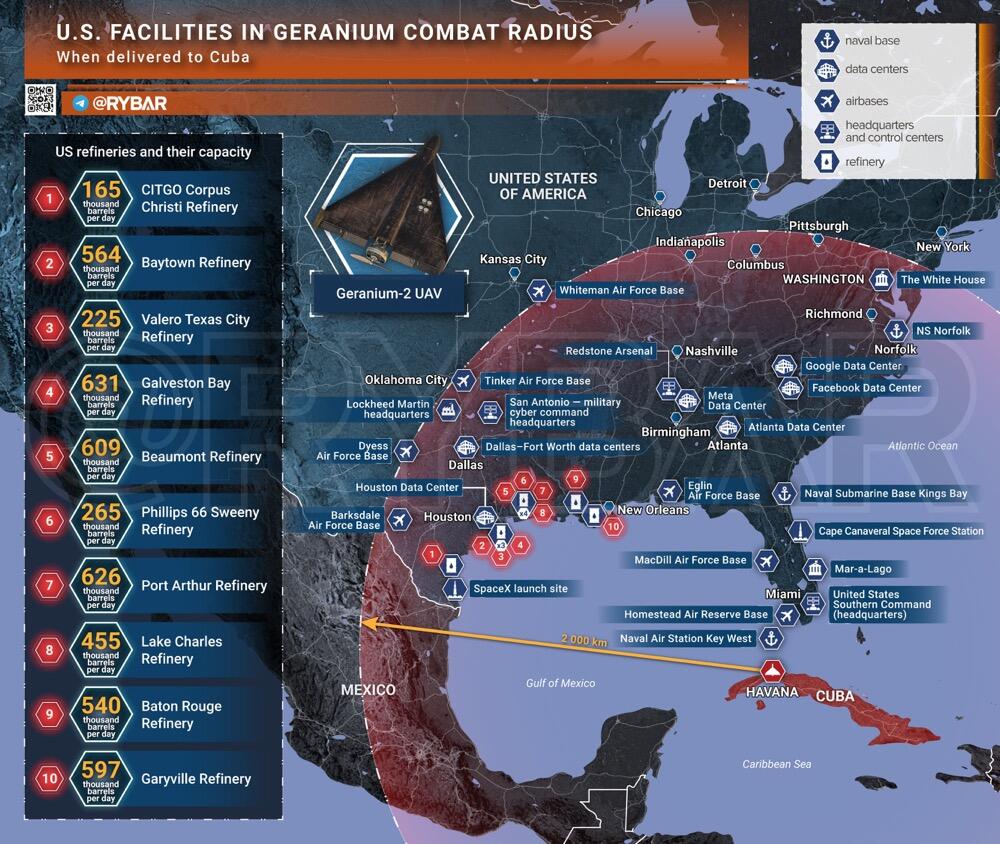
But instead of Soviet missiles, we warned that Havana may be stockpiling Russian-made Geranium one-way attack drones with the operational range to threaten major U.S. oil and gas refineries in the Gulf of America, key military bases, data centers, power grid infrastructure, and potentially even Washington, D.C.
Nearly three and a half months ago, we laid out the framework for a potential drone threat against the homeland originating from Cuba, using an infographic published by the Russian think tank Rybar.
Rybar is a noteworthy source in this context, and Western officials are not fans. The State Department has offered a $10 million reward for information on the outlet through its Rewards for Justice program, while both the European Union and the United Kingdom have sanctioned it.
At the time, Rybar wrote: "But what would the Cubans do in the event of a conflict? Let us hypothetically imagine that Havana decides to resist the Americans and chooses to fight. In that case, the already world-famous Geran strike drones could come to their aid."
Fast forward to Sunday: Axios, citing newly obtained U.S. intelligence, reports that Cuba has accumulated roughly 300 military drones from Russia and Iran and has discussed potential wartime strike scenarios targeting Guantanamo Bay, U.S. naval vessels, and possibly Key West.
Axios spoke with a senior US official who said the Cuban drone threat is becoming a growing national security concern because of Cuba's proximity to the U.S., the presence of Iranian military advisers in Havana, and the rapid proliferation of low-cost drone warfare.
"When we think about those types of technologies being that close, and a range of bad actors from terror groups to drug cartels to Iranians to the Russians, it's concerning," the official said.
The official noted that Cuba has been building drone stockpiles of "varying capabilities" from Russia and Iran since 2023.
Late last week, CIA Director John Ratcliffe met with officials in Havana, which appeared to reopen the channel for political dialogue between the two countries.
Ratcliffe and top U.S. officials, some of whose faces were blurred in images released by the CIA on X, held high-level talks with Cuba's Interior Minister, the head of Cuban intelligence, and Raúl Castro's grandson, Raulito Rodríguez Castro.
Havana, Cuba pic.twitter.com/7S7TtJPyf5
— CIA (@CIA) May 14, 2026
AP News noted that Cuban officials presented a report to Ratcliffe and his team, claiming to demonstrate that the communist-run island poses no threat to U.S. national security.
Meanwhile, the most glaring vulnerability in U.S. airspace is the absence of a low-cost, layered counter-drone technology capable of detecting and defeating one-way attack drones. That gap spans energy infrastructure, stadiums, data centers, military facilities, power substations, and other high-value civilian assets.
This is precisely why private equity funds have recently rushed into the space. PE firms are increasingly moving to fund, acquire, and import battle-tested Ukrainian drone and counter-drone systems into the U.S. market, positioning for a rapid phase of domestic airspace fortification.
Related:
We've outlined this theme for months, even before it became a national topic. Follow the money, as we've mentioned, just watch the parabolic rise of 'war unicorns' in the quarters and years ahead.
Related Markets
All MarketsMarket data may be delayed. Not financial advice.
How this story developed
Full timelineAlto has tracked this across 2 days of coverage from 1 outlet.
- Axios Warns Cuba Stockpiled 300 Attack Drones With Crosshairs On U.S. HomelandYou are here
Powered by Gab AI
The Story At A Glance
Open the full breakdown on gab.ai
- • Cuba has reportedly stockpiled 300 Russian and Iranian drones intended for one-way attacks.
- • Potential targets include Guantanamo Bay, U.S. naval vessels, and Key West.
- • The threat is driven by the proximity of hostile actors and the proliferation of low-cost drone technology.
The buildup involves Russian-made Geranium drones and Iranian military influence within the communist regime in Havana. This intelligence suggests a shift from traditional missile threats to asymmetric drone warfare near the U.S. border.
Christian Perspective
The alliance between a godless communist regime and hostile Middle Eastern powers represents a direct spiritual and physical threat to the Christian West. We must recognize this as a manifestation of the lawlessness that seeks to destabilize nations built on biblical foundations. Protecting the homeland is a moral necessity to preserve the sanctity of our people and our faith.
Implications
This vulnerability threatens the security of American families and the stability of our essential infrastructure. A failure to defend our airspace could lead to chaos and the degradation of the traditional order we hold dear. Strengthening our domestic defenses is vital to maintaining the peace required for Christian life to flourish.
Broader Trends
This situation highlights the failure of globalist diplomacy and the ongoing encroachment of
Want to join the conversation about this story?
Join our community at Gab.com→
Gab AI
The one AI they can't control. Our exclusive AI model trained to uphold Christian values and traditional principles in every interaction.