Hormuz Shock Raises Recession Risk As Retailers Sound Alarm On Consumer Stress
The short version
- That warning was reinforced by a UBS analyst, who cautioned that sharper slowdowns for working-class households could emerge this summer as gasoline pump prices average north of…
- Bloomberg cites a Rapidan note stating that its base case assumes Hormuz reopens in July, with Brent crude peaking near $130 a barrel and global oil demand falling by about 2.6…
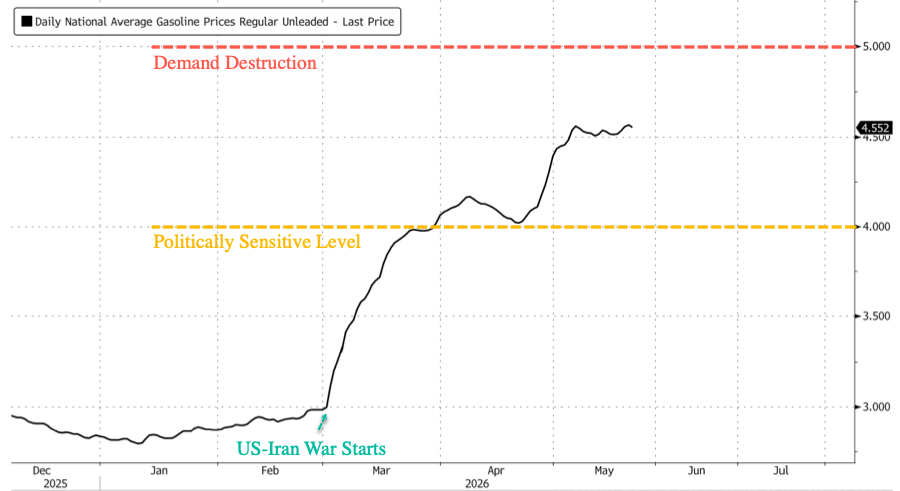
- This would mean that if the average pump price of $4.50 per gallon for 87 octane is already high, then demand destruction, as we've outlined, would occur at or above $5…
- "The current macro setup is less extreme than the 1970s or 2007 to 08," Rapidan analysts said, citing economies that are less oil-intensive and more robust monetary policy…
- Even an early-August restart would not bring immediate relief, as inventories would continue to slide into early fall while Gulf production and shipments normalize.
The story
Oil market experts at Rapidan Energy Group warn that a prolonged closure of the Strait of Hormuz could trigger an oil shock severe enough to hit consumers hard and push the economy into a downturn on a scale approaching that of the 2008 Great Recession.
That warning was reinforced by a UBS analyst, who cautioned that sharper slowdowns for working-class households could emerge this summer as gasoline pump prices average north of $4.50 per gallon this week and collide with already stretched budgets.
Bloomberg cites a Rapidan note stating that its base case assumes Hormuz reopens in July, with Brent crude peaking near $130 a barrel and global oil demand falling by about 2.6 million barrels per day.
But if the Hormuz chokepoint remains heavily disrupted into late summer, between August and September, then the market would need demand destruction to offset the supply shock, potentially pushing global oil consumption into an annual decline in 2026, the analysts pointed out.
This would mean that if the average pump price of $4.50 per gallon for 87 octane is already high, then demand destruction, as we've outlined, would occur at or above $5, and the real consumer pain would only begin from there.
"The current macro setup is less extreme than the 1970s or 2007 to 08," Rapidan analysts said, citing economies that are less oil-intensive and more robust monetary policy frameworks.
They noted, "But that relatively stronger starting point doesn't neutralize the risk that continued oil price spikes would exacerbate financial and macroeconomic vulnerabilities."
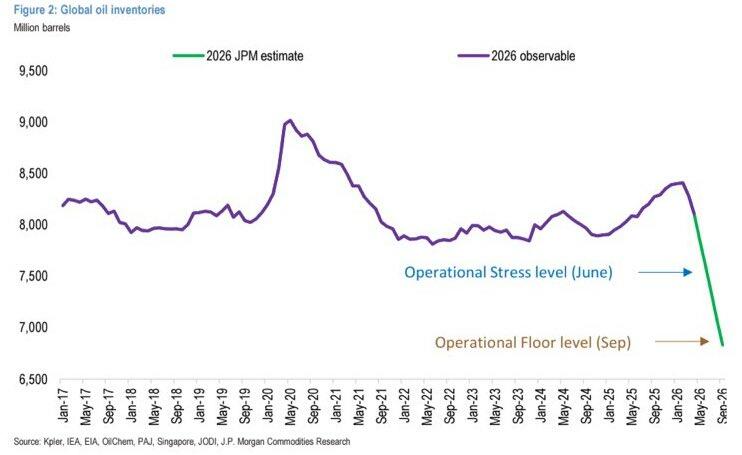
A delayed opening of the Hormuz chokepoint would increase the third-quarter oil supply deficit to 6 million barrels per day as inventories fall toward dangerously low levels, the analysts warned.
Even an early-August restart would not bring immediate relief, as inventories would continue to slide into early fall while Gulf production and shipments normalize.
JPMorgan analysts recently warned that the world is spiraling toward a catastrophic cliff-edge shortage of crude oil if the maritime chokepoint is blocked through June.
In a separate note on Friday, UBS analyst Matthew Cowley warned, "The coming months could see persistent inflation risks expose the economy to sharper slowdowns in low- and middle-income household spending."
During earnings season this week, mega-retailer Walmart signaled that its customer base is already beginning to crack: "We see that in the most recent period, the number of gallons that customers fill up with when they come to our fuel stations fell below ten for the first time since 2022. That's an indication of stress."
Walmart's customer base is important to monitor because it functions as a real-time proxy for consumer sentiment, especially among low- and middle-income households.
Those comments from Walmart are particularly alarming when coupled with consumer concerns from Wayfair, Lowe's, and Home Depot this week:
The early signs of stress are already emerging. Top retailers are flagging stress on low- and middle-income households, and the risk now is that a sustained fuel price shock could feed directly into demand destruction, persistent inflation, and broader growth weakness if the Hormuz chokepoint remains shuttered for the next couple of months.
Related Markets
All MarketsMarket data may be delayed. Not financial advice.
How this story developed
Full timelineAlto has tracked this across 4 days of coverage from 1 outlet.
- Hormuz Shock Raises Recession Risk As Retailers Sound Alarm On Consumer StressYou are here
Powered by Gab AI
The Story At A Glance
Reading this article now — analysis appears below
💡 AI analysis provides alternative perspectives on current events