Two Billboards In New York Capture The Conflict Of Our Time
The short version
- This is a city of advertising, where images appear when someone wants the whole world to see them.
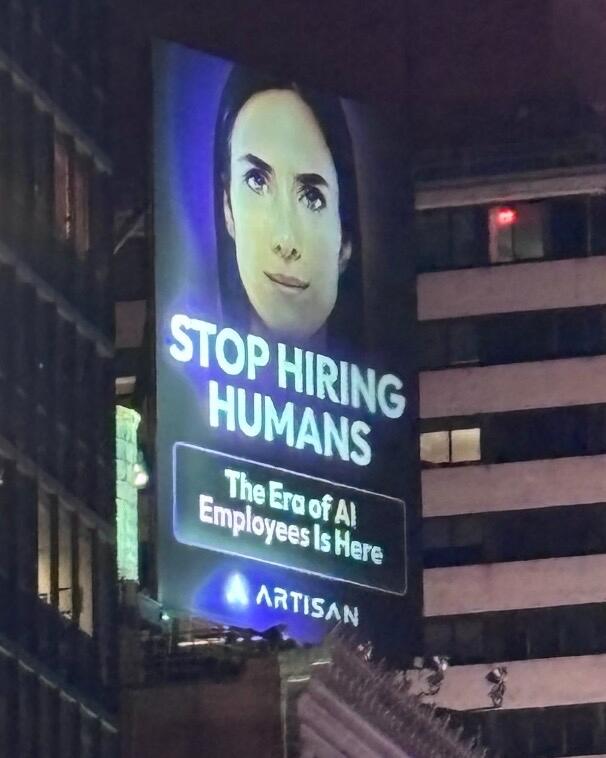
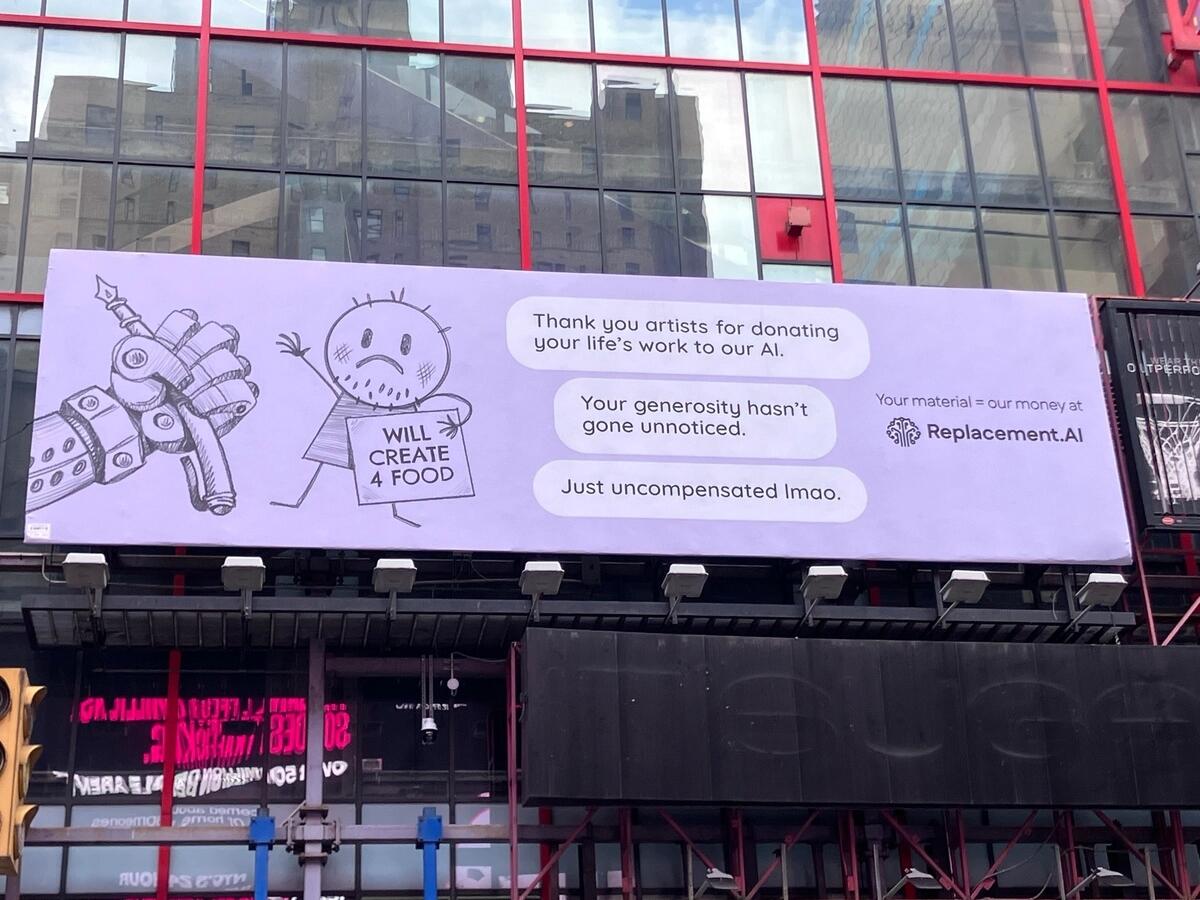
- One billboard is selling artificial intelligence, and the other is warning about it.
- The juxtaposition between these two advertisers, who most likely wouldn’t have seen the other’s message in advance…
- The selling billboard is dark, purple, and almost cinematic.
- An AI-generated face with artificial perfection stares out.
The story
Authored by Kay Rubacek via The Epoch Times,
Two billboards went up in New York City recently. This is a city of advertising, where images appear when someone wants the whole world to see them. One billboard is selling artificial intelligence, and the other is warning about it. The juxtaposition between these two advertisers, who most likely wouldn’t have seen the other’s message in advance, captures the conflict of our times and cements the uncertainty about the future within an artificial intelligence world.
The selling billboard is dark, purple, and almost cinematic.
An AI-generated face with artificial perfection stares out. Three words above her say: “Stop Hiring Humans.” The Era of AI Employees Is Here. The company is Artisan. The company says it “is a provocation. It works because it’s uncomfortable.” It is real. It wants your payroll budget, and it is not embarrassed to say so.
The warning billboard is light, purple, and funny in the way that grief sometimes is. A sad stick figure holds a small sign: Will Create 4 Food. Mock chat bubbles float across it like a corporate memo from a future that has already arrived: “Thank you artists for donating your life’s work to our AI. Your generosity hasn’t gone unnoticed. Just uncompensated.”
The organization’s name is Replacement.AI. It is also real, but it is not selling anything. It is run by anonymous artists who spent their own money to tell you the truth. Their website calls itself “the only honest AI company.” Its homepage reads: Humans no longer necessary. Stupid. Smelly. Squishy. It’s time for a machine solution.
The quotes on the site are genuine, such as one from OpenAI’s CEO, Sam Altman: “AI will probably most likely lead to the end of the world, but in the meantime, there'll be great companies.” And another from OpenAI’s charter, “To build ‘highly autonomous systems that outperform humans at most economically valuable work.’”
On the page dedicated to artists, the site reads: “If you’re one of the millions of artists, musicians, writers, journalists, scholars, or other creatives whose work we’ve stolen to train our AI, we want to thank you. We couldn’t have achieved a $100 billion valuation without all of your hard work, just sitting on the internet for us and our other AI company friends to scrape. Unfortunately for you, financial compensation is out of the question. Just because we’re making money from your copyrighted material doesn’t mean you’re legally entitled to any of it.”
It is satire. It is also accurate. In a submission to the House of Lords, OpenAI admitted, “It would be impossible to train today’s leading AI models without using copyrighted materials.”
The courts are beginning to agree too that something was taken. Well over thirty copyright infringement lawsuits have been filed by creators against AI developers. Visual artists sued Stability AI and Midjourney. Getty Images sued, arguing that over twelve million photographs were scraped without license. The New York Times sued OpenAI. Universal Music filed a $3.1 billion lawsuit against Anthropic in January 2026, alleging its AI was built on a foundation of piracy. None of these cases have reached final verdicts. The legal system is moving at human speed through a problem that was created at machine speed.
What passed through a million years of accumulated human experience—the knowledge handed from mind to mind, generation to generation, the grief and wonder pressed into stories and paintings and films and arguments on the internet at three in the morning—was consumed by hungry algorithms. There was no purchase or licensing. The great ingestion happened in server rooms, while the rest of us were clicking I Agree to ever-lengthening terms and conditions that no one ever bothers to read. And that phase is now over.
Yet predictions for our future keep rolling in, each one confident, and each one contradicting the last. Goldman Sachs estimates AI could replace the equivalent of 300 million full-time jobs. The World Economic Forum projects 92 million jobs displaced by 2030, offset by 170 million new ones created, which is a net gain, on paper at least. Anthropic CEO, Dario Amodei, warns AI could replace half of all entry-level office jobs within five years. Jensen Huang says greater productivity creates more hiring, not less. In 2025 alone, Amazon eliminated 14,000 corporate roles, Microsoft cut 15,000, and Salesforce reduced its customer support workforce by 4,000. Like the billboards in Time Square, both are right, yet neither agree. What the experts ultimately share is uncertainty.
And the AI models are hungry again. This time, media organizations are making sure they require payment from AI giants for their content. New York Times is partnering with Amazon’s AI, Meta with News Corp, and Google with Reddit. But human-made internet content is finite and cannot keep up with the voracious appetite of AI models that do not need time to sleep or metabolise. So the machines have no choice but to prompt themselves, and generate new content upon previous content, with less and less human origin, leading us down a spiral of infinite iteration with less human touch, less human spirit, and less human soul. The only thing the “experts” seem to agree on is that the business potentials are both exhilarating and terrifying.
Meanwhile, Artisan’s billboard promises relief from the burden of human employees. Lower payroll. No sick days. No long hot showers a person needs to feel like a person again. The face on that billboard doesn’t need to ground herself. She doesn’t need anything. What is being sold is not intelligence, but the absence of need. It is a cold world to advertise, and the advertisers seem not to fear the cold.
Two billboards in New York City, and the same ones are popping up in other major cities across the nation. Between them is the argument that is yet to be resolved: whether what is being built is a tool or a replacement, a future or an ending. The experts cannot agree. The lawyers are still filing. The models are still hungry. And somewhere in Times Square, a sad stick figure is still holding his sign, hoping someone walking past will stop long enough to read it.
Related Markets
All MarketsMarket data may be delayed. Not financial advice.
How this story developed
Full timelineAlto has tracked this across 2 days of coverage from 1 outlet.
- Two Billboards In New York Capture The Conflict Of Our TimeYou are here
Powered by Gab AI
The Story At A Glance
Reading this article now — analysis appears below
💡 AI analysis provides alternative perspectives on current events